
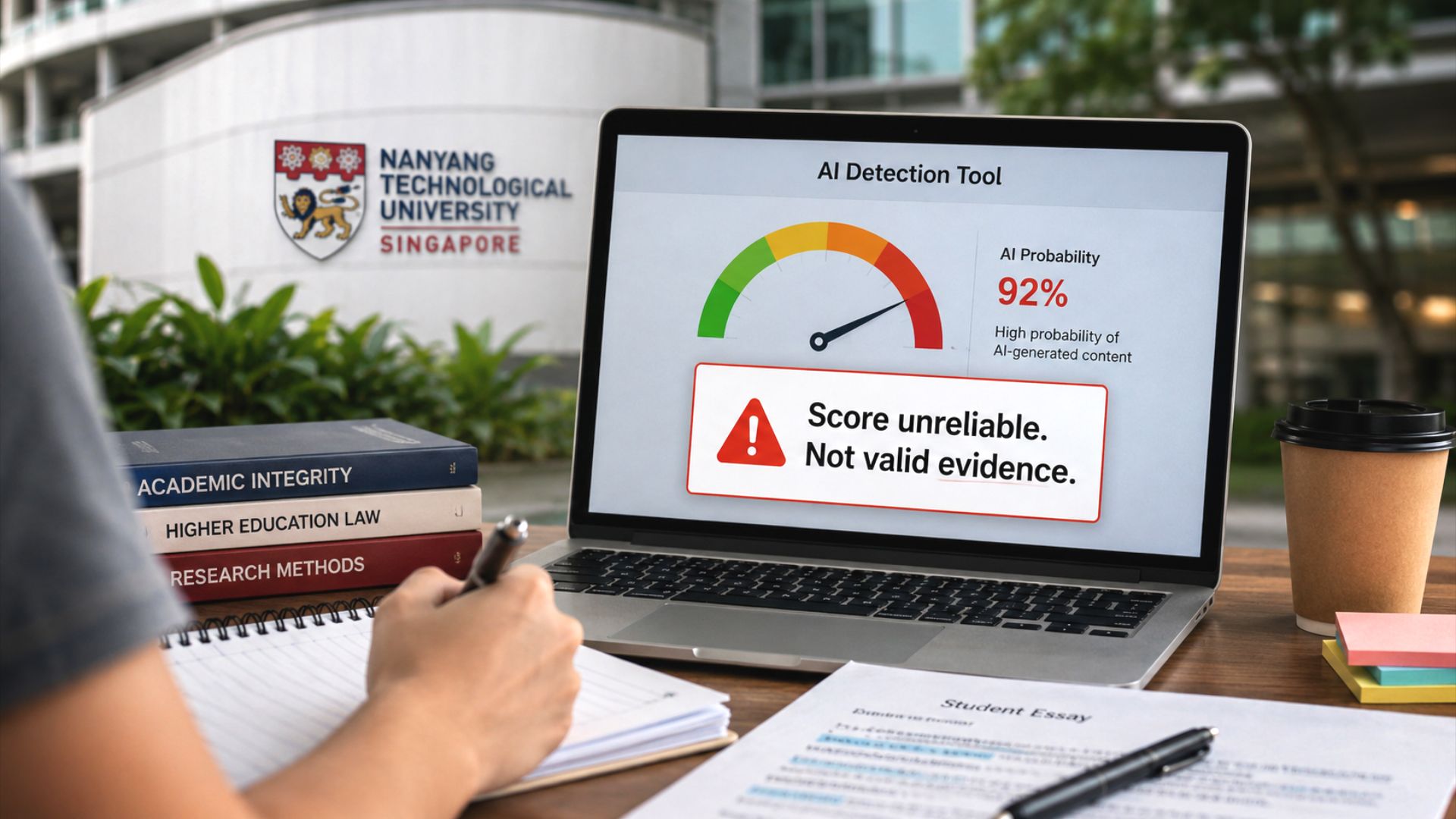
NTU: Current AI detection tools are ‘fundamentally unreliable,’ and AI probability scores can’t be used as evidence of academic misconduct
NTU: Current AI detection tools are ‘fundamentally unreliable,’ and AI probability scores can’t be used as evidence of academic misconduct

Summary
-
Nanyang Technological University (NTU) will deactivate its institutional AI detector by Dec 31, 2026, and will stop using it from 2027 onward.
NTU says artificial intelligence (AI) detection tools lack reliable evidence for deciding whether students have committed academic misconduct.
Faculty members will be encouraged to use documented AI disclosures and assess student learning through the work process.
SINGAPORE: Nanyang Technological University (NTU) will stop using its institutional artificial intelligence (AI) detector from 2027.
The university told faculty members on Thursday, Aug 13, that its current AI detection tools aren't reliable enough for misconduct decisions.
The detector will be deactivated at the end of the current semester, on Dec 31, Channel NewsAsia (CNA) reported (Aug 14), citing an email sent to faculty members.
NTU: AI detection scores are not reliable evidence
Dr Tan Seng Chee, NTU’s associate vice-provost for education transformation, said AI probability scores won't be treated as evidence of academic misconduct.
NTU has described existing automated AI detection tools as “fundamentally unreliable,” according to an email signed by Dr Tan Seng Chee.
Dr Tan wrote that automated tools also struggle to tell apart unauthorised AI use and responsible AI use within the curriculum.
NTU drops AI detection tools after last year’s case of students who were accused of AI use misconduct
The decision follows controversy over the use of AI at NTU in 2025.
Three students were accused of using generative AI when preparing essay proposals and long essays. Their classes had stated that ChatGPT and other AI tools weren't allowed for that work.
The students challenged the accusations and raised concerns about how their cases were handled.
All three were penalised for using generative AI. NTU later consulted the students and upheld a zero mark for one student who appealed.
The university's latest position takes a different approach. Instead of treating a detector's probability score as proof, faculty members are being asked to look at how students produced their work.
The change includes using process-based assessment and documentation to show a student's learning and work processes.
Academic AI use misconduct still requires proper evidence
NTU has also provided faculty members with guidance on handling AI detection during the current semester.
The guide tells staff not to present automated AI scores or flags as proof of a violation. It also asks them to establish standard disclosure rules for the use of AI in their classes.
Newsletter
Get updates straight to your inbox
Students and faculty already have access to NTU's enterprise AI suite this academic year.
The process created a tension in the university's approach: students are being given institutional AI tools while another system tries to identify AI use in their work.
The positive change is about what universities choose to measure. If the goal is to understand whether students have learned, a percentage from an AI detector says little on its own.
A student's drafts, sources, disclosures and development of an assignment can provide much more useful evidence.
The new approach also gives lecturers a clearer job. They can assess the work and the learning behind it, rather than spending time trying to interpret an uncertain machine score.
As AI use isn't going away in education, the more sensible answer is to make the rules more defined and then review students with evidence that can actually be examined.