
‘Creativity imagines, technology enables, engineering builds’: Johor makes case for creative-digital hub

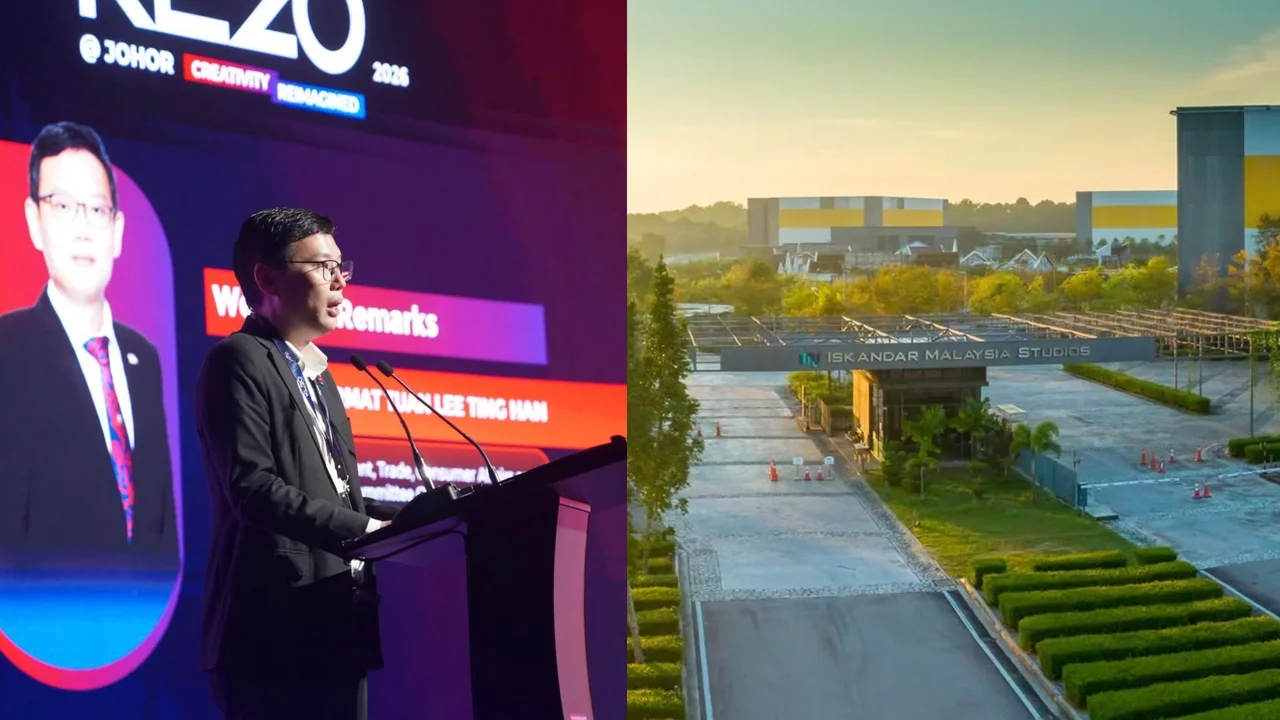
MALAYSIA: A speech delivered by Johor Investment, Trade, Consumer Affairs and Human Resources Committee Chairman Lee Ting Han on behalf of Menteri Besar Dato’ Onn Hafiz Ghazi and the Johor Government at KL20 @ Johor 2026 — The Orange Economy Chapter event at Iskandar Malaysia Studios has laid out an ambitious vision for the state’s creative economy.
He noted that the convergence of creativity, technology, and the JS-SEZ positions Johor to become a place where ideas become intellectual property, productions reach global markets, and the creative and digital economies reinforce each other.
Lee’s address, delivered to an audience of creative industry leaders, investors, and policymakers at what he described as “a fitting venue for a conversation about creativity, technology and the future,” framed the creative economy not as a cultural add-on to Johor’s industrial development but as an integral part of the digital economy itself.
The JS-SEZ as a creative economy platform
Lee situated Johor’s creative economy ambitions squarely within the JS-SEZ framework. Spanning approximately 357,000 hectares across southern Johor, the zone has recorded RM110 billion in approved investments in 2025, which is the highest among Malaysian states, with 85.5% within the JS-SEZ footprint.
The 11 promoted sectors include the digital economy, which Lee connected directly to creative industries.
“The next question is: what do we create with that capability?” he asked, after noting that Malaysia’s information and communications sub-sector alone recorded RM152.9 billion in approved investments in 2025, driven by AI, big data, data centres, and cloud computing.
The answer he offered was the creative economy, which he described as “increasingly part of the digital economy itself.”
The global creative economy opportunity
Lee cited substantial figures to frame the opportunity. The cultural and creative industries globally represent a US$2.3 trillion economy, equivalent to approximately 3.1% of global GDP, according to UN Trade and Development’s 2022 estimate.
Creative services generated US$1.7 trillion in exports in 2024, accounting for around 20% of global services trade. Global content investment has grown from US$120 billion in 2012 to US$251 billion in 2025, projected to reach US$255 billion in 2026, according to Ampere Analysis.
“Content is no longer simply a cultural product; it is an economic asset, a driver of technology and innovation, and a pathway for creative talent and businesses to reach global markets,” Lee said.
Newsletter
Get updates straight to your inbox
Creativity imagining the future
Lee’s address took an unusual turn by drawing on science fiction cinema to make his case. He cited Gattaca, The Matrix, Minority Report, I , Robot, The Machine, Her, and Ex Machina as examples of creativity imagining futures that technology has since begun to deliver.
“Maybe we should stop thinking of creativity, technology and engineering as separate worlds. Creativity imagines. Technology enables. Engineering builds. Business scales. Society decides what should be built,” he said.
Lee closed with a question he invited the audience to carry through the day: “What future are we imagining today that the next generation will build tomorrow?”