
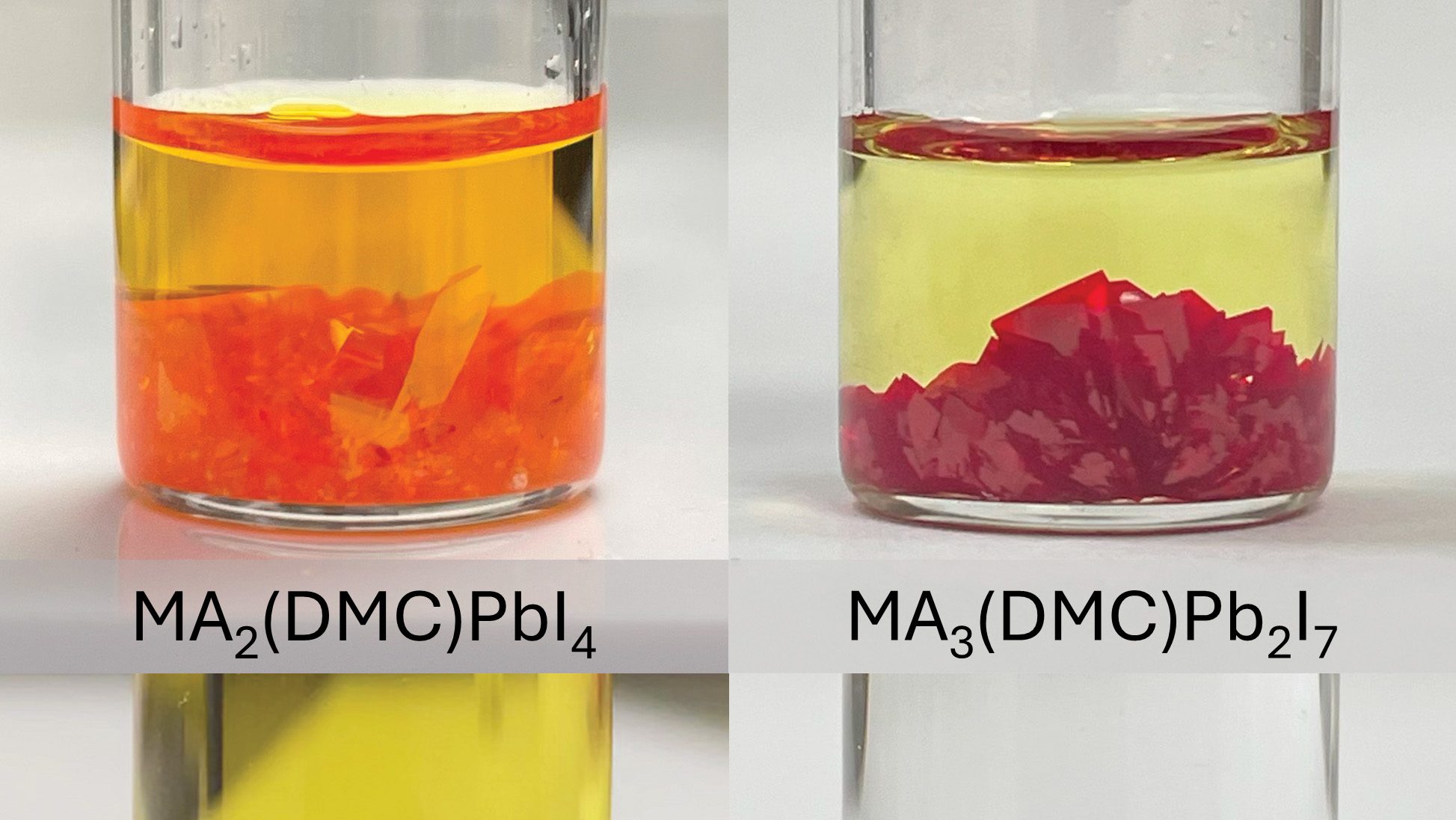

SINGAPORE: Researchers at Nanyang Technological University (NTU) have made significant advancements in semiconductor materials by synthesizing four unique types of two-dimensional (2D) halide perovskites.
These materials hold great promise for applications in solar cells, light-emitting diodes (LEDs), and optoelectronic devices.
The breakthrough was led by Associate Professor Nripan Mathews from NTU’s School of Materials Science and Engineering, with Dr Ayan Zhumekenov, a research fellow at the school, serving as the study’s lead author.
The team employed an innovative method to develop the new perovskites, incorporating dimethyl carbonate, a non-toxic solvent, into methylammonium-based perovskite crystals.
Through detailed analysis, the researchers found that the band gap—the energy required for an electron to become conductive—could be adjusted by altering the ratio of methylammonium to dimethyl carbonate within the crystals.
This is significant because the band gap directly influences the material’s colour and electrical properties, making tunable band gaps crucial for adapting perovskites to various technological applications.
Notably, one of the newly developed perovskites demonstrated a remarkable thermochromic property, allowing it to switch between two colours.
When heated to 80°C, the material shifted from orange to red and reverted to its original colour upon cooling to room temperature. The team repeated this colour-changing process over 25 cycles, showcasing the material’s stability and reliability.
This thermochromic behaviour opens up exciting possibilities for practical applications, such as smart coatings that adapt to temperature changes and heat-sensitive inks that change colour at specific thresholds.
In addition to these applications, the researchers believe their discovery will advance the development of 2D halide perovskites in the field of optoelectronics and beyond.
Their innovative approach to engineering these materials highlights their potential to drive progress in energy-efficient technologies and dynamic colour-switching systems.
 Follow Google News
 Join us on WhatsApp
 Follow us on Telegram