

In spite of the government’s stated efforts “to achieve economic growth driven by sustained productivity improvements rather than manpower growth”, the productivity growth remains negative for the first half of 2013, to add to the contraction in 2012
IN the recently released findings by the Ministry of Manpower (MOM) in its Labour Market, Second Quarter 2013 report, the ministry has noted that the real productivity growth in the first half of this year has been a negative 2%. Last year too, the labour productivity change was -2.6% overall.
Explaining this, the MOM said in a release, “In the first half of 2013, total employment increased by 62,600, higher than the growth of 58,900 in the same period last year. This translated to employment growth of 4.0% from June 2012 to June 2013. As employment grew faster than GDP growth, productivity growth was negative in the first half of the year.”
“GDP growth in the first half of 2013 was 2.0% (year-on-year), while real productivity growth was -2.0%.”
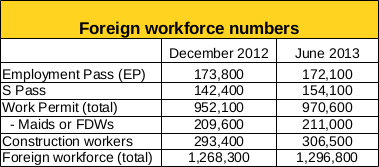
According to the MOM, foreign employment (excluding the maids or foreign domestic workers) grew only by 27,000 in the first half of 2013, as compared to 34,100 in the same period last year. “This reflected the continued fall in the number of Employment Pass (EP) holders and slower growth in Work Permit (WP) and S Pass holders,” the ministry noted.
Meanwhile, local employment rose by 34,100 up till June this year, as against 22,800 in the same period last year.
The ministry also cautioned that in view of the demand and supply outlook, the labour market is expected to remain tight in the coming quarters. “Unemployment should remain low, though it is likely to increase as the pace of restructuring picks up. Given the momentum in employment growth and time needed for productivity improvements to moderate manpower demand, employment growth for the year is likely to be high, similar to that observed last year,” it said.

Why is productivity important?
MOM defines labour productivity as:
Labour productivity relates output to the number of workers employed. Growth in labour productivity is the key to higher living standards as a country can sustain real wage increases without losing competitiveness, only if labour productivity grows.
Right now, Singapore’s economy is in the midst of restructuring and is still dependent on continued robust employment creation for GDP growth. Once, this restructuring is complete, hopefully, labour productivity will take a positive turn resulting in real wage increases for Singaporean workers.

newzzit
 Follow Google News
 Join us on WhatsApp
 Follow us on Telegram