
Researcher advocates for widespread use of banana leaves to wrap food

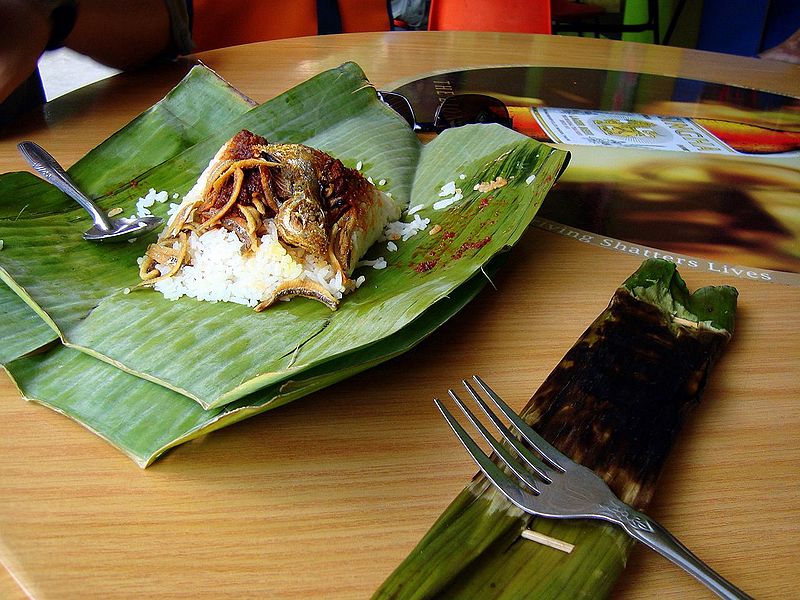
Photo from Wikimedia Commons.
The humble but multipurpose banana leaf is being used as wrapping for various Asian foods and delicacies.
In recent years, however, households and businesses have turned to using plastic and polystyrene containers as cheap and fast alternatives in the city. Plastic and polystyrene are single-use and disposable but do not decompose and just contribute to the pollution problem.
A researcher has advocated for a return to Malaysian roots in using banana leaves as wrappings for food due to its environmental sustainability and health benefits.
Ros Mahwati Ahmad Zakaria, a researcher at the Universiti Kebangsaan Malaysia’s Institute of the Malay World and Civilisation, reported that banana plants grow in less than a year making them a "viable replacement" to artificial food packaging.
The banana leaf also has a natural waxy coating which provides insulation to fresh, hot food.
“Contrasted with artificial wrappings, the leaves do not produce adverse chemical reactions when in contact with hot food. They are not easily damaged, and can withstand temperatures reaching 100°C. Furthermore, an ongoing study in Indonesia has revealed banana leaves contain polyphenols similar to those found in tea leaves, which are rich in antioxidants,” Ros Mahwati said as quoted in a report by the Malay Mail.
In addition to its sustainability and natural benefits, Ros Mahwati also talked about the inherent pleasant experience of eating aromatic food wrapped in banana leaves.
Banana trees are, however, facing a decline both in cities and rural areas. When she conducted a survey among women aged 40 to 50 years working different occupations, Ros Mahwati found that 94.5 percent of the women can no longer identify which banana leaves are used for food.
"Simply put, they are viewed as no longer necessary in the modern world."
Newsletter
Get updates straight to your inbox
The use of the banana leaf in Malay food is a significant cultural symbol of our relationship with nature, she added.
“Its importance cannot be underestimated, as it features prominently in pantun, ‘joget’ songs, sayings, and folk tales. At this rate, banana leaves and their usage will end up being forgotten by youths and future generations, eventually ceasing to be a part of Malay culture."
She presented her research at the recent National Malay Gastronomy Seminar by Universiti Kebangsaan Malaysia’s Institute of the Malay World and Civilisation. -/TISG