
Workers' Party MPs raise questions about how autonomous ride-hailing services will affect taxi, PHV drivers in Singapore
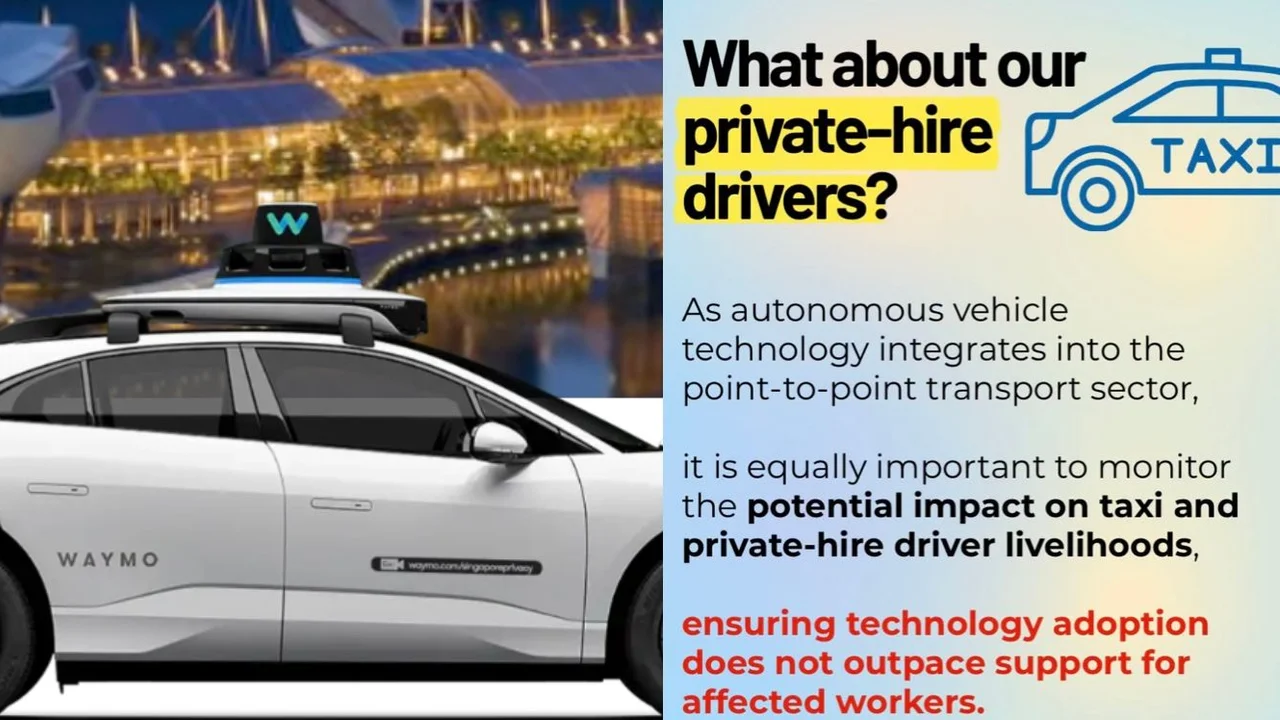
SINGAPORE: This week in Parliament, two Workers’ Party Members of Parliament (WP MPs) will be raising questions regarding autonomous cars, including how Singapore’s taxi and private hire vehicle drivers will be affected.
It was reported last month that in 2028, the autonomous driving firm Waymo will launch a fully driverless ride-hailing service in Singapore, after the company announced a partnership with the Ministry of Transport and Land Transport Authority concerning an all-electric commercial fleet. It will be the first such service in Southeast Asia.
WP MPs Louis Chua and Jamus Lim (Sengkang) will ask questions regarding regulations on autonomous vehicles, specifically whether they will be different from current ride-hailing regulations.
More relevant to the over 70,000 taxi and private-hire car drivers operating in Singapore, the MP’s will ask questions regarding the potential impact on their livelihoods.
After the LTA said on Sept 18 that it will not allow autonomous vehicle deployment to run ahead of Singapore’s ability to retrain and support affected drivers, the WP MPs are asking what specific indicators, including driver earnings, will be monitored, as well as what changes could trigger a slowdown of deployment.
What the government has said
In July, Transport Minister Jeffrey Siow had issued the assurance that driver jobs won't “vanish any time soon.” He acknowledged that cabbies’ and PHV drivers’ concerns as autonomous vehicle technology has developed, but said that at present, only about 20 such vehicles are operating in Singapore, mostly in the Punggol area. He noted that even if every autonomous vehicle in the world were relocated to Singapore, it would only amount to roughly 7,000 cars—less than 10% of the existing point-to-point driver workforce.
“So, autonomous vehicles are not displacing today’s drivers, and even in 10 years, I expect that we will still require many human drivers,” he said.
Additionally, during the launch of Waymo last month, Mr Siow said that the autonomous vehicle industry would create jobs in Singapore, including fleet management, remote operations, maintenance, testing and data analysis.
In a social media post on Sep 25, former President Halimah Yacob referred to a Financial Times article about the impact of autonomous vehicles on driving jobs. She noted how the piece cited a paper about Wuhan, where autonomous vehicles have been tested. After Baidu launched the Apollo Go in 2022, researchers discovered that taxi drivers’ average daily income decreased by 11%. Moreover, drivers worked longer hours, grew more stressed and unhappy, and began to look for new jobs.
“Another report shows that San Francisco is also one of several US cities where taxi drivers’ pay per trip fell after robotaxis landed. Food for thought for Singapore on how driverless vehicles could impact drivers’ jobs,” she added.
Newsletter
Get updates straight to your inbox
What Singaporeans are saying
Based on comments on the Workers’ Party’s social media post, concerns remain.
"Is there a lack of PHV and taxi drivers in this line? Why do we need to break our rice bowl?” one asked.
“Any suggestion on what to do for these drivers?” asked another.
“We know we need to move forward because of technology. Do we really need AV to take over our rice bowl? And PHV and taxis really help older Singaporeans to survive. We still have bills to pay… I hope the government will think of us. We don’t demand much, just an income to survive,” wrote a third. /TISG