

SINGAPORE: National University of Singapore (NUS) researchers from the Department of Biochemistry and NUS Centre for Cancer Research (N2CR) at the Yong Loo Lin School of Medicine have pioneered a groundbreaking treatment using stem cell precision engineering technology.
This novel approach aims to deliver drugs directly to tumour sites in dogs and cats suffering from late-stage cancer, providing new hope for pets with no other treatment options available and showing potential for use in human patients.
Under the leadership of Associate Professor Too Heng-Phon, the research team modified mesenchymal stem cells (MSCs) to target cancerous tumours.
These engineered cells are equipped with a potent ‘kill-switch’—cytosine deaminase—that produces a high, localized concentration of the cancer-killing drug 5-fluorouracil within the tumour environment.
The ‘kill-switch’ also activates anti-cancer immunity by triggering the cancer’s innate cGAS-STING and related pathways, stimulating the immune response and suppressing tumour growth.
To date, this innovative treatment has been administered to nearly 100 dogs and cats with various conditions, including perianal adenoma, lung metastasis, and sarcoma.
Most of these animal patients have shown positive responses, ranging from full recovery and cancer remission to an improved quality of life.
Remarkably, no significant side effects have been observed, likely due to the localized action of the therapeutic cells within the tumour environment.
For example, one dog with a tumour around its eye did not lose its sight, demonstrating the precision of the treatment in sparing surrounding healthy tissues.
Further observations revealed that some dogs with recurrent cancers experienced no relapse or side effects, underscoring the effectiveness of the engineered therapeutic cells in combating cancer while minimizing adverse effects.
Unlike traditional chemotherapy, which often causes harmful side effects and is limited by dosage constraints, the MSCs deliver high treatment concentrations directly to the affected areas, reducing toxicity in the rest of the body.
However, the team found that remnants of tumours remained after a few rounds of treatment in some late-stage cancer cases.
To address this, they enhanced the treatment by utilizing the MSCs’ payload to amplify the cGAS-STING and related pathways, which are critical for delivering chemotherapy drugs like 5-fluorouracil in activating anti-cancer immunity.
They also incorporated the expression of interferon beta—a cytokine known to recruit and facilitate T-cell activation for anti-cancer immunity.
Proper regulation of interferon beta is crucial, as excessive amounts in the bloodstream can cause side effects, but the correct dosage can effectively target cancer cells.
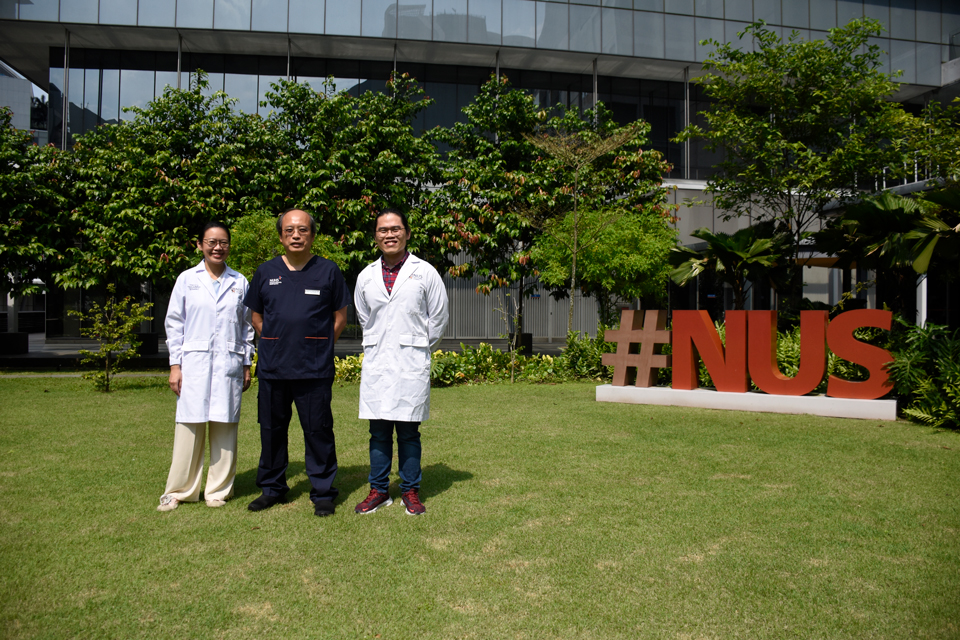
Associate Professor Too said, “We are making the treatment more efficient by modifying cells that are like ‘hunter killers’ where they home in on the tumours and destroy only these tumours and not other healthy parts of the body.
This explains why there are no side effects. Drugs in chemotherapy usually lead to some level of side effects.
Our treatment taps on the body’s own biological system, which treats the tumour with no significant toxicity—this surpasses what drugs in chemotherapy can do.”
In January 2024, Associate Professor Too and senior research fellows Dr Sarah Ho and Dr Woo Jun Yung from the Department of Biochemistry and N2CR at NUS Medicine established AGeM Bio Pte Ltd.
The company aims to validate the manufacturing processes of the enhanced treatment to prepare it for human use, with an estimated completion date by the third quarter of 2025.
The team plans to commence the first phase of human clinical trials by the end of 2025, collaborating with clinicians from the National University Hospital (NUH) to deliver intratumoral injections of the engineered MSCs to a small group of patients with recurrent glioblastoma, a severe form of brain tumour.
Subsequent trials will involve larger groups of patients to further assess the treatment’s efficacy and refine the approach.
/TISG
 Follow Google News
 Join us on WhatsApp
 Follow us on Telegram