
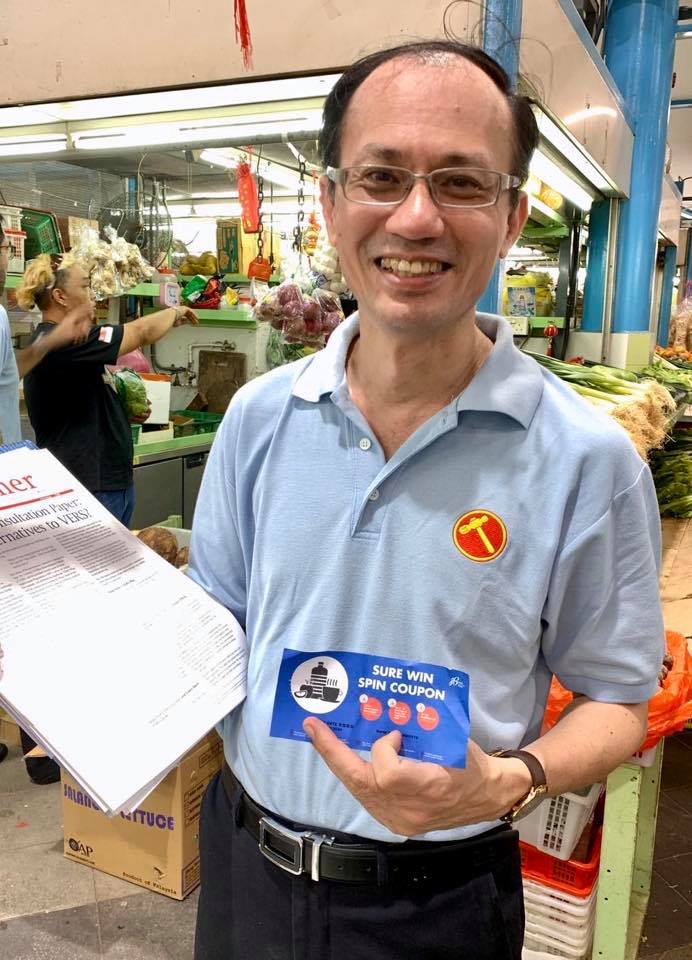

Former Non-Constituency Member of Parliament (NCMP) and Workers’ Party (WP) politician Yee Jenn Jong took to his blog on 8 June to respond to Prime Minister Lee Hsien Loong’s speech on Singapore’s post-Covid-19 future, the first in a series of ministerial national broadcasts.
He spells out four things he wishes to see in a post-Covid-19 Singapore:
1. Domestic Wage Reforms
He claims that Singapore is the “MOST UNEQUAL” of all developed nations, with doctors getting paid four times more than nurses and eleven times more than construction workers. He compares Singapore to Germany and Australia where a construction worker is paid half of an average doctor. Whereas in Hong Kong, being a small and open economy like Singapore, nurses are paid a third, and construction workers a quarter that of doctors.
He states how even before the pandemic, there were already higher retrenchments amongst PMETs amidst a challenging work environment. He proposes that the pandemic, with increasing job stresses, can serve as an opportunity for Singapore to “transform domestic industries”. The point is to make use of government interventions to make “certain jobs” more viable for Singaporeans, to “progressively pay better” for technical skills like in other developed countries and to “move the industry up the productivity path”.
He suggests imposing Minimum Wages in order to match the Swiss standard of living.
2. Improving the productivity of migrant workers
He addresses the high numbers of low wage migrant workers in Singapore, stating that the country has started to become over-reliant on these workers than initially planned. He links this to higher wealth inequality, higher pandemic risks and possibly higher xenophobia, social divisions, overcrowding and less social capital and national solidarity.
He mentions how besides providing better accommodation, Singapore needs to bring in “more productive foreign workers” to have a better “starting base” to “pay them better”. He suggests bringing in trained workers such as those familiar with the tools, processes and automation needed in Singapore to “jump-start productivity”. This, in return, can uplift productivity and wages at the low end, and allow us to lessen our reliance on foreign migrant workers. He says how with more skilled overseas workers, more investment in better construction processes and automation, Singapore could potentially elevate itself on the global arena for construction companies.
He also cites how Singapore could treat these workers with better welfare, such as to allow them to “make it up the career ladder”.
3. Free the Singapore Spirit
A quote from his blog, “We are victim of our past successes… We celebrate innovation only when it meets the government’s agenda but clamp down on alternative views”.
“Be open. Be free-spirited. Be bold. Our past leaders were so.” He states how leaders in the government service or political office “are rotated frequently”, have become too “wary of projects” that may come across as “risky” and are too afraid to allow “smaller start-ups to have a go at projects in case we have to answer if projects fail”.
“We need to free the spirit, not mute it.” He encourages reforms to start from educating in schools, through changing up the current system of “sorting out students by abilities and then fast track them along career paths.” He pushes to “celebrate ambiguity in education” and allow students to ask bold questions and let them create.
4. To become more Resilient
The notion of a “gig economy” whereby more people take up food delivery and private hire jobs have been increasing. He says that this shows how among the PMET Singaporeans, many of those who have been retrenched or are in low paying jobs, turn to these to find a way to make a living. He suggests reclaiming PMET jobs and to work out a “viable career path” for Singaporeans in domestic industries which are “too low-paying” to sustain Singapore’s high cost of living.
Similarly, he also proposes investing “aggressively” in food sources overseas to expand ownership of critical resources outside of Singapore.
Overall, Yee hopes that Singapore can become a more resilient, creative, productive and egalitarian country post-Covid-19.
 Follow Google News
 Join us on WhatsApp
 Follow us on Telegram