
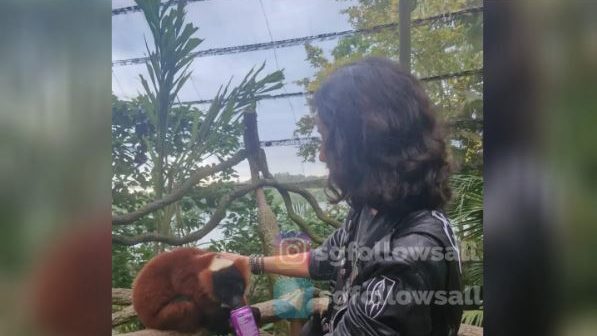

SINGAPORE: Singaporeans have had a lot to say after the photo of a woman allowing a lemur to drink from her soft drink can at the Singapore Zoo went viral online.
Posted on March 15 (Saturday) on the Instagram account of sgfollowsall, the picture shows a woman in a black leather jacket standing in front of a red ruffed lemur. In her left hand, she holds the drink can up to the lemur’s mouth, while with her right hand, she appears to be stroking the animal at the nape of its neck.
As the woman’s back is turned to the person who took the photo, her face cannot be seen.
“Can meh?” reads the caption on the post. @sgfollowsall said that it had been shared by a follower and that the incident had occurred on March 14.
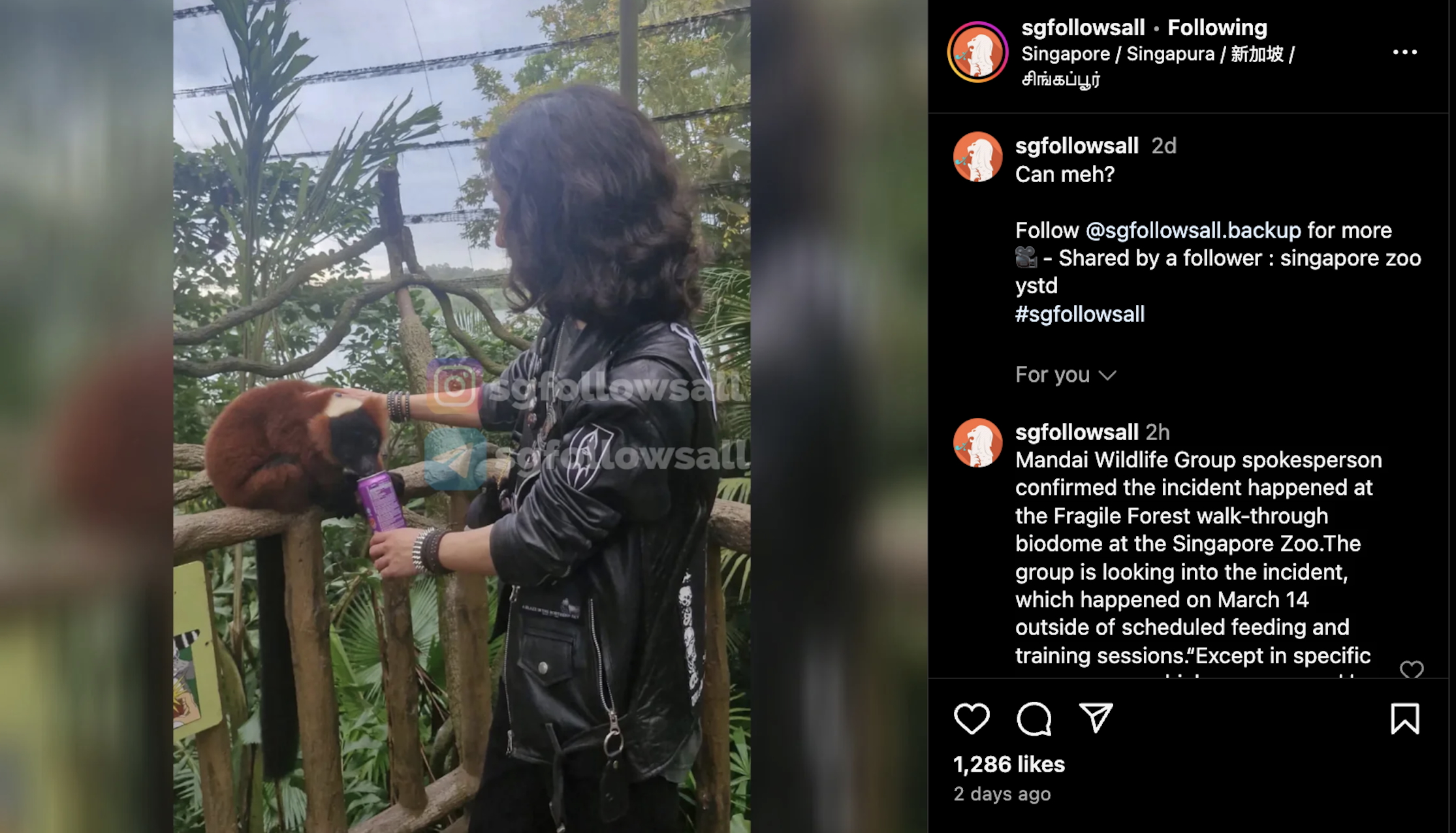
In a recent comment to the post, a Mandai Wildlife Group spokesperson was quoted as saying the woman had given the lemur a drink at Singapore Zoo’s Fragile Forest walk-through biodome outside of scheduled feeding and training sessions.
“Except in specific programmes which are managed by our animal care personnel, our park rules explicitly state that visitors are to refrain from touching and feeding the animals they encounter in the Mandai Wildlife Reserve’s parks and public spaces,” the spokesperson is quoted as saying.
According to Mandai Wildlife Reserve’s website, the status of the red ruffed lemur is critically endangered, which means it is at extremely high risk of extinction in the wild.
“The only place to see this endangered primate in the wild is on Madagascar’s Masoala Peninsula. Political upheaval in 2009 led to a rapid upsurge of illegal logging, which had a serious impact on Masoala Nature Reserve, the only protected area in the lemurs’ limited range. Red-ruffed lemurs are also trapped and eaten as food. Efforts are now underway to reestablish a protected area for these critically endangered lemurs,” the site says.
Understandably, many Singaporeans who have commented on the issue have been appalled at the woman’s actions.
Some have called for zoo staff to be present at all times, but others have pointed out that this would be unfeasible, given the large number of people needed to do this.
“You would not believe the number of people (including children!) I saw them touching and attempting to touch the lemurs and flying foxes. These are wild animals, not pets!” wrote a local Reddit user.
Another who used to volunteer as a conservation ambassador at the bird park years ago confirmed this, saying that visitors used to do foolish things, especially when they thought no one was around.
One said that a simple solution would be to impose a fine, adding that “unfortunately, people only learn when $$ is involved… I’m glad we have a ‘fine’ reputation.” /TISG
 Follow Google News
 Join us on WhatsApp
 Follow us on Telegram