
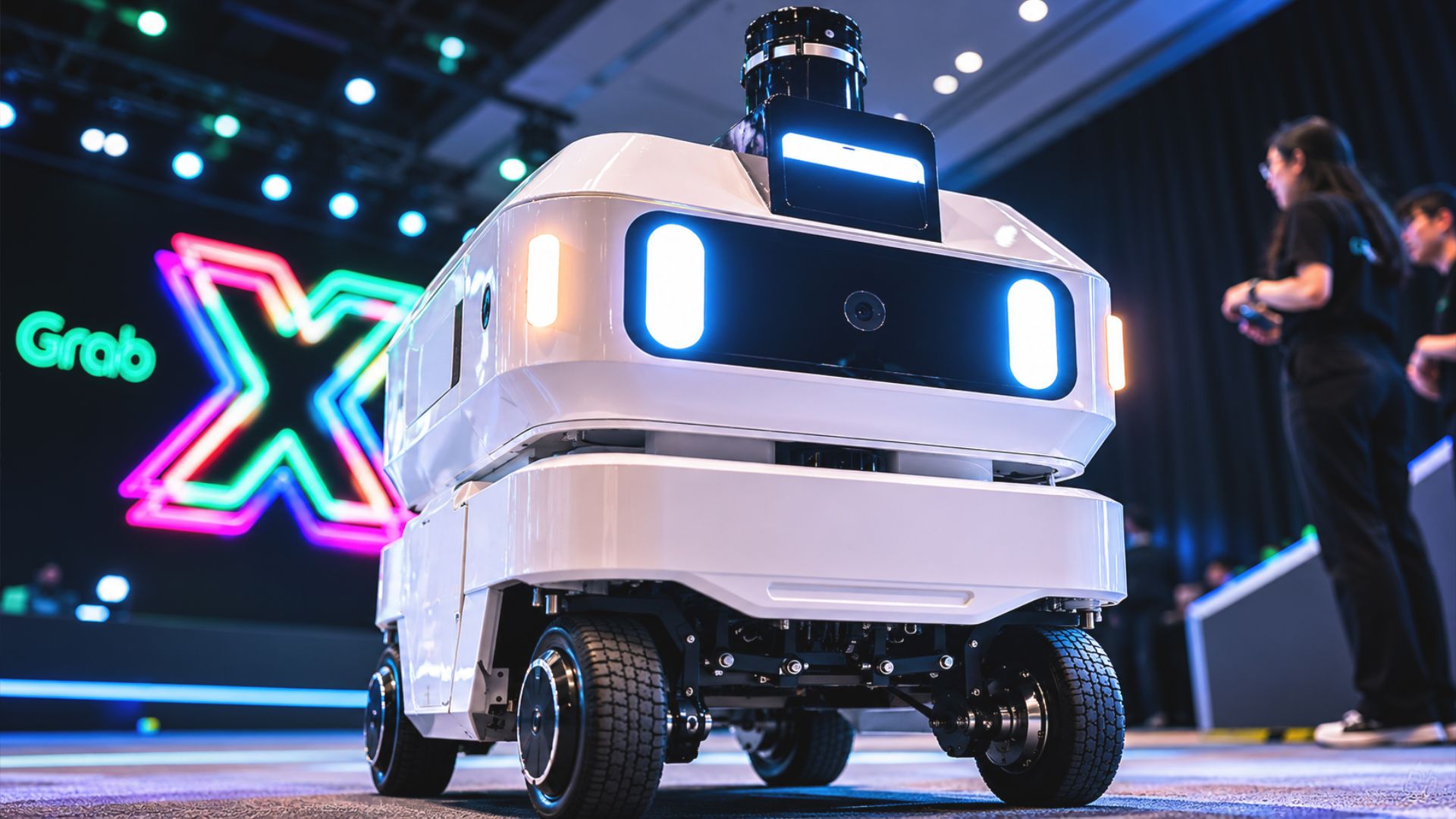

SINGAPORE: Singapore’s delivery economy may soon gain a new co-worker; one that doesn’t ride a bike, wait for lifts, or search for block numbers.
Grab plans to launch a pilot of its first delivery AI robot in Punggol in late 2026 as it pushes further into physical artificial intelligence (AI) and robotics, according to Fortune’s report.
The move is to address a problem many Singapore businesses already know all too well: service demand keeps growing, but workers remain hard to find, and labour costs keep staying high. So rather than replacing Grab drivers outright, Grab says the robots are meant to handle the least efficient parts of delivery.
Carri, Grab’s AI robot, will handle the first and last 100-metre deliveries
Grab’s robot, called Carri, is built to handle the first and final 100 metres of delivery journeys, including tasks such as moving food or parcels from roadside pickup points to apartment doorsteps.
Speaking at the Asia Tech (ATx) summit on May 20, Grab chief technology officer Suthen Paradatheth said these small stretches consume meaningful time across thousands of deliveries each day.
Mr Paradatheth further explained that most Grab deliveries already travel more than two kilometres. The usual friction happens before and after the actual trip, where drivers spend time walking, locating units, waiting, and completing handoffs. Grab estimates that these final steps account for around 10% of delivery time.
For Grab drivers, that could mean fewer repetitive tasks. For customers, the company hopes to improve delivery coverage in areas with demand where drivers are less likely to wait around.
Punggol becomes a testing ground for AI robots and autonomous vehicles on the ground
Mr Paradatheth said autonomous vehicles could help expand services in supply-constrained markets such as Singapore.
Grab will not be alone in AI, robotics, and autonomous vehicle tests. Seven other firms, including logistics company DHL and local startup Quikbot, are expected to test autonomous systems in Punggol. The pilots extend beyond food delivery. Other projects will focus on parcel handling, cleaning, and security work.
Singapore’s Minister for Digital Development and Information, Josephine Teo, said at the ATx summit that the government plans to support these trials through shared testing systems, operating rules, and infrastructure that enable robots to move safely across the district. Her view was that these tools can help workers extend services into places that are harder to serve consistently.
Singapore’s public messaging around AI has increasingly focused on augmentation rather than replacement, helping workers do more instead of reducing headcount.
Grab’s bigger AI ambition goes beyond just delivery
The robot trial also fits into Grab’s wider AI strategy. The company has already partnered with OpenAI since 2024 to improve areas including mapping, accessibility and customer support.
Grab is also working with the Chinese autonomous driving company WeRide and has invested in autonomous vehicle firms, including May Mobility and Momenta.
Grab’s chief executive officer, Anthony Tan, previously said automation could create new job paths instead of eliminating the work entirely. Examples discussed included remote safety monitoring, data work, and maintenance of sensing equipment.
Mr Paradatheth described Grab’s internal direction as one in which people and AI systems work side by side, an idea that is already evident within the company. He said most Grab engineers now use AI coding tools in their daily work while keeping human review before the software goes live.
Singapore’s broader AI race is also gathering speed. On the same day as the announcement, OpenAI said it would invest S$300 million into Singapore’s AI capabilities, including its first applied AI lab outside the United States. NVIDIA also announced a local research centre focused on embodied AI.
The more important question is not robots; it is where drivers and people fit in
Delivery AI robots tend to ignite the same debate each time: convenience versus jobs. But Singapore’s labour market has long relied on finding ways to stretch limited manpower.
If these pilots succeed, the real test may go beyond whether the robots can deliver food. It may be a question of whether companies can redesign work so people spend less time on repetitive tasks and more time on work where human judgment still matters.
Because, at the end of the day, technology still works best when it removes friction, not people.
Read related: NVIDIA to launch its new research hub in Singapore, marking latest boost to city-state’s artificial intelligence drive
 Follow Google News
 Join us on WhatsApp
 Follow us on Telegram