
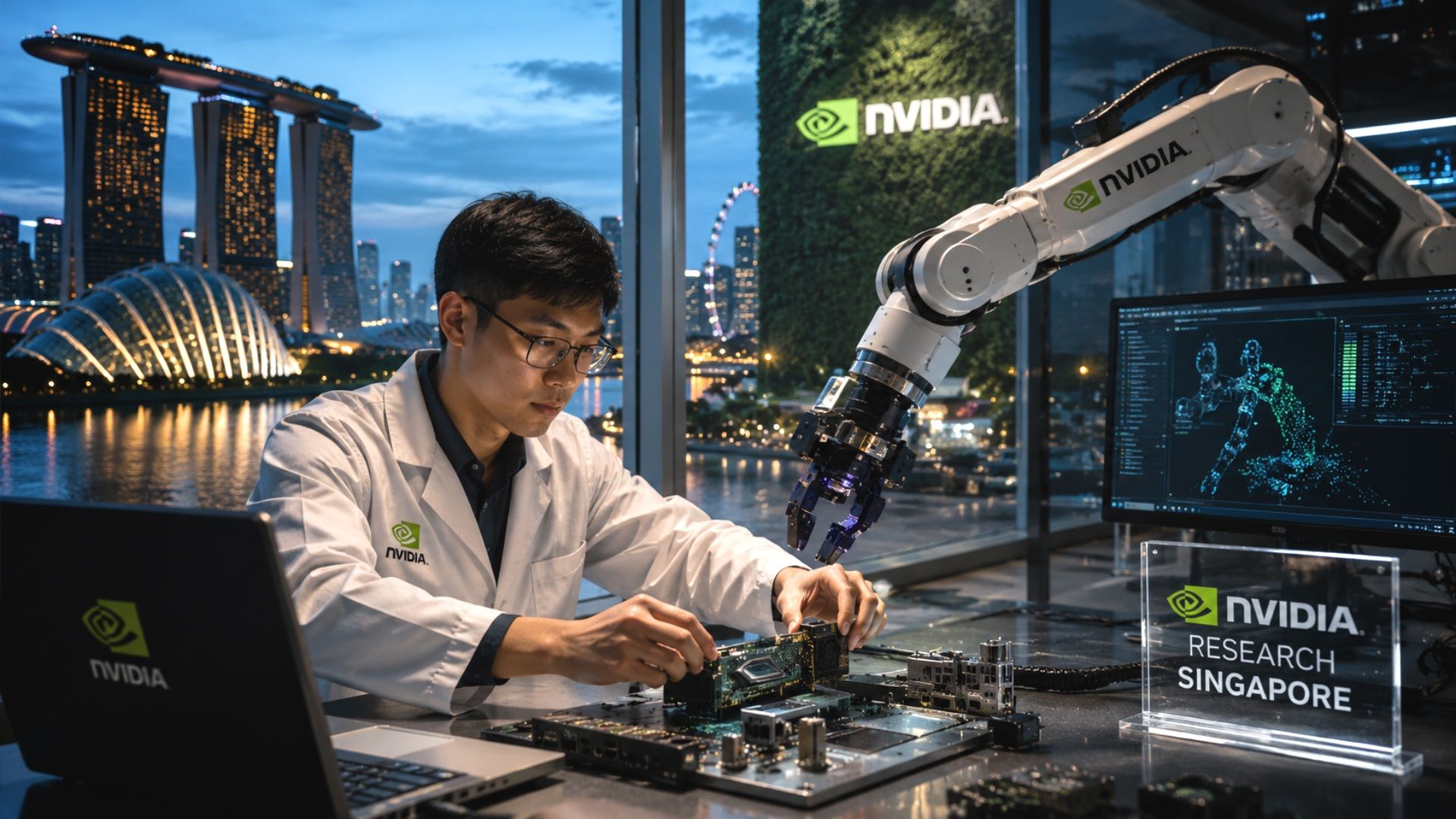

SINGAPORE: Singapore’s artificial intelligence (AI) plans just gained another heavyweight name. Chip giant NVIDIA will open its first research hub in Singapore, adding fresh momentum to the city-state’s push to become a place where AI is built and tested in daily use.
According to CNBC, the new lab will focus on embodied AI and on improving AI infrastructure efficiency for interacting with the physical environment through robots, autonomous vehicles, and automated systems, beyond just chat windows and text prompts.
The announcement came during the opening day of the ATxSummit, where Singapore rolled out a more extensive set of AI deployment plans.
From AI research to real-world trials
NVIDIA’s new lab will work with universities, industry groups and government agencies and become the chip giant’s second research presence in the Asia Pacific and its first in Singapore.
Alongside that, Singapore announced a new testbed planned for later this year where companies can jointly design, deploy and test commercial AI robotics systems.
Early participants are expected to include Certis, DHL, Grab and QuikBot. Trials are expected to cover tasks such as food delivery, parcel movement, cleaning, and security patrols, supporting existing workers rather than replacing them outright.
Singapore will also work with robotics firms, including Slamtec and Unitree Robotics, through a new Centre for Intelligent Robotics initiative.
Singapore is now switching from asking what AI can visually generate to what AI can physically do
Singapore’s size has always shaped its strategy. It doesn’t need to compete by having the biggest land area or labour pool, but it makes itself useful to industries that need stable regulation, skilled talent, and a place to test ideas at a real scale instead. This is the kind of thinking process that made it more visible in the world of AI.
Recent government signals have also focused on moving AI from experiments into everyday operations across sectors such as manufacturing, finance, and services. Singapore has also been studying standards, testing frameworks and ways to help firms adopt AI safely.
The attention to embodied AI now points to a switch in the conversation from asking what AI can visually generate to what it can physically do.
The more useful question is not whether robots will replace people
The more useful question is whether AI can remove repetitive work while opening higher-value roles. Singapore’s approach so far suggests it wants deployment with guardrails rather than technology for its own sake. The emphasis on trials, partnerships and controlled testing reinforces that direction.
For people in Singapore, this means that the systems being tested today are increasingly being built close to home.
And if those trials work, Singapore may even export more than just technology next, such as a playbook for integrating AI into Singaporeans’ daily lives without turning the whole process into public anxiety, workplace disruption or career chaos.
Read related: MOM: AI is complementing jobs, not displacing labour in Singapore
 Follow Google News
 Join us on WhatsApp
 Follow us on Telegram