
Beyond Haze: Singapore’s Unpriced Toxicity Risk

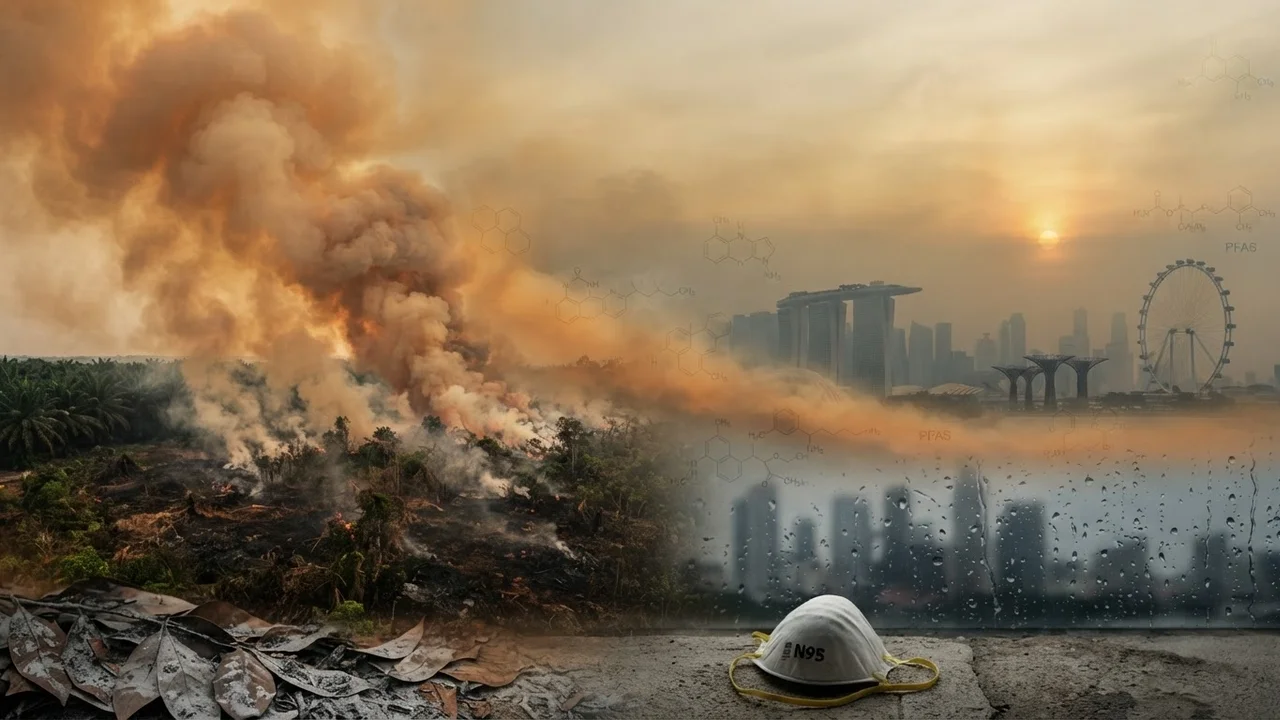
The haze situation has become a yearly affair with no solution in sight
By ID Capital
Singapore is one of the better regulated countries in Asia when it comes to chemical risk, with strict controls on pesticides, industrial emissions, food-contact materials and hazardous substances, alongside sophisticated air-quality monitoring.
Yet every year, when smoke drifts across from Indonesia, Singapore is reminded of the limits of that regulatory strength: it can regulate what happens within its borders, but not the economic and health costs of what arrives from outside them.
Haze is usually framed as an air-quality problem, the PSI rises, PM2.5 becomes the headline number and familiar questions return. But what crosses the border with the smoke is more complex than a PM2.5 reading suggests.
A forest fire is a chemical reactor
A fire does not produce a single substance called haze. Its emissions depend on what is being burned, what has been applied to the land and the conditions under which it burns. Peat is different from crop residue. Vegetation treated with agricultural chemicals is different from vegetation that has not been treated.
Research on open burning in Southeast Asia shows that haze contains pollutants beyond those typically discussed. A 2018 study of crop-residue burning across 10 Southeast Asian countries estimated that open burning released an annual average of 32 gigagrams of polycyclic aromatic hydrocarbons (PAHs), 0.03 gigagrams of organochlorinated pesticides and 94 grams of dioxins between 2010 and 2015. There is also evidence that pesticides can affect the pollutants produced during burning. A 2011 experimental study found that burning pesticide-contaminated corn straw produced 35 to 270 times more PCDD/PCDFs than burning uncontaminated straw.
Where Singapore sits makes it susceptible to toxicity risks
None of this establishes that these chemicals are being carried into Singapore by this year's Indonesian fires. But Singapore knows more about how much pollution is arriving than about the full chemical composition of every plume crossing its borders.
The National Environment Agency monitors pollutants including PM2.5, PM10, sulphur dioxide, nitrogen dioxide, ozone, carbon monoxide and selected volatile organic compounds. The challenge is not a lack of monitoring, but the limits of national systems when exposure originates beyond Singapore's jurisdiction. Strong domestic regulation cannot fully protect Singapore from chemicals released in neighbouring countries.
A 2018 study illustrates why. Researchers screened more than 450 pesticides in Singapore rainfall collected between October 2015 and March 2017, detecting 123 pesticides in 101 samples. Although the study did not identify their origins, it showed that atmospheric processes can transport chemicals into Singapore beyond regulatory boundaries. Singapore can regulate local pesticide use, but not chemical exposure that crosses its borders, making haze a visible example of the region’s broader transboundary toxicity challenge.
Chemical Toxicity Poses a Systemic Economic Risk
Singapore illustrates why chemical toxicity should be understood as a systemic economic risk, not merely an agricultural or farming issue. Although the country has very little agricultural land, a 2026 study of women in the S-PRESTO preconception cohort detected metabolites from 13 pesticides in urine samples, alongside PFAS and phthalates.
This human-biomonitoring evidence shows that chemical exposure can reach populations through multiple pathways, including food, consumer products, domestic use and the wider environment. Exposure is therefore not necessarily confined to farms, agricultural regions or the countries where chemicals are produced and applied.
The detection of these chemicals does not, by itself, establish the scale of Singapore’s economic burden or prove that they have caused specific health outcomes. It does, however, show that Singapore residents are exposed to transboundary chemical risks associated with cancer, reproductive harm, hormonal disruption and other long-term health effects.
Silent Threats, Global Stakes: Regional Solutions for Toxicity in Asia
Over the past 10 months, ID Capital, together with Deep Science Ventures in the UK and the Grantham Foundation for the Protection of the Environment, studied chemical toxicity across 12 Asian markets. Through this report, we have seen that Singapore has some of the region’s strongest systems for chemical regulation and environmental monitoring. It has the institutional capacity to identify and manage many domestic risks, but its exposure to chemicals originating beyond its borders cannot be addressed through national regulation alone.
This work is supported by the Grantham Foundation for the Protection of the Environment, founded in 1997 by British investor Jeremy Grantham and his wife, Hannelore Grantham. Grantham, who famously predicted the Japanese asset bubble, the dot-com crash, and the global financial crisis, has also identified chemical toxicity as one of the next major underpriced risks. He describes the cumulative harm from the hundreds of thousands of synthetic chemicals introduced since World War II as “the most underrecognized challenge facing humanity this century.”
Newsletter
Get updates straight to your inbox
Hui Zhang, Simon Watts, Martin C. Philix, Shane A. Snyder, Choon Nam Ong, Occurrence and distribution of pesticides in precipitation as revealed by targeted screening through GC-MS/MS, Chemosphere, Volume 211, 2018, Pages 210-217, ISSN 0045-6535, https://doi.org/10.1016/j.chemosphere.2018.07.151
Oanh, N. T. K., Permadi, D. A., Hopke, P. K., Smith, K. R., Dong, N. P., & Dang, A. N. (2018). Annual emissions of air toxics emitted from crop residue open burning in Southeast Asia over the period of 2010–2015. Atmospheric Environment, 187, 163–173. https://doi.org/10.1016/j.atmosenv.2018.05.061
Yao, M., Cohen, N., Mouzica, T., Midya, V., Andra, S. S., Arora, M., Armstrong-Davies, L., Chan, J. K. Y., Chan, S. Y., Chan, J. C. Y., Elkin, E. R., Jagani, R., Meher, A. K., Narasimhan, S., Oulhote, Y., Huang, J. Y., & Valvi, D. (2026). Determinants of exposures to preconception plasma perfluoroalkyl substances and periconceptional urinary phthalate and pesticide metabolites in a Singaporean longitudinal preconception cohort. Environmental Research, 305, 125079. https://doi.org/10.1016/j.envres.2026.125079
Zhang, T., Huang, J., Deng, S., & Yu, G. (2011). Influence of pesticides contamination on the emission of PCDD/PCDF to the land from open burning of corn straws. Environmental Pollution, 159(6), 1744–1748. https://doi.org/10.1016/j.envpol.2011.01.042