
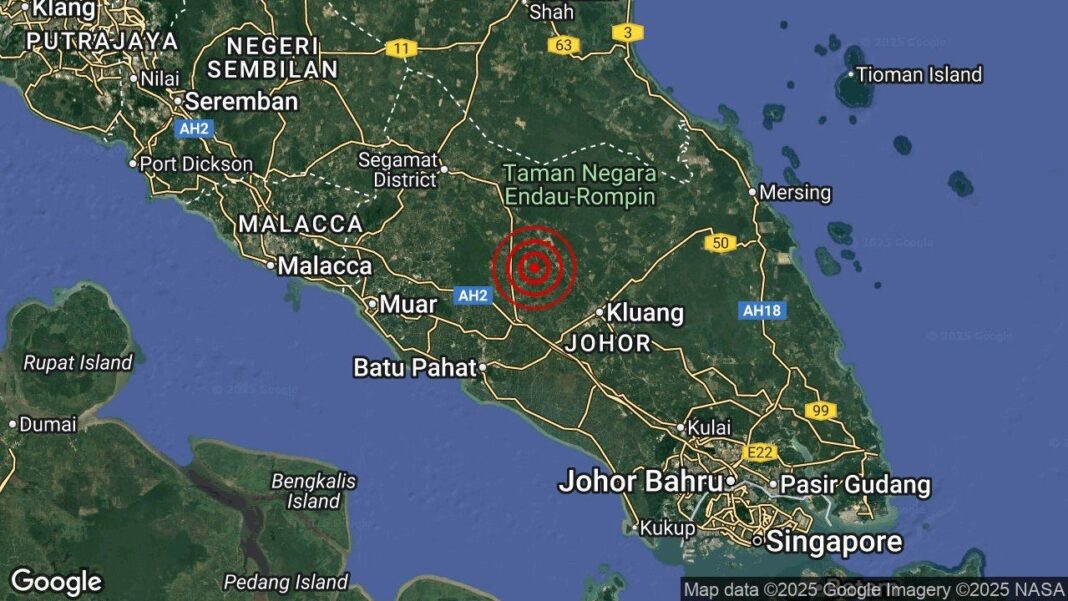

JOHOR BAHRU: What began as an ordinary Sunday morning turned unsettling for many residents in Johor. At dawn, walls shook, ceilings cracked, and debris fell as a pair of earthquakes rippled through the northern part of the state. Though mild in magnitude, the tremors were strong enough to be felt across parts of Negeri Sembilan, Melaka, and Pahang. This was a sharp reminder that Peninsular Malaysia, and even Singapore, are not beyond nature’s reach.
The first jolt, a 4.1-magnitude quake, struck at around 6:15 a.m. near Segamat. Just three hours later, a milder 2.8-magnitude tremor was recorded northwest of Kluang. The Malaysian Meteorological Department (MetMalaysia) later confirmed that both events had their epicentres close to the Mersing Fault Zone.
‘Faults are active’
Experts have been quick to remind the public that Sunday’s events were not a freak occurrence. “(Sunday’s) earthquake is a reminder – the Johor region already experienced even larger earthquakes (back) in 1922 – that at least some of the faults in the Malay Peninsula are active, even if earthquakes in the area are rare,” said Aron Meltzner, earthquake geology expert at Nanyang Technological University’s (NTU) Earth Observatory of Singapore, speaking to Channel News Asia (CNA).
His comments echo historical records. In 1922, two earthquakes measuring above 5 on the Richter scale shook Johor, widely felt across the region. In 1948, tremors near southern Singapore damaged property, including a house in Chinatown.
For geologist Wei Shengji of NTU’s Asian School of Environment, the precedent is clear. “There is a chance that larger earthquakes could take place in the future, as bigger events (such as those in 1922) did occur in the past,” he told CNA.
Risk is small, but not zero
MetMalaysia has sought to reassure the public that the risk of large earthquakes is limited. Its director-general, Mohd Hisham Mohd Anip, told CNA that while quakes do occur in Peninsular Malaysia, “based on existing records of seismic activity … magnitudes are weak and do not (usually) exceed magnitude 5. Therefore, tremors from this zone are not expected to have a major impact.”
Yet other experts are cautious. The Academy of Sciences Malaysia’s (ASM) Azlan Adnan told CNA that the location of Sunday’s epicentres reinforces the idea that the Mersing Fault Zone is “indeed active”. He noted that if the fault ruptured in full, it could generate a quake of up to 6.5 in magnitude.
What it means for Singapore
For Singaporeans, the weekend tremors may feel distant, but experts caution against brushing them aside. Meltzner recalled how the 1948 quake rattled Geylang, Bukit Timah and Sentosa. “Because the shaking in 1948 was similar to what people felt (on Sunday), the 1948 earthquake was probably also about magnitude 4, but much closer to Singapore, demonstrating that earthquakes happen in Singapore, too, even if they are rare,” he told CNA.
The concern now is not just about old houses rattling, but whether future tremors could also impact critical infrastructure. With major cross-border projects underway – including the Electric Train Service (ETS) extension and the Johor Bahru–Singapore Rapid Transit System – the stakes are higher than in the past.
That history emphasises a key point: Singapore is not immune. While quakes here may be infrequent, the dense urban landscape means that even a moderate tremor could disrupt daily life. A quake that damages a single housing block or knocks out power to a neighbourhood would ripple widely in a city so tightly packed.
The weekend tremors may not have caused damage on the island, but they serve as a reminder that vigilance, rather than complacency, is what will keep Singapore safe.
A regional wake-up call
Sunday’s earthquakes may have been mild, but they were enough to rattle confidence. For residents who felt their walls shake, and for commuters who depend on cross-border infrastructure, the weekend served as a wake-up call.
As experts stress, the likelihood of a catastrophic event may be low – but it is not zero. And as history shows, even a single tremor can leave its mark.
Read also: ETS to Johor Bahru in final stretch with December launch target, says Transport Minister Loke
 Follow Google News
 Join us on WhatsApp
 Follow us on Telegram