
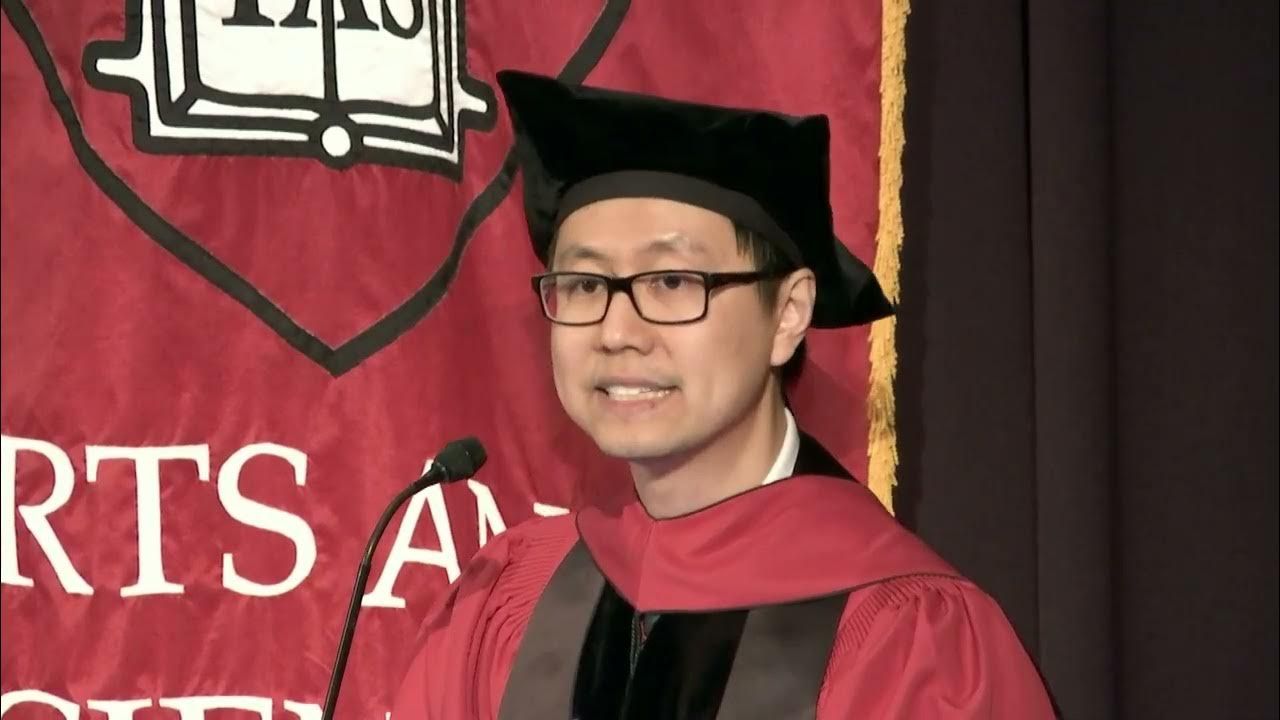

SINGAPORE: A Singaporean who was turned away by local universities has won widespread admiration online after sharing how that setback eventually led him to earn a PhD from Harvard University.
Dr Joel Tan’s story gained attention after he delivered a student address at the May 28 hooding ceremony for Harvard Medical School-affiliated PhD programmes, where he reflected on an academic journey that was anything but straightforward.
In his speech, Dr Tan spoke candidly about growing up in Singapore with a strong interest in biology but being repeatedly told that higher education might not be for him because of his grades.
For a period of time, he believed those assessments.
That belief appeared to be reinforced when he was unable to secure a place at any Singapore university despite applying twice over two years.
Rather than giving up, Dr Tan looked overseas and was accepted by the University of Toronto, a decision that would ultimately change the course of his life.
“Someone opened a door that had been closed to me, and because of that, I eventually found my way here, to Harvard,” he said.
During his address, Dr Tan described how his educational path in Singapore had been “not always obvious or straightforward”.
“In high school, I really wanted to study biology, but I was told many, many times that it was not a realistic path for me,” he said.
According to Dr Tan, his middle school results were deemed insufficient for biology classes, and he was instead directed towards what he described as easier science subjects, such as physics and chemistry.
Because those subjects did not align with his interests, his academic performance suffered further.
Everything changed when the University of Toronto accepted him into its undergraduate programme.
There, he was finally able to take his first biology class and gained access to mentors, laboratories and a scientific community that helped him discover his potential as a researcher.
“I often think about how much of my life depended on someone, somewhere, deciding that my past performance did not have to define my future potential,” he said.
He noted that many people possess the curiosity, creativity and ability to succeed but may never get the opportunity to demonstrate it unless someone is willing to give them a chance.
Using his approximately 11-minute speech to advocate for greater diversity in science, Dr Tan argued that research benefits when people from different backgrounds and experiences come together.
“We need people who arrived here with perfect grades and people who needed that third chance,” he said. “We need people whose paths were straightforward and people whose paths were anything but, because science is stronger when more people can contribute to it.”
He also urged fellow graduates to become people who open doors for others.
“Talent is everywhere. Curiosity is everywhere. Potential is everywhere. And if there’s anything that we’ve learned on this long road to the stage, it is that sometimes a single opportunity is all you need to achieve your goals.”
According to the speaker who introduced him at the ceremony, Dr Tan will continue his work as a postdoctoral fellow, focusing on research aimed at addressing neurodegeneration.
His story struck a chord with many Singaporeans online, with commenters celebrating both his achievement and the message behind it.
“I wish him all the best!” wrote one netizen, while another said: “Happy for him!!! Very inspiring! Very proud of a fellow Singaporean!”
Others congratulated Dr Tan directly, with one commenter writing: “Congratulations to Joel, wishing him all the best.”
Several netizens said his experience highlighted how talent can sometimes be overlooked.
“Know your worth. Proud of this fellow SG who ignored what this so-called elite local universities couldn’t see,” one commenter remarked.
Others reflected on broader issues within Singapore’s education system.
One person argued that Dr Tan’s story showed the importance of allowing students to pursue subjects they are passionate about, adding that opportunities to study overseas remain inaccessible to many families.
“He was lucky that he could afford to study overseas. Not everyone here has that privilege,” the commenter wrote.
A particularly lengthy response came from a Singaporean who said they related strongly to Dr Tan’s experience.
While praising the education they received in Singapore for providing a strong foundation, the commenter said they only reached their full potential after leaving the country.
Describing themselves as a “square peg” who did not fit into a predetermined mould, they argued that educational systems should create more room for failure, resilience, courage and independent thinking.
“I’ll always have mixed feelings about Singapore. It is my home, but it is also the place that made me feel ‘less than’ by daring to not fit into its predetermined boxes,” they wrote.
Others shared remarkably similar stories.
One netizen recalled being prevented from taking biology at O Levels after not performing well enough in Chinese, a decision that closed off pathways into biotechnology and biology-related studies in Singapore.
The commenter eventually went overseas, earned a PhD in neuroscience and went on to enjoy a two-decade academic career.
Another suggested that Dr Tan’s experience was not unusual, given the limited number of places available in local universities.
They argued that many capable Singaporean students end up studying overseas and often excel when given the opportunity.
The commenter recounted how their university initially admitted four Singaporean students as part of a pilot programme more than two decades ago. According to the account, three graduated with first-class honours while the fourth earned second-class upper honours. One of the students was even named salutatorian.
The results reportedly impressed faculty members and led the University of Manchester’s Computer Science department to accept more Singaporean students in subsequent years.
 Follow Google News
 Join us on WhatsApp
 Follow us on Telegram