
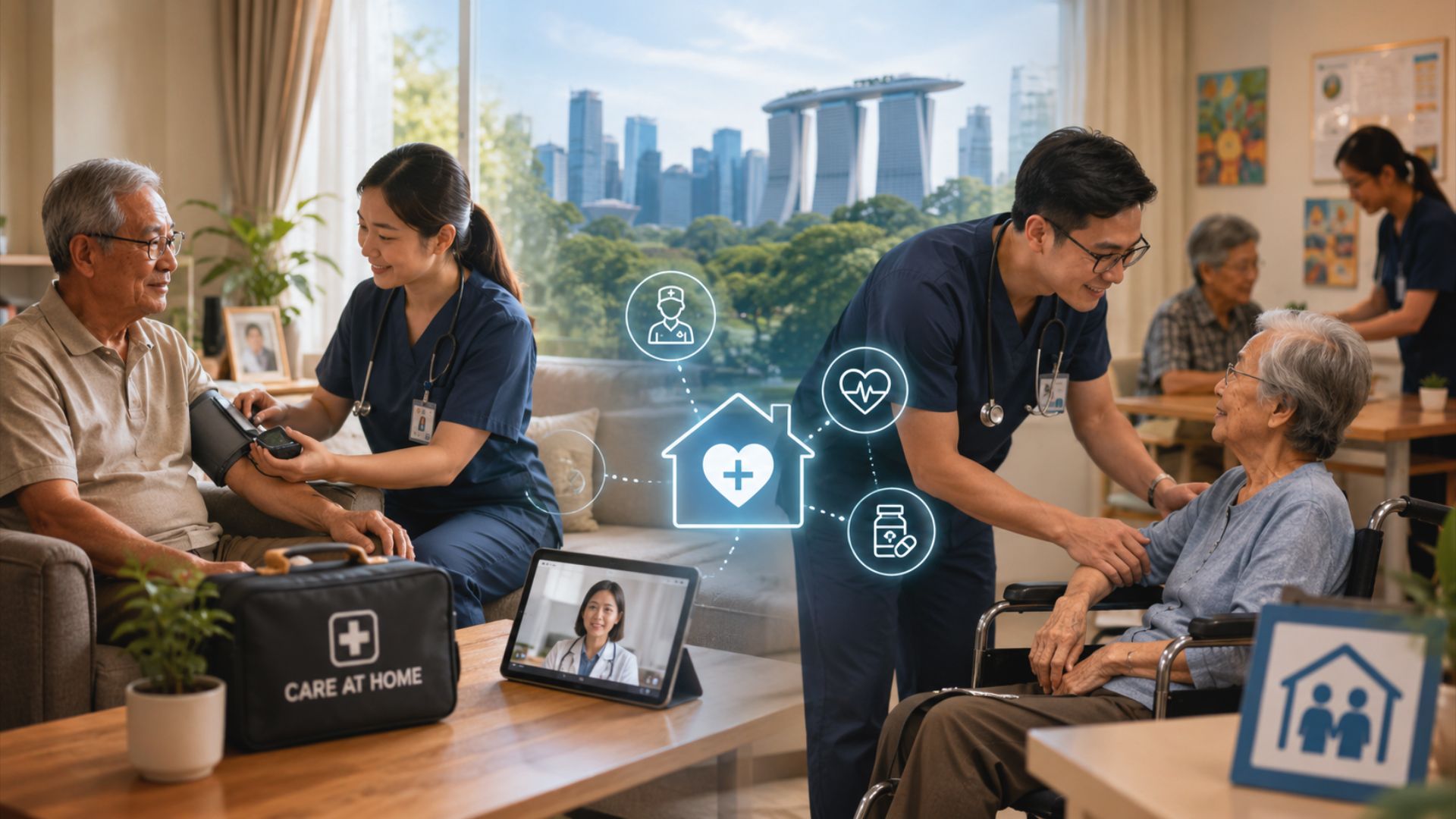

SINGAPORE: More patients in Singapore will soon be able to recover at home or in nursing homes while still receiving hospital-level treatment, under expanded healthcare programmes designed to reduce unnecessary hospital stays and improve patient recovery.
The Ministry of Health’s (MOH) efforts are to bring more healthcare into the community, allowing eligible patients to receive treatment outside hospital wards without compromising medical care. The approach also helps free up hospital beds for patients with more serious conditions, Channel NewsAsia (CNA) reported (July 22).
Recovering at home with hospital support
82-year-old Jiang Tong Kai is among those benefiting from the Mobile Inpatient Care @ Home (MIC@Home) programme after being admitted to Khoo Teck Puat Hospital for lower limb swelling caused by fluid retention, constipation and poorly controlled diabetes.
Although he is still officially an inpatient, his treatment now continues from home. His wife, Madam Bey Chin Kiat, received guidance from hospital staff on caring for him, while healthcare professionals make home visits and charity workers provide daily support.
She said the arrangement has made life much easier because travelling between home and hospital had become difficult for the elderly couple.
Expanding care beyond hospital walls
MIC@Home began as a trial in 2022 before expanding nationwide in 2024. Today, it is available at every government restructured hospital except the Institute of Mental Health.
The programme has supported about 152 patients across Khoo Teck Puat Hospital, Tan Tock Seng Hospital and Woodlands Hospital. Another 150 patients are expected to receive the service by the end of this year.
Patients who need help with daily activities previously required family members or caregivers to support them at home, which proved difficult for some elderly couples and those with limited family support.
To address this, NHG Health partnered with Thye Hua Kwan Moral Charities in July 2024. Its team of 60 care staff visits patients every day during the first five days after they return home. They monitor vital signs, help with medications, assist with wound care, and provide other daily support while hospital teams continue to oversee treatment through home visits and teleconsultations.
Dr Boh Toon Li, Senior Consultant at Khoo Teck Puat Hospital and Lead Geriatrician for the MIC@Home programme, said recovering in familiar surroundings with loved ones can improve patients’ wellbeing and support recovery.
The programme is currently free, although Thye Hua Kwan Moral Charities is studying a paid version while looking at expanding the service to other healthcare clusters.
Bringing specialist care into nursing homes
Healthcare providers are also extending specialist geriatric care directly into nursing homes to reduce avoidable hospital admissions among frail seniors.
Woodlands Hospital piloted the THRIVE (Transforming Health and Resilience In Vulnerable Elders) programme at Ren Ci @ Woodlands. A multidisciplinary team worked alongside nursing home staff to review residents’ health, adjust treatment plans and provide specialist support.
After one year involving 300 residents, unplanned hospital admissions and emergency department visits fell by about one-third. More than 60 per cent of residents avoided hospital admission altogether during the pilot.
Assistant Nurse Clinician Anushiya Rajendran from Ren Ci @ Woodlands said reducing hospital transfers means residents spend less time making exhausting hospital trips and more time taking part in meaningful daily activities. She also said having direct access to specialist expertise has strengthened staff confidence in caring for residents with complex medical needs.
Woodlands Hospital hopes to expand the THRIVE programme to more nursing homes while developing a sustainable long-term model.
A healthcare model built around patients
Singapore’s ageing population’s demand for hospital care will continue to rise. Programmes that safely deliver treatment at home or inside nursing homes can improve patients’ comfort while helping hospitals focus resources on those who need intensive care the most.
Good healthcare isn’t measured only by the number of hospital beds available. It’s about giving people the right care in the right place. When patients can recover safely in familiar surroundings with proper medical support, everyone stands to benefit.
 Follow Google News
 Join us on WhatsApp
 Follow us on Telegram