
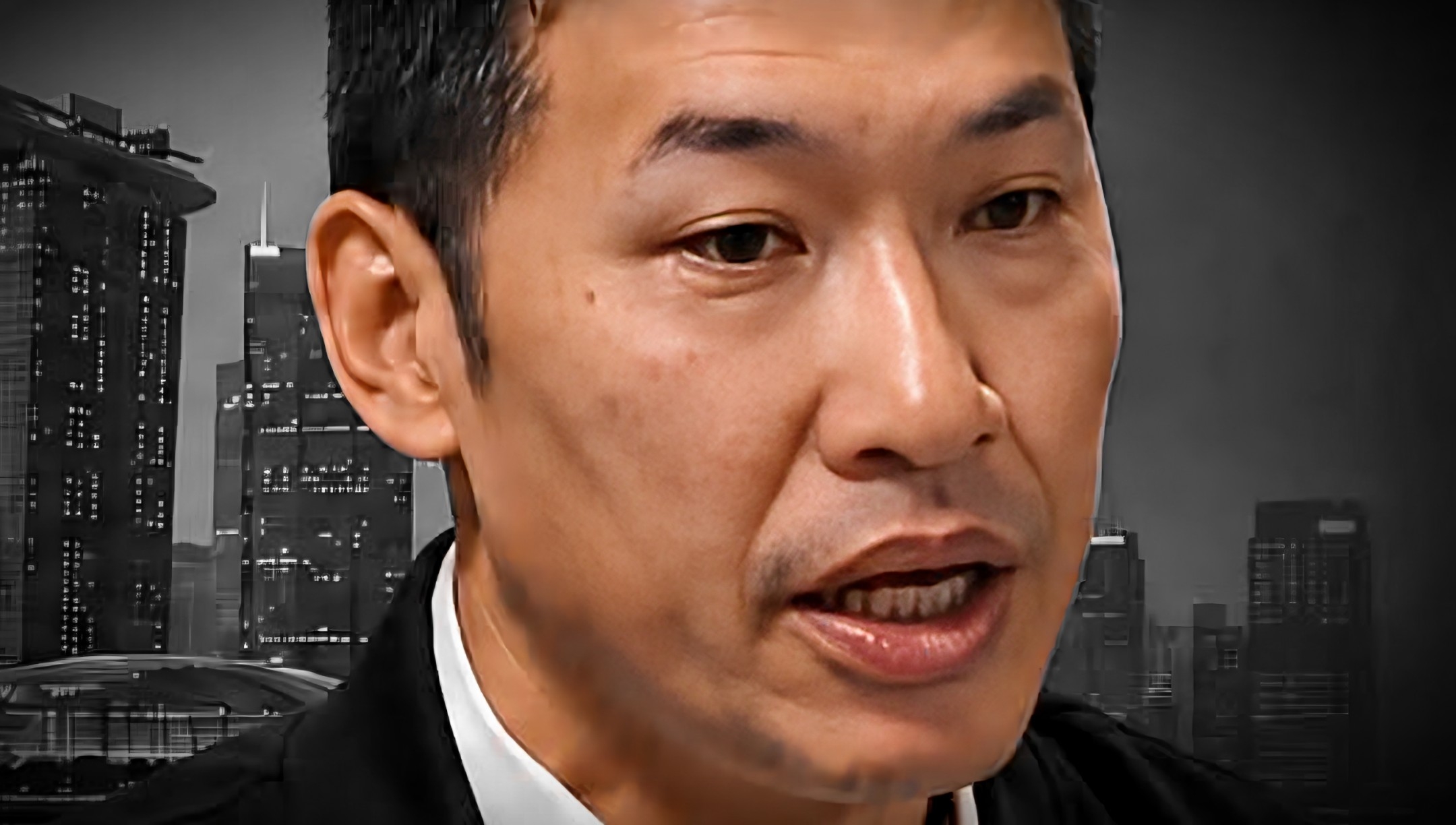

SINGAPORE: The backlash against Acting Minister for Culture, Community and Youth, David Neo, has gained new steam after a tribute he posted for one of Singapore’s pioneer artists has drawn speculation as to whether it was penned by an artificial intelligence (AI) language model.
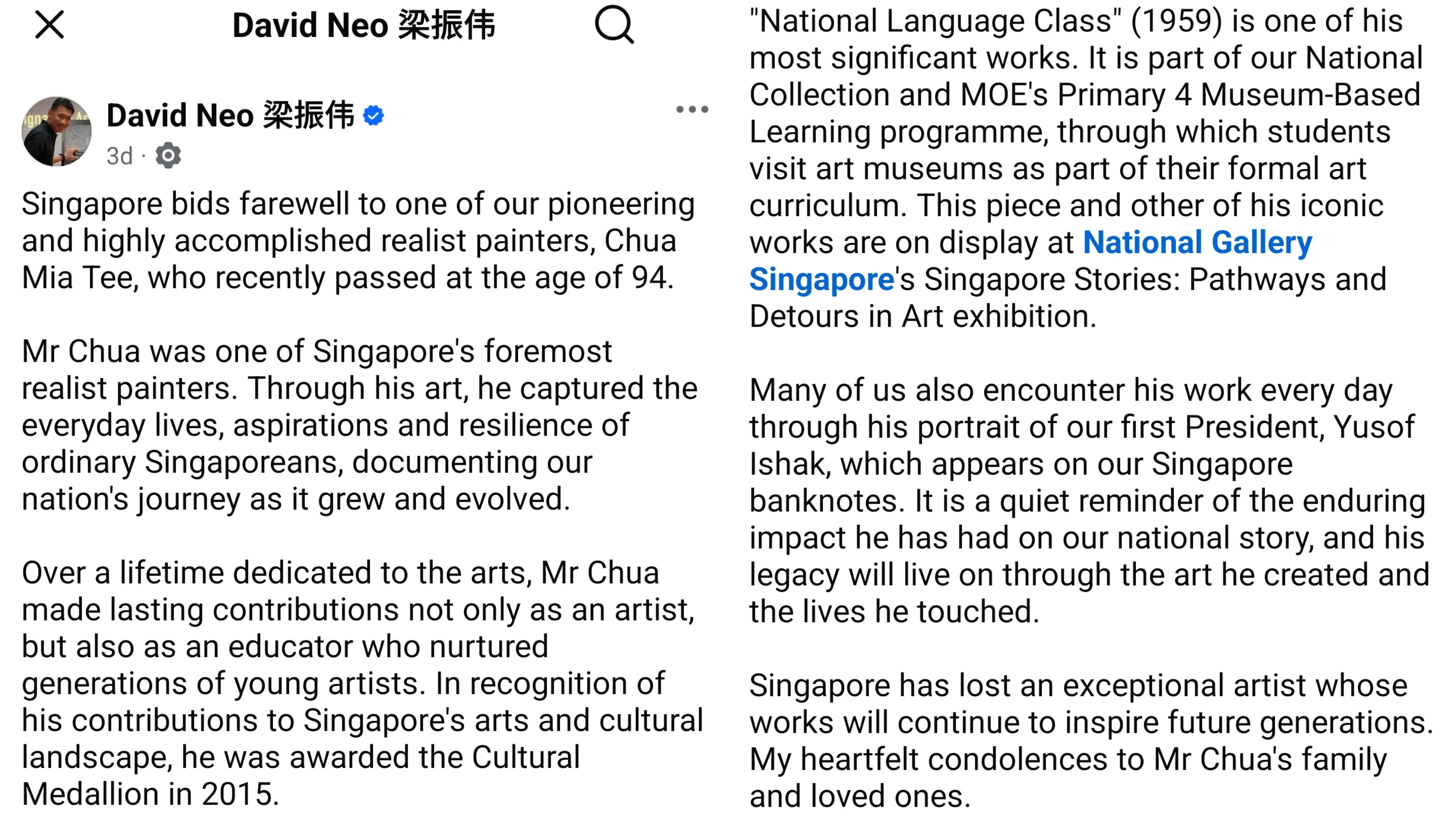
The post, which was published on Mr Neo’s Facebook page on Friday (10 July), paid tribute to Chua Mia Tee, one of Singapore’s most well-known realist painters, who passed that same day at the age of 94. The post read:
“Singapore bids farewell to one of our pioneering and highly accomplished realist painters, Chua Mia Tee, who recently passed at the age of 94.
“Mr Chua was one of Singapore’s foremost realist painters. Through his art, he captured the everyday lives, aspirations and resilience of ordinary Singaporeans, documenting our nation’s journey as it grew and evolved.
“Over a lifetime dedicated to the arts, Mr Chua made lasting contributions not only as an artist, but also as an educator who nurtured generations of young artists. In recognition of his contributions to Singapore’s arts and cultural landscape, he was awarded the Cultural Medallion in 2015.
“National Language Class” (1959) is one of his most significant works. It is part of our National Collection and MOE’s Primary 4 Museum-Based Learning programme, through which students visit art museums as part of their formal art curriculum. This piece and other of his iconic works are on display at National Gallery Singapore’s Singapore Stories: Pathways and Detours in Art exhibition.
“Many of us also encounter his work every day through his portrait of our first President, Yusof Ishak, which appears on our Singapore banknotes. It is a quiet reminder of the enduring impact he has had on our national story, and his legacy will live on through the art he created and the lives he touched.
“Singapore has lost an exceptional artist whose works will continue to inspire future generations. My heartfelt condolences to Mr Chua’s family and loved ones.”
Eagle-eyed netizens noted that the tribute contained tell-tale markers that suggested it had been crafted by an AI model like ChatGPT.
Some drew attention to the fact that the post mentioned that Mr Chua passed “recently” instead of “today,” even though it was published on the same day Mr Chua had departed, and pointed out that AI models are often programmed to avoid predicting dates or absolute time.
Perhaps most glaringly, some netizens noted that the entire tribute remains largely abstract rather than personal, even though it is a condolence message.
It speaks of Mr Chua capturing the “everyday lives, aspirations and resilience” of Singaporeans, making “lasting contributions,” and leaving an “enduring impact,” but it does not include any personal anecdotes, memories, or reflections from the author.
Human-written tributes often include something like, “I had the privilege of meeting Mr Chua…” or “I remember being struck by…”. Such phrases lead to a personal recollection or a specific interaction as the individual reflects on the person who has passed.
None of that appeared throughout the post, making it seem impersonal and as though it was crafted by AI.
Some netizens also said the structure of the post appeared highly formulaic as it progressed in a very predictable sequence. It began by announcing Mr Chua’s passing, moved on to summarise his achievements, highlighted the recognition he received, discussed some of his most notable works, reflected on his legacy, and concluded with condolences.
This clear, methodical progression mirrors the way AI models frequently organise memorial tributes, critics say.
A large part of the post also reads like a carefully organised catalogue of facts about Mr Chua rather than a meaningful reflection on the dearly departed. The post systematically covers his career and gives almost a laundry list of accomplishments in a broad but encyclopaedic manner that resembles the way AI frequently summarises information from multiple sources.
The language throughout is filled with broad, universally positive language, with phrases such as “pioneering,” “highly accomplished,” “foremost,” “lasting contributions,” “enduring impact,” “exceptional artist,” and “inspire future generations” that come across as complimentary but generic.
Critics say AI-generated writing often relies on this type of safe, positive language because it avoids making more distinctive or subjective observations.
The mechanical cadence of the post also drew scrutiny as it seemed to follow a repetitive sentence structure. Many of the sentences begin in a similar way, such as “Mr Chua was…”, “Through his art…”, “Over a lifetime…”, “In recognition…”, and “Many of us also…”.
The ending, where Mr Neo extended his condolences, is being slammed as a textbook memorial conclusion, as well, since AI-generated tributes frequently end in this manner as they transition from summarising the person’s legacy to expressing sympathy.
Pointing out these uncanny characteristics, netizens are bashing the Minister for not making the effort to pen his own tribute, arguing that the post he published is so impersonal and mechanical that it might have been better if he had posted nothing at all.
Some also posted the results of AI detector apps that show at least 65 per cent of the post may have been written by AI.
Quite a large number of commenters questioned whether Mr Neo did not have time to write his own post, referring to an infamous remark he made just days earlier in Parliament about ministers being too busy to watch movies.
Responding to an opposition parliamentarian’s question about whether he had seen the original or dubbed version of the Teochew film Dear You, the first-term MP had quipped, “Ministers have no time to watch movies.”
Though the comment may have been intended to be a light-hearted jibe, it quickly triggered a firestorm of criticism, with many pointing out that watching films is part of his job as Minister of Culture.
As the backlash continued, the ruling party politician and former Chief of Army was christened online as “No Time Neo” — a tag that he may not be able to shake off so soon, given the fresh backlash against the new memorial post.
The memorial post has attracted a flood of critical comments, with many questioning the authenticity of the tribute. Several netizens openly doubted that Mr Neo had penned the message, with one writing, “I doubt the condolence message was written by him. Where could he find time?”
Another sarcastically remarked, “You had time to write this? Oh wait…,” while a separate commenter quipped, “Since when do you have time for anything? Thought you very busy??”
Others suggested the tribute felt obligatory rather than heartfelt. One commenter accused the Acting Minister of being “performative”, asking, “eh now got time to be performative?”, while another said, “After the ‘no time’ saga, this post doesn’t seem authentic…”.
Many comments also questioned Mr Neo’s appreciation of the arts, particularly in light of his portfolio overseeing culture. One of the most pointed remarks said, “Doubt you had the interest to catch his exhibition at the National Gallery. It’s fine that you have neither time nor intellectual capacity to enjoy the arts. The least you could do is to be authentic and pen a condolence message only when you mean it, not out of obligation.”
Several others echoed similar sentiments, with one asking, “You sure you got time to watch and appreciate his works?”
Another netizen wrote bluntly, “You sure you got the luxury of time to appreciate his art? Even if so, you know how to appreciate? Don’t think so leh, because don’t see you speak like a cultured person much…”
Questions over whether Mr Neo had made any effort to engage with Mr Chua’s legacy also surfaced repeatedly. “Minister, you got time to view his art collection and research on Chua?” one commenter asked, while another wrote, “A great loss indeed to the Singapore art world. Don’t suppose you had time to see his paintings did you Minister?”
Others argued that the controversy surrounding his parliamentary remarks had exposed what they saw as a broader disconnect from the cultural portfolio he oversees.
One commenter said it was “quite disappointing” that Mr Neo appeared to have “no time” for “an important topic in the art scene”, adding that Parliament’s discussion had been anticipated and that he “should have spent time to find out about this very important subject matter.”
Some took aim at what they viewed as his priorities as Minister for Culture, Community and Youth. One commenter urged him to “be more focused on art appreciation, not just sitting in parliament and joke on art and cultural stuff,” calling his conduct “really a let down.”
Another commenter said Mr Neo’s earlier statement that “Minister has no time for movie” had already “revealed your disconnect”.
They added that while Singapore was mourning the loss of a respected artist, Mr Neo’s comments have “unfortunately diminished” his credibility.
Taken together, the comments reflected how the criticism had evolved beyond the wording of the condolence message itself. For many, the tribute became another flashpoint in the wider backlash that began with Mr Neo’s “no time” remark, reinforcing perceptions among critics that he lacked both a personal connection to the arts and the authenticity expected of the minister responsible for Singapore’s cultural portfolio.
 Follow Google News
 Join us on WhatsApp
 Follow us on Telegram