
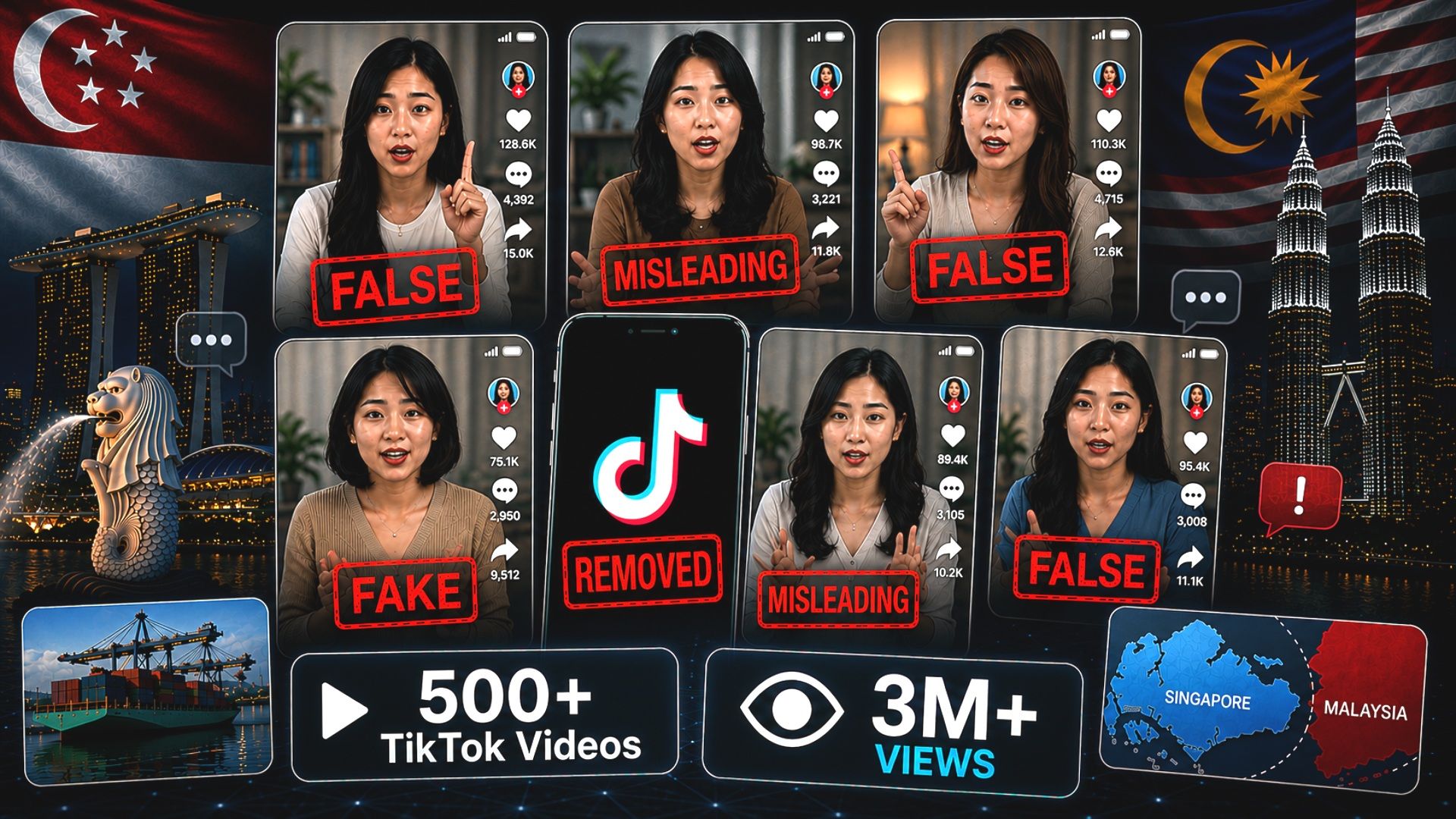

SINGAPORE/MALAYSIA: Artificial intelligence (AI) now isn’t just writing essays or making artwork anymore. It has evolved into fronting convincing, human-like social media personalities that can speak, smile, and gain trust while spreading fake information.
A Channel NewsAsia (CNA) investigation found around 500 TikTok videos featuring AI-generated or manipulated women making false or misleading claims about Singapore and Malaysia. Published between October 2025 and June 2026, the videos attracted more than three million views before some accounts were removed, CNA reported (July 13).
The videos covered subjects such as Singapore’s economy, foreign policy and ties with China. While they mixed real events with genuine statistics, many slipped in claims that were either distorted or completely fabricated, making the misinformation harder to spot.
Familiar faces delivering the same script to influence/convince viewers
CNA examined 30 TikTok accounts and found a production-line approach behind more than 550 videos. Almost all used AI-created, manipulated, or copied female presenters. Many also recycled voices, scripts and talking points across different accounts.
One false story claimed that Singapore Foreign Minister Dr Vivian Balakrishnan had unsuccessfully pleaded with China and Indonesia to stop a shipping route that would bypass Singapore’s port. CNA found no evidence that such an incident ever happened.
Of the 550 videos analysed, 94 repeatedly promoted the same misleading claims. Together, those videos alone drew more than 1.6 million views.
The investigation found that 24 different accounts rotated through identical scripts over several weeks, creating the impression that multiple independent creators had reached the same conclusion.
After CNA shared examples with TikTok and sought comment, the platform removed two of the accounts for violating its rules on deceptive behaviour.
TikTok said it actively removes accounts involved in activities such as covert influence operations, impersonation, spam and other forms of manipulation.
Real news used to support false stories
Rather than inventing everything from scratch, many videos began with genuine headlines before steering viewers towards misleading conclusions.
Some suggested Singapore’s port was about to lose its global position because China’s Hainan Free Trade Port had opened. Others pointed to ExxonMobil’s planned refinery closure as supposed proof that Singapore’s economy was in decline.
Those claims ignored important facts. Singapore handled a record 44.66 million containers in 2025 and has remained the world’s second-busiest container port for the past 15 years.
The same method appeared in videos discussing investment links with China. While Singapore has been China’s largest foreign investor since 2013, some creators used that fact to suggest Singapore’s success depended entirely on aligning with Beijing.
Malaysia was also targeted. Several videos blamed the country’s slower development on policies affecting its ethnic Chinese community.
Experts warn that AI-generated influencers use repetition to build audience trust
Associate Professor Saifuddin Ahmed from Nanyang Technological University’s Wee Kim Wee School of Communication and Information said these campaigns don’t have to persuade people immediately.
Instead, repeating the same message across many accounts makes the claims feel more familiar, increasing the chance that viewers accept them over time.
The Associate Professor also said attractive AI-generated presenters help keep viewers watching, using many of the same psychological techniques that make influencer content successful.
Benjamin Ang, who heads the Centre of Excellence for National Security at the S. Rajaratnam School of International Studies (RSIS), said Mandarin-speaking audiences may face extra challenges because fact-checking efforts in that language still trail behind English-language content.
Mr Ang encouraged people to help friends and family recognise the dangers of endless doomscrolling, instead of feeding them misleading content to boost views and engagement.
Mr Saifuddin added that trying to spot AI-generated faces on its own is becoming unrealistic as the technology improves. A better defence is learning how coordinated campaigns work, such as recognising repeated claims that appear across many accounts but aren’t reported by credible news organisations.
AI makes coordinated disinformation cheaper and harder to detect
The investigation suggests that modern influence campaigns no longer depend on a single viral post. They can rely on dozens of convincing AI personalities repeating the same narrative until it feels familiar or even convincing.
While CNA couldn’t identify who operated or funded the network, the pattern showed how cheaply AI can produce polished content at scale, making misinformation harder to detect and easier to spread.
Singapore has invested heavily in digital literacy over the years, but technology keeps changing. Learning to question repeated narratives, check trusted sources and pause before sharing content may be the simplest defence any of us has. As AI becomes more convincing, healthy scepticism is becoming just as valuable as digital skills.
Read related: Police uncover footage of AI-generated fake Zoom meeting scam impersonating PM Wong that tricked victim out of S$4.9M
 Follow Google News
 Join us on WhatsApp
 Follow us on Telegram