

JAKARTA: Indonesia has passed a long-delayed law to protect domestic workers, marking a change after more than two decades of debate. The shift gives legal recognition to a workforce that has long operated without formal safeguards.
According to SBS News (April 24), the new move now affects more than 4 million domestic workers, 90% of whom are women, yet for years, they were not legally recognised as workers or covered by formal labour protections. This left them outside labour laws, exposed to abuse, and with little recourse when things went wrong.
That is now set to change. Under the new law, domestic workers will be entitled to rest days, health insurance, pensions and vocational training. It will also be illegal to hire children or allow employment agencies to deduct wages, practices activists say have been common.
Parliament’s approval drew applause in Jakarta. Law and Human Rights Minister Supratman Andi Agtas presented it as a step towards fairness, saying the new law sets out clearer protections while giving employers legal certainty. He also noted that President Prabowo Subianto had pushed for the bill to be completed, Channel NewsAsia (CNA) reports (April 21).
Regulators have now been given 12 months to finalise how the law will be enforced, including setting penalties for employers who breach the rules.
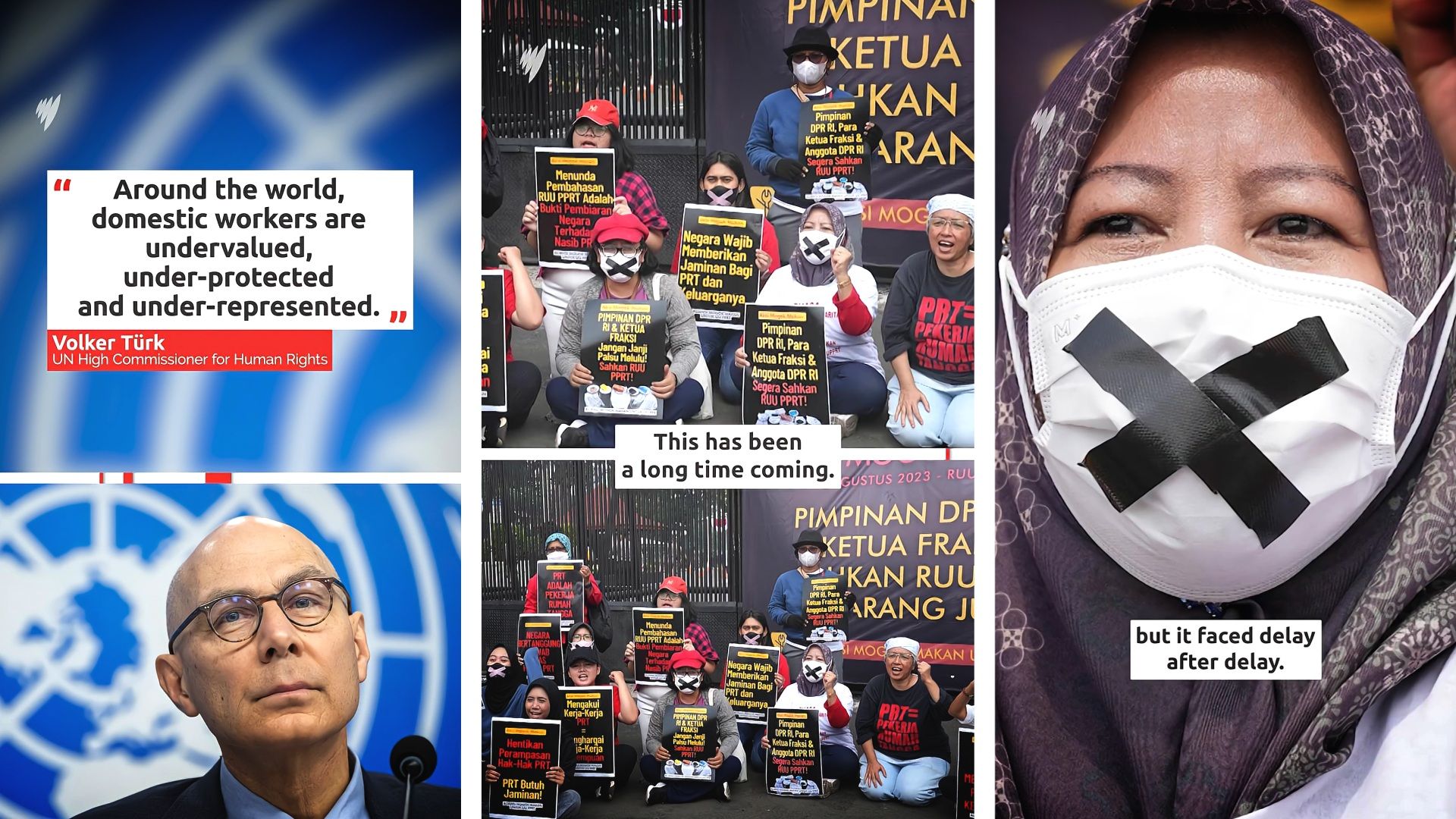
United Nations: “Around the world, domestic workers are undervalued, underprotected and underrepresented…”
UN High Commissioner for Human Rights Volker Türk praised Indonesia’s decision, describing it as a major step forward with historic significance. He said, “Around the world, domestic workers are undervalued, underprotected and underrepresented. This is an historic opportunity to turn the tables on this neglect and to protect, respect and honour their invaluable contribution to the welfare of so many people.”
The new law introduces several baseline protections for domestic workers
Domestic workers will now have access to training, as well as health and unemployment benefits. It also bans the hiring of anyone under 18, a notable change in a country where many leave school early.
There is still a wage gap as the law doesn’t set a minimum salary. Instead, the government has given itself 12 months to work out detailed rules, including penalties for violations, as without proper enforcement, laws can sit on paper while daily practices stay the same.
For many domestic workers, the law feels overdue
The bill first appeared in 2004. Since then, it has faced repeated delays. Advocacy groups kept pushing, arguing that domestic workers were invisible in the legal system despite their role in keeping households running.
One domestic worker described the moment as something that had taken over two decades to achieve, especially for women who had long been sidelined.
Jala PRT, a domestic workers’ rights group, called the law historic. Its coordinator, Lita Anggraini, said the law finally brings recognition to workers who had been ignored for years.
Abuse cases kept pressure on lawmakers to act
The urgency of the law is tied to real cases of abuse. Jala PRT recorded more than 3,300 abuse cases between 2021 and 2024. These ranged from physical harm to economic exploitation and even human trafficking.
One widely reported case in 2023 involved a young domestic worker in South Jakarta who suffered severe abuse. Several individuals were later jailed, with sentences of up to four years.
Cases like this kept the issue in public view and added pressure on lawmakers to act.
Stronger protections for domestic workers could shape expectations
For Singapore, Indonesia is also one of the main source countries of domestic helpers for the nation and across Southeast Asia.
Similar, stronger protections, like those enforced in Indonesia now, could shape expectations abroad as well. It may also influence future policy discussions on worker welfare, contracts, and employer responsibility.
At the same time, the law shows how long it can take to formalise protections for work that happens behind closed doors.
Rules on paper mean little without education and inspection
Currently, even supporters say passing the law is only the first step. Advocates stress that employers also need to understand their responsibilities. Public education will be crucial, as without it, the law risks becoming another rule that few follow.
There is also the question of enforcement because rules on paper mean little without inspections, reporting channels, and consequences. A law can change status overnight, but changing behaviours takes longer.
Nevertheless, this is a necessary reset, toward the finish line. The coming years will matter more than the last 22.
If the follow-up rules are strong and enforced, this could reshape how domestic work is treated across the region beyond Indonesia. Otherwise, it risks becoming just another symbolic win with limited impact.
 Follow Google News
 Join us on WhatsApp
 Follow us on Telegram