
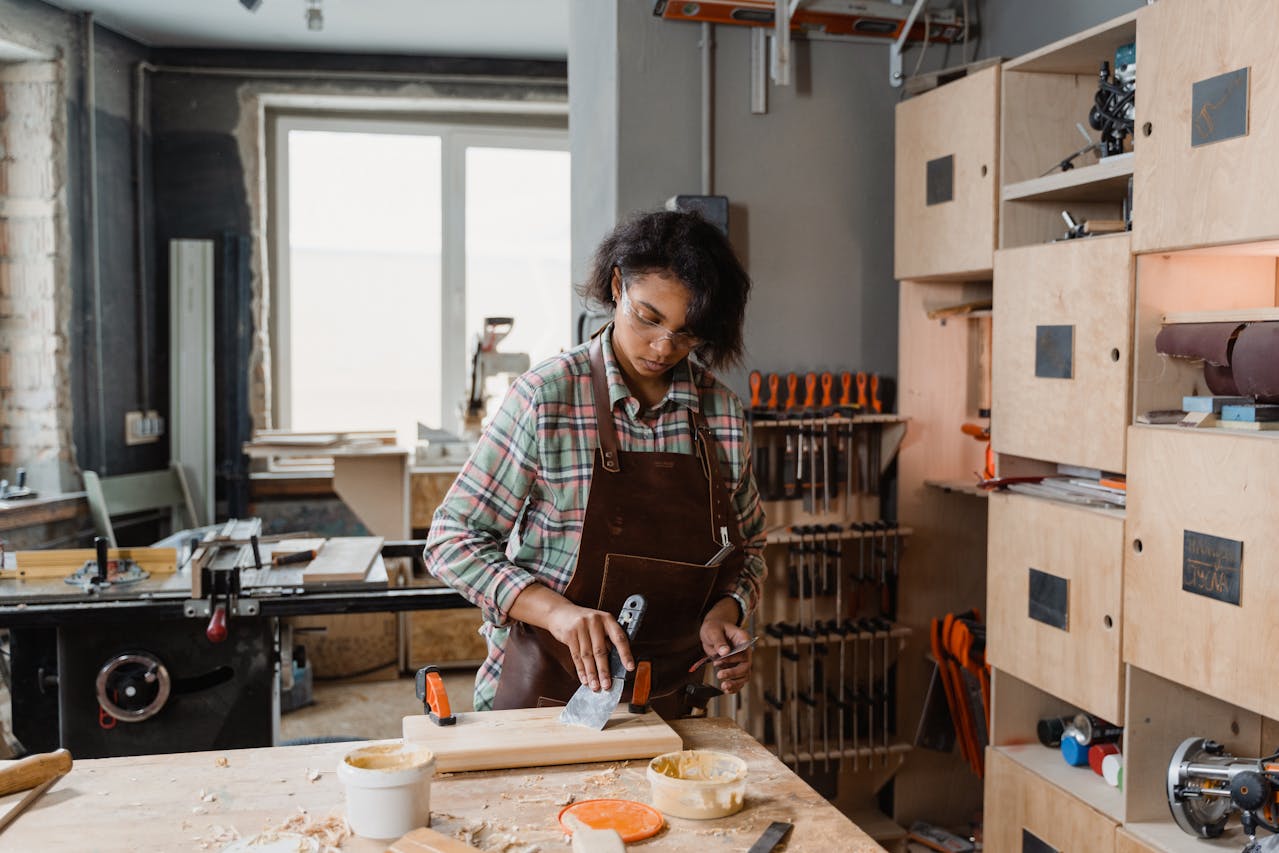
A young female carpenter (for illustration purposes only)
Forget the office: Singapore’s youth are turning to skilled trades and shaking up career norms

Growing up, Daniel Yap pictured a future that looked a lot like many others around him. Maybe he would become a musician, do research, or follow his father into engineering. At university, he took the expected route, studying materials science and engineering, but outside lecture halls and labs, something else was quietly pulling at him.
He began spending his free time watering plants, nurturing seedlings, and selling what he grew. What started as a small side hustle slowly grew into something much bigger — and much more meaningful.
“It turned out to be the best thing I ever did,” Mr Yap said.
Even as opportunities opened up in more conventional fields, he kept returning to the soil. Today, at 32, he runs Noi Gardens full-time in Singapore and has expanded his operations to Johor Bahru. Across both locations, he employs about 18 people.
Farming, he said, never felt like a calculated career move. It felt more like answering a call. Each day brought something new to learn, whether it was improving growing systems or figuring out how to run a business. The journey also took him far beyond Singapore, to farms in Thailand, Malaysia, Holland, Australia, and Taiwan, where he observed how people grow, sell and connect with their produce.
“It’s almost like discovering what makes people happy around the world,” he said.
In the early days, he did everything himself — watering, planting, and tending to every crop. Over time, he built systems to support growth, both for his plants and his business.
A new generation finds meaning in working with their hands
Mr Yap’s journey mirrors a bigger change among millennials and Gen Zs, many of whom are gravitating to practical, skills-based vocations. For them, the attraction lies in seeing actual outcomes from their exertion — and in the likelihood of putting up something of their own.
Certified plumber Geraldine Goh, 31, has observed this transformation immediately. After working as a facilities management officer at a town council, she started her own plumbing business, Agraffe, in 2017. Since then, she has seen more young people showing interest in an industry long viewed as unglamorous.
Students like Mr Shameer Khan, 22, and Mr Yeo Kai Xun, 23, are among them. Mr Khan enrolled in BCA Academy’s plumbing and pipe-fitting course to broaden the services offered by his interior renovation company. Plumbing, he said, appealed to him because of its wide scope — from sewage systems to fire protection and water installations.
Mr Yeo, an architecture graduate, saw plumbing as a way to combine design knowledge with a love for fixing things. For him, getting licensed is a step towards a practical, hands-on career in the built environment sector.
Ms Goh, who also trains new plumbers, believes the timing matters. Many veteran plumbers are nearing retirement, and with them goes decades of hard-earned troubleshooting knowledge.
“Diagnosing concealed leaks, recurring pipe failures, or poor water pressure isn’t something you learn overnight,” she said. “It comes down to whether you have the heart to help people.”
The quiet satisfaction of craft and creation
Experts say the renewed interest in skilled trades is driven by a simple but powerful idea: the satisfaction of creating something real.
“It’s craftsmanship with a visible payoff,” said Mr Dominic Ng, chief executive of the Singapore Furniture Industries Council (SFIC) Institute.
Carpentry and woodworking, once seen purely as manual labour, are increasingly viewed as creative, resilient and future-ready skills. At the SFIC Artisan Academy, participation among those under 35 has risen steadily, with many learners going beyond basic skills to strengthen their long-term career prospects.
Business development manager Raymond Tuan said participants generally fall into two camps: homeowners eager to work on their own spaces and workers under 40 who dream of freelancing or running their own businesses. Many in the second group juggle full-time jobs and attend classes at night or on weekends.
Architecture graduate Shannon Tan, 26, joined the programme because she wanted a career that stayed interesting. “It’s never boring,” she said. “Working with your hands can be more fulfilling than sitting at a desk, especially while you’re young.”
A similar pull is being felt in hospitality. Dr Natt Srinara from EHL Hospitality Business School said young people are noticing real vacancies and clear entry points in roles such as guest relations, kitchens, housekeeping and maintenance — areas that continue hiring even as white-collar sectors slow down.
“There’s pride in being good at something tangible,” he said, whether it’s plating a dessert beautifully or earning praise from a guest.
Changing perceptions, one story at a time
Social media has helped reshape how skilled trades are seen. Platforms like TikTok and Instagram shine a spotlight on “maker culture,” where baristas, pastry chefs, woodworkers, and horticulturists share their craft — and turn passion into livelihood.
Newsletter
Get updates straight to your inbox
Mr Yap has leaned heavily into this shift. All over Facebook, Instagram, TikTok, and Xiaohongshu, his content has progressed from memes to informative columns, humour, plant care advice and farm excursions, generating fresh business prospects along the way.
Other industries are also seeing renewed interest. The lift and escalator sector, for instance, recorded a 21% increase in workers aged 35 and below between 2023 and 2025. The median age of local workers has fallen from 46 to 40.
For Mr Muaaz Samat, 25, a maintenance technician at a hospital, the job offers both technical challenge and purpose.
Yet, in spite of the mounting awareness and attention, disgrace continues. Skilled trades are still extensively linked to small income, low standing in the community, and limited advancement.
Government initiatives to professionalise trades and clarify progression routes are ongoing, but experts say changing mindsets is just as important. Showing clear success stories — how someone can rise from an entry-level role to management — can make a real difference to parents and young people alike.
As Dr Issac Lim of Anthro Insights put it, the question is simple: can skilled trades offer both a decent living and social respect as a first-choice career?
For Mr Yap, the answer is already clear. “It was like this farming life chose me instead,” he said.
And for a growing number of young Singaporeans, working with their hands is no longer a backup plan — it’s a future they are choosing to build.