
Content creators claim Singapore-based firm failed to pay over S$171,000
SINGAPORE: For the past few months, influencers from Singapore, Malaysia, and the Philippines have publicly said that a marketing business in Singapore, Partipost, has failed to pay them, although there have been no criminal findings against it.
While allegations of delayed payment have been around since late last year, posts on Threads and other social media platforms in the past few months have drawn negative attention to Partipost.
Furthermore, on Tuesday (June 16), the MCA Federal Territories Legal Bureau, an advocacy and legal aid arm of the Malaysian Chinese Association, held a media conference on the matter. Its head, Victor Teoh, announced that more than 200 content creators were reportedly affected by the company, which is said to have failed to pay more than RM543,000 (S$171,000), according to reporting from The Star.
He added that the influencers “claim that despite completing the assignments given to them, the payments promised by the platform have not been received.”
The report added that some of the content creators have since filed police reports, in the hopes that the authorities will investigate the matter. They have also called on the Partipost to provide clarity on the situation and pay the content creators what they are owed.
One was quoted as saying that while she had finished 20 tasks and was supposed to be paid RM10,074.08 (S$3,160), which she never received. Another said that prior to late 2024, she was paid by Partipost regularly. Since then, she hasn’t been paid at all, and the company now owes her RM19,000 (S$5,985).
What is Partipost?
The company offers to connect content creators, often micro- and nano-influencers, with brands. These brands run campaigns using Partipost, with content creators completing tasks and publishing content, for which they are supposed to get paid.
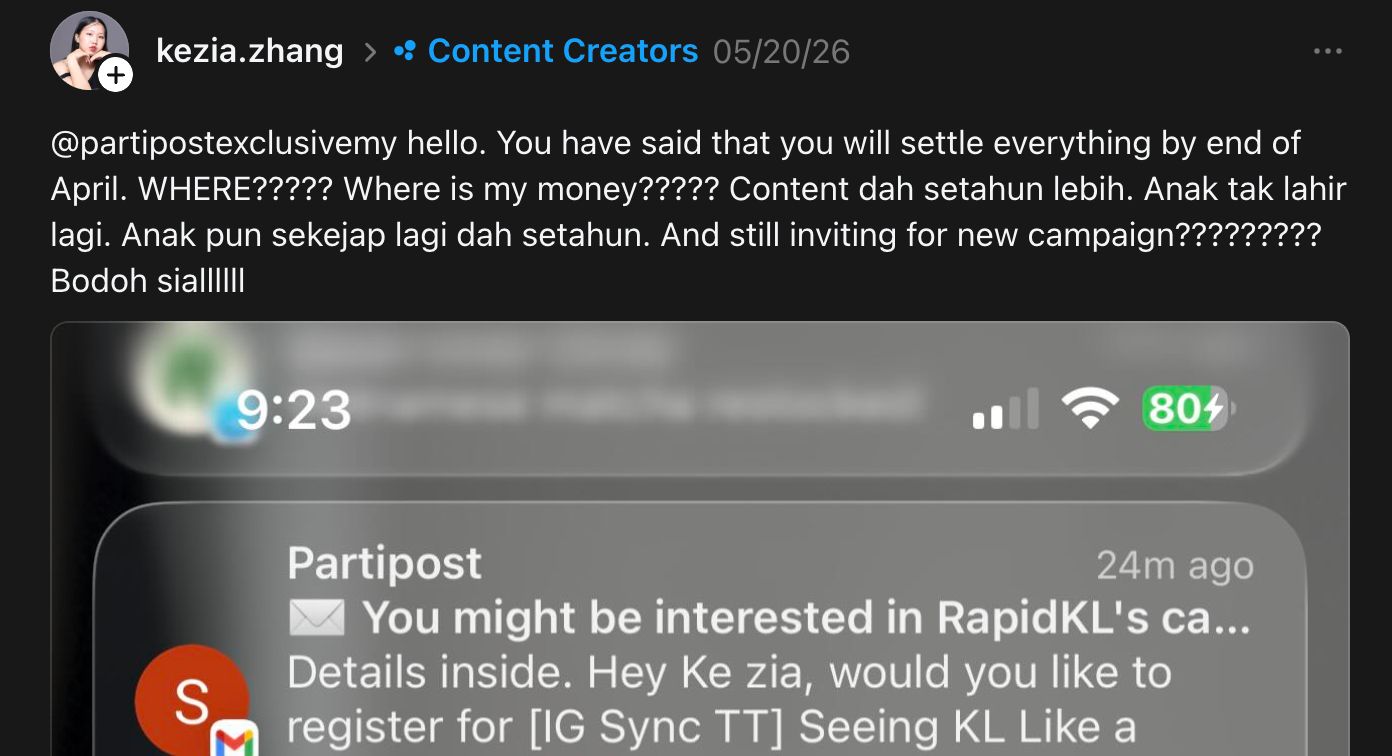
Kezia Zhang, an Indonesian influencer living in Malaysia, has been posting on Threads about Partipost’s non-payment since the beginning of 2026, but her posts have received more attention of late.
Ms Zhang wrote that in spite of not having been paid, Partipost invited her to join yet another campaign, and claimed that she had been promised that she would receive her earnings by the end of April.
“WHERE????? Where is my money?” she wrote, and a commenter on that post told her about a WhatsApp group “specially fighting for Partipost debt recovery.”
Debora Kwek, an influencer in Singapore, also took to social media regarding the issue, posting on Instagram that the firm only paid her for the work she had completed when she threatened them with legal action.
Newsletter
Get updates straight to your inbox
“I contemplated sharing this, but I really feel like creators need to be protected. We’re in this weird industry where we do months of work without a real guarantee we will get paid, and it’s all based on promises with clients or agencies we thought we could trust,” she wrote in an IG stories post.
Partipost appears to address the issue on its landing page, where it says, “Payouts are typically credited into your Partipost wallet after the campaign ends. Should there be a delay, you can be sure that our team is working closely with the brand to send the money across asap.” /TISG