
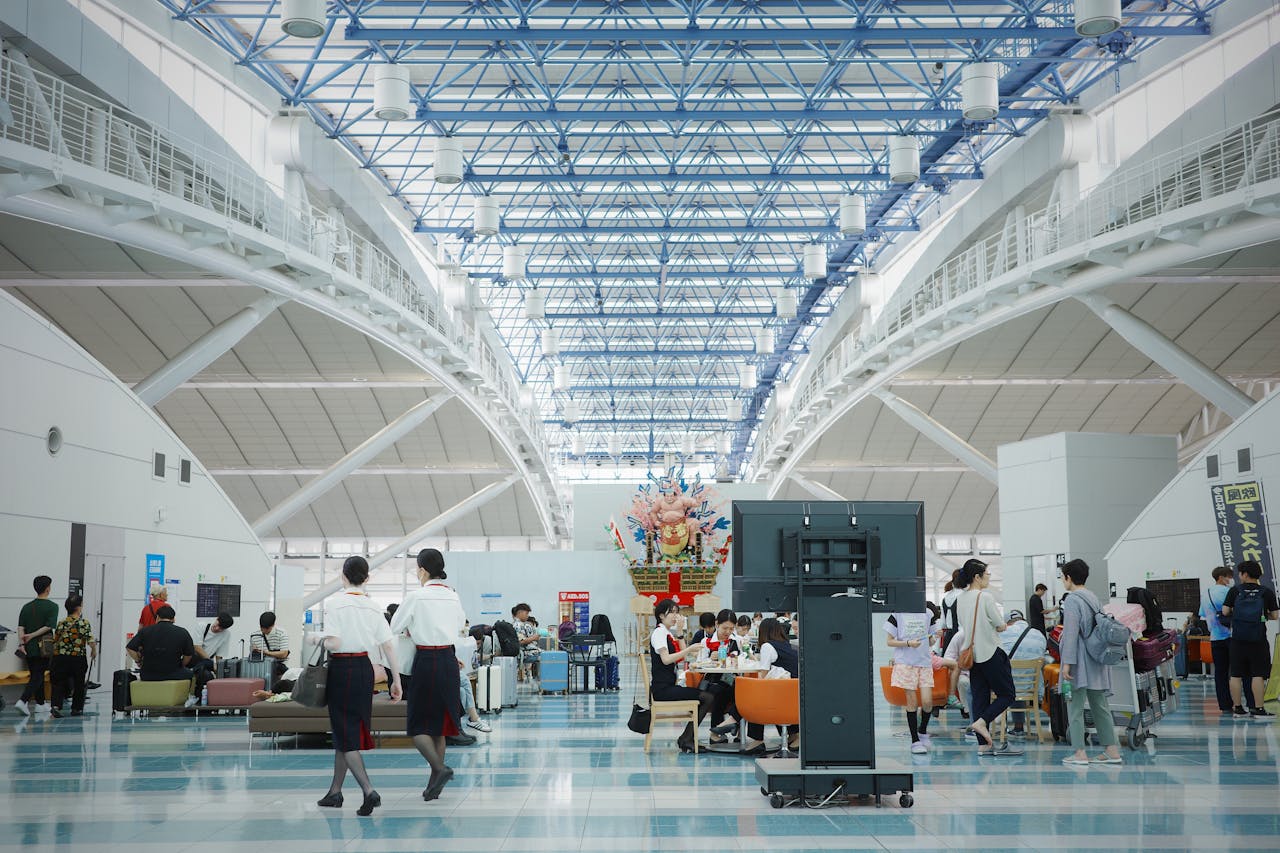
Airport in Japan (for illustration purposes only)
China issues travel warning as spat with Tokyo puts fresh strain on Japan’s already faltering economy

Japan’s already fragile economy is bracing for yet another setback — this time from a diplomatic storm that has spilled far beyond political statements and into the day-to-day lives of workers, business owners, and communities that depend on tourism.
The tensions flared after Prime Minister Sanae Takaichi warned on Nov 8 that any Chinese attempt to seize Taiwan by force would pose a “survival-threatening” danger to Japan. Beijing reacted sharply, calling the remarks unacceptable and urging Chinese citizens to avoid travelling to Japan. The ripple effect was immediate: Tourism-linked stocks slid, and analysts say this could be just the start of a deeper chill.
Tourism at risk — and with it, everyday livelihoods
For years, Chinese tourists have been the lifeblood of Japan’s tourism industry. In 2025 alone, 5.7 million mainland Chinese visitors — nearly one in four tourists — have walked Japan’s streets, filled its shops, and packed its restaurants.
If that flow slows, the consequences will be felt widely. Economist Takahide Kiuchi estimates Japan could lose ¥1.79 trillion (S$15 billion) in economic activity over a year if the diplomatic freeze drags on — a meaningful blow for an economy already struggling to maintain momentum. He points to 2012 and 2013, when a territorial dispute sent Chinese visitor numbers sliding nearly by 8%.
Tourism has been one of Japan’s rare bright spots. Last year, spending by foreign travellers supplied almost all of the country’s modest economic growth. A sharp drop now, warns Stefan Angrick of Moody’s Analytics, could knock Japan’s GDP growth down by another 0.2 percentage point. “Hardly catastrophic,” he said, “But an unwelcome drag for an economy already struggling to find traction”
The reminder of Japan’s struggle is already visible: the economy shrank 0.4% in the latest quarter, ending a year-long streak of growth.
A war of words turns serious
What began as a pointed remark by Takaichi quickly spiralled. China’s consul general in Osaka posted — and later deleted — a fiery remark on X suggesting that Japan had crossed a dangerous line. Japan summoned China’s ambassador in protest. China summoned Japan’s in return. Beijing issued travel warnings and escalated military activity near the contested Senkaku Islands. Japan scrambled fighter jets.
State media in China kept up the pressure, calling Takaichi’s comments “egregious” and accusing Tokyo of meddling in China’s internal affairs.
At the centre of all this is Taiwan, a self-governed island that China claims as its own. Beijing has never ruled out using force. Japan, just over 100 kilometres away at its closest point, has long viewed a Taiwan conflict as a national security threat — especially given its alliance with the United States, which maintains “strategic ambiguity” on whether it would defend Taiwan.
No side wants to blink
Analysts say neither country is signalling a willingness to back down. Veteran investor David Roche expects the freeze to last until Takaichi softens her stance — something Beijing considers a red line. But Takaichi, buoyed by a stunning 69% approval rating, has little incentive to reverse course.
Political risk expert Tobias Harris warns that the standoff could turn into a “THAAD-like episode,” referring to China’s fierce retaliation against South Korea in 2016 that triggered years of tourism bans and economic punishment.
Newsletter
Get updates straight to your inbox
For Beijing, Taiwan is a core sovereignty issue. For Tokyo, standing firm is increasingly tied to national defence — and domestic politics. Both sides, it seems, feel they cannot afford to show weakness.
A difficult winter ahead
For ordinary Japanese — hotel owners in Hokkaido, shopkeepers in Ginza, tour guides in Kyoto — the geopolitical drama may soon translate into quieter streets and shrinking incomes. The market reaction is just the first tremor. Economists worry the true damage could unfold slowly, persisting long after headlines fade.
Japan, the world’s fourth-largest economy, had only just begun to find its footing again. Now, once more, it finds itself pulled into the gravitational force of regional tensions.
The looming question isn’t whether Japan’s economy will be hit — it’s how deep the wound will be, and how long it will take to heal.