
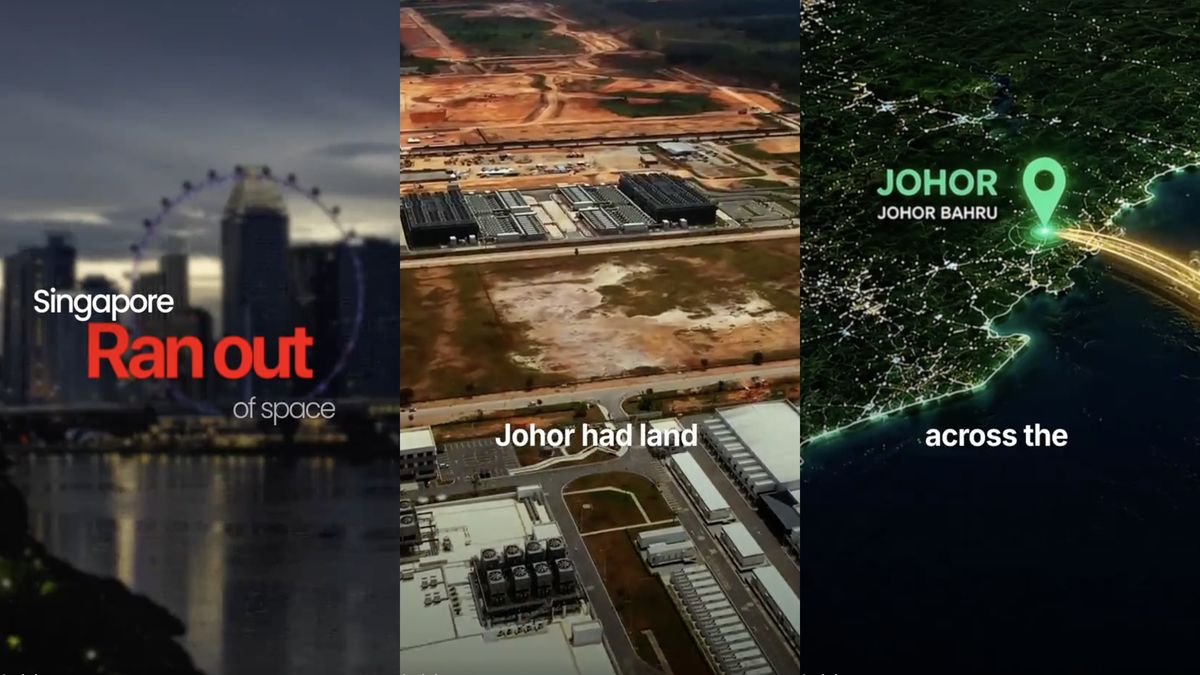
Billions invested, but how many jobs? Johor's data centre boom under scrutiny

JOHOR BAHRU: The data centre boom in Johor sounds exciting as tech giants pour billion-ringgit investments into Malaysia’s southernmost state, but how many locals will actually benefit from it?
In a TikTok video, Malaysian venture capitalist-turned EdTech and AI-native builder Deric Yee said the uncomfortable truth about Johor’s data centres is that the machines mostly run themselves, requiring only 50 to 200 permanent staff.
“The value only goes to people who are actually ready for it. The high-paying jobs will go to whoever has the skills, whether it’s cloud, software engineering, AI infrastructure, DevOps, etc.”
Johor, which is just across the Causeway from land-scarce Singapore, became the fastest-growing data centre market in Southeast Asia, with large investments from tech giants including Nvidia and Microsoft.
Boom raises questions over local job gains
Earlier this year, the state became Malaysia’s fastest-rising investment hub, attracting RM110 billion (S$35.5 billion) in approved investments, thanks to AI and data centres.
However, to accommodate these huge investments, Johor’s resources have come under increasing pressure. On Wednesday (June 24), The New Straits Times reported that the Malaysian government plans to develop dams, riverbank water storage schemes, barrages and raw water transfer infrastructure due to rising water demand there.
Still, the question remains whether these huge investments will translate into opportunities for locals.
Sara Loo, Associate Research Officer with the Malaysia Studies Programme at the ISEAS – Yusof Ishak Institute, said in a Fulcrum commentary in December that the promise of data centre job creation, especially those requiring technical skills, may be “illusory”.
Data centres, according to her, are similar to traditional infrastructure projects such as highways or bridges, whose primary value lies in utility rather than long-term job creation.
Limited job creation despite major investment
The Business Times reported earlier this year, citing a chairman of one of Johor’s development committees, that the state had approved 51 data centre projects as of November 2025.
Based on this, an aggressive estimate of 200 employees per data centre would translate to about 10,000 jobs, while assuming just 50 workers per facility would result in only about 2,500 jobs.
In addition, Ms Loo said that big tech companies traditionally preferred to import foreign talent for higher-end roles, as practised by companies like Microsoft, which reportedly brought in outside technicians for its Boydton, Virginia data centre investment, resulting in only 25 local hires.
Newsletter
Get updates straight to your inbox
Demand for skilled workers, however, particularly in the construction industry, will remain strong to support data centre buildout, she added.
Johoreans commenting on Mr Yee’s video shared similar concerns, including whether the state could keep up with the water, land and electricity demands of data centres, as well as rising electricity and water bills.
One commenter said, “What’s the point? They build data centres in Malaysia and use Malaysian labourers for most blue-collar jobs. The one gaining is not Malaysia in the long run.”
“Malaysia is picking up rubbish others don't want,” another added. /TISG