
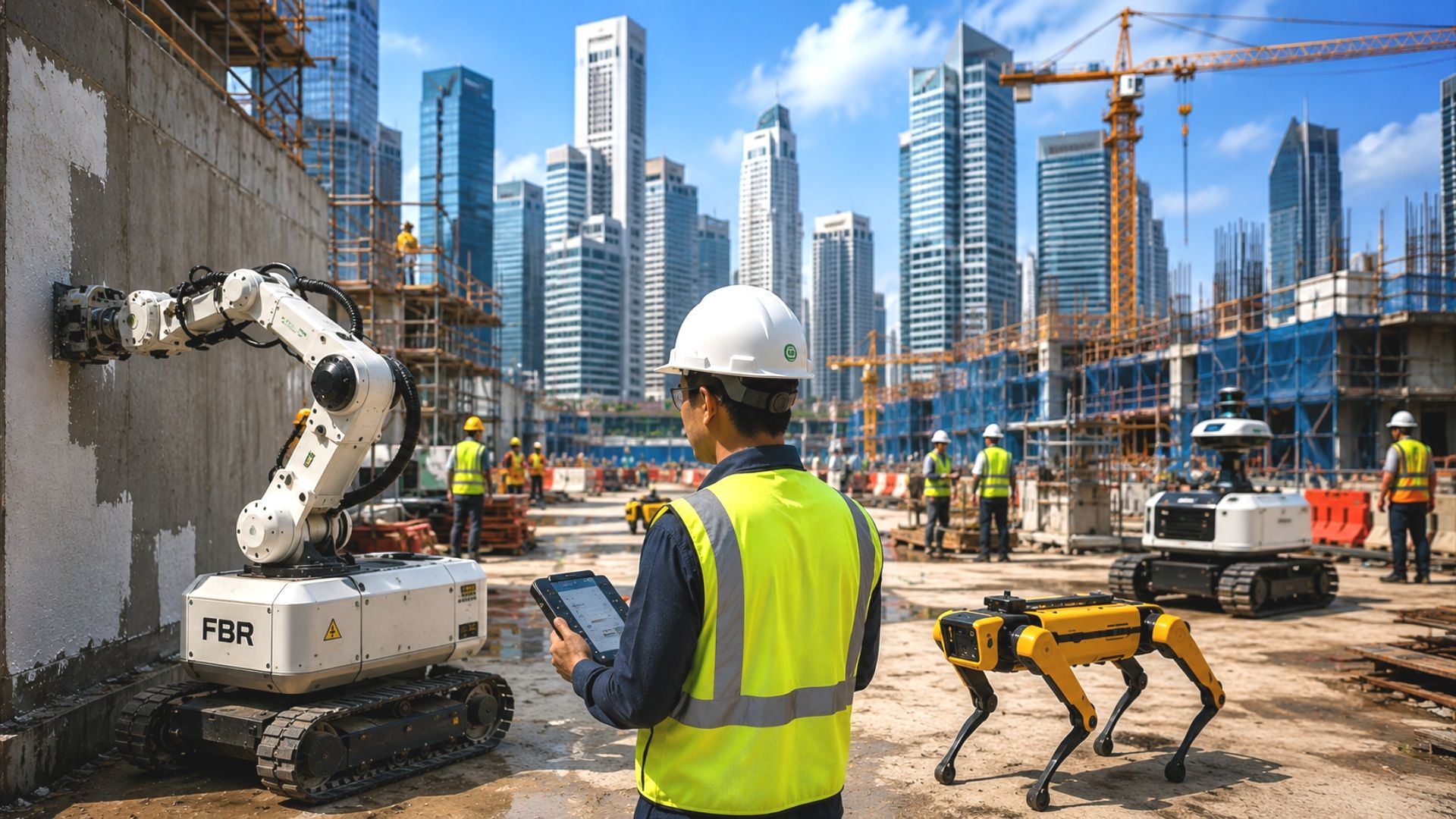

SINGAPORE: Singapore’s construction firms are bringing more robots onto worksites as they try to ease manpower shortages, raise productivity and make the industry more appealing to younger workers.
Painting robots, tunnel-drilling machines and other automated equipment are now being used across about 60 construction projects, though robots still account for only a small part of major developments.
The shift isn’t about replacing workers overnight. Instead, builders see robots handling repetitive and physically demanding work while people focus on operating, maintaining and managing the technology, Malay Mail reported (July 12), citing The Straits Times.
Robots aim to make construction work more attractive
Construction has long struggled to attract local workers because of its physically demanding nature. Edmund Ng, founder of Seng Soon Huat Construction, said the company began using painting robots in 2025 to change that image.
Rather than spending long hours doing strenuous work, employees can supervise the machines instead. The company says one worker overseeing three painting robots can complete work that previously required six workers.
Mr Ng believes the real breakthrough will come when a single local worker can manage even more robots, reducing reliance on manual labour while creating higher-skilled roles.
Foreign workers still form the backbone of the sector
Automation is arriving while Singapore’s construction industry continues to depend heavily on foreign workers. Non-residents made up nearly four in five of the industry’s 566,800 workers at the end of 2025.
Public agencies are encouraging the adoption of robotics. The Housing & Development Board (HDB) and JTC Corporation have introduced requirements and pilot projects, reducing manpower needs and improving productivity across construction sites.
High costs keep many companies cautious
Despite the interest, robots don’t come cheaply. Painting robots cost between S$80,000 and S$180,000, depending on their capabilities. Contractors also worry about spending heavily on equipment that could become outdated as newer technology enters the market.
Andy Lu, assistant secretary-general of the Singapore Contractors Association Limited, said many firms are cautious because some robotic systems have yet to prove themselves in real construction environments.
Limited after-sales support also makes companies think twice before making major investments.
Humans will still play a central role
Industry players don’t expect robots to replace construction workers anytime soon. Machines still need people to make decisions, carry out maintenance and deal with work that requires judgment or flexibility.
The industry’s direction is moving towards humans and robots working together instead of competing with each other. One example comes from Japan, where Kajima Corporation demonstrated a dam project using 14 automated construction vehicles controlled remotely by just three operators located about 400km away.
Mr Lu said companies that embrace new technology early will be in a stronger position than those that wait too long to adapt.
Singapore’s construction industry has relied on manpower for decades, but robotics could gradually change the type of work people do rather than eliminate jobs altogether.
If technology can make construction safer, less physically demanding and more skilled, it may become a career that appeals to more young people. The challenge now is making sure the technology is reliable, affordable and practical enough for firms of every size to adopt.
 Follow Google News
 Join us on WhatsApp
 Follow us on Telegram