
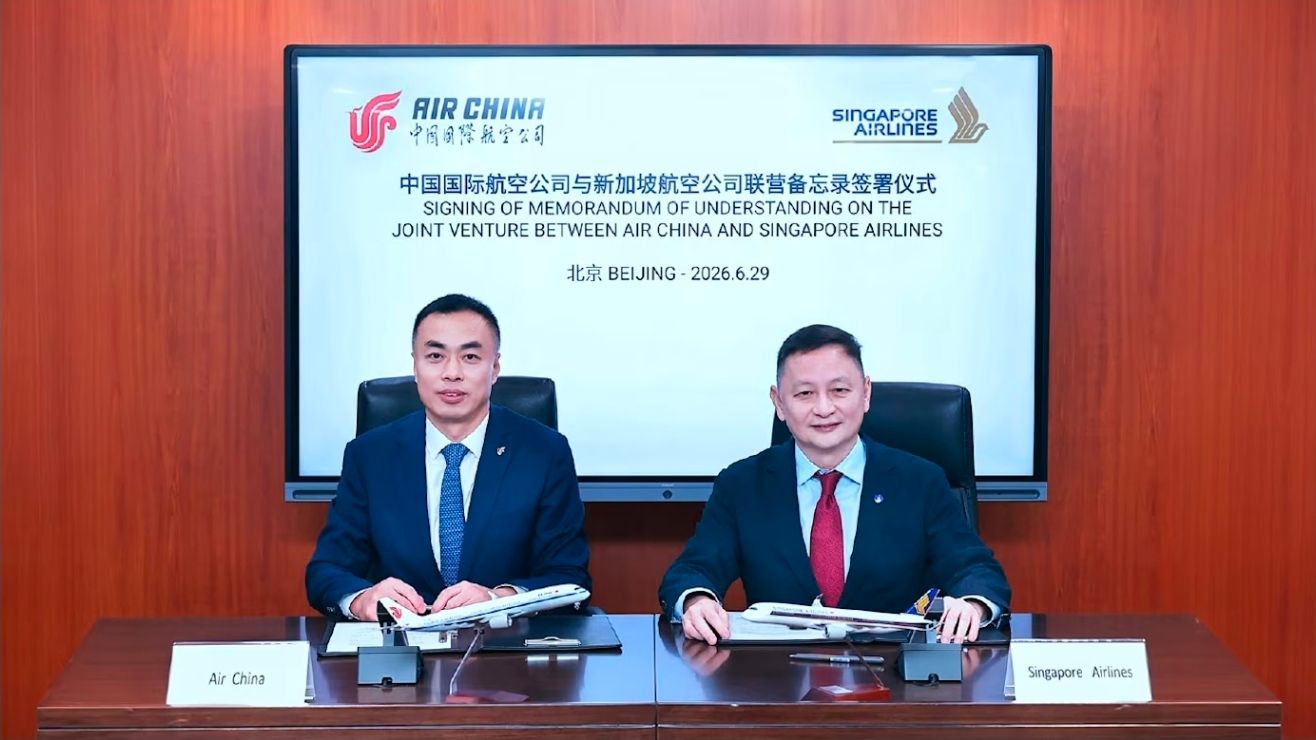

SINGAPORE: Singapore Airlines (SIA) and Air China are set to deepen their partnership after signing a memorandum of understanding (MOU) to establish a commercial joint venture aimed at strengthening air connectivity between Singapore and China.
The agreement was signed in Beijing on June 29 by the two Star Alliance members and marks the latest step in a partnership that has been in place for nearly a decade.
SIA and Air China have been operating joint flights on selected routes since 2016. Currently, the arrangement covers direct services between Singapore and four cities in mainland China: Beijing, Chengdu, Chongqing and Shanghai.
The airlines said in a joint statement that the proposed venture will see the two carriers work together more closely across several areas of their operations. This includes coordinating flight schedules and fares, expanding their codeshare network, and improving benefits for members of their respective frequent flyer programmes.
The airlines also intend to broaden their existing codeshare agreement beyond the current routes. Plans include adding more services between Singapore and mainland China, expanding connections within China, and offering passengers access to destinations outside both countries through the combined network.
As part of the collaboration, SIA and Air China will explore the introduction of joint fare products, while also pursuing joint marketing initiatives and revenue-sharing arrangements. The companies noted that these plans remain subject to regulatory approval.
Beyond commercial cooperation, the airlines said they will exchange operational expertise and best practices in areas including ground handling, in-flight catering and onboard service, with the aim of enhancing the overall passenger experience.
Aside from its links with Air China, SIA also shares a deep relationship with Air India, despite the Indian carrier’s drag on its earnings.
The relationship between the two airlines dates back more than a decade. In 2013, SIA partnered with Indian conglomerate Tata Sons to establish Vistara, a full-service carrier that began operations in 2015. Under the joint venture, Tata held a 51 per cent stake while SIA owned the remaining 49 per cent.
In 2022, Tata Sons reacquired Air India from the Indian government, returning the airline to the Tata Group nearly 70 years after it had been nationalised. Later that year, Tata announced plans to merge Vistara into Air India as part of a wider consolidation of its aviation business.
Under the merger agreement, which was completed on Nov 12, 2024, SIA invested additional capital into the enlarged airline group and received a 25.1 per cent stake in Air India, while Tata retained the remaining 74.9 per cent.
The investment has yet to pay off for SIA. Since SIA began accounting for its share of Air India’s results in 2024, the Indian carrier has weighed on the group’s earnings for about five consecutive quarters.
In May, SIA reported record revenue of SG$20.5 billion for the financial year ended 31 March, driven by stronger passenger demand, improved yields and lower full-year net fuel costs. Operating profit rose 39 per cent to SG$2.38 billion.
Despite the strong operating performance, the airline’s net profit fell 57.4 per cent year on year to SG$1.18 billion. The decline was attributed mainly to Air India’s losses, as well as an accounting gain recorded in the previous financial year.
Air India posted a loss of SG$3.56 billion, or about US$2.8 billion, substantially higher than the US$2.4 billion loss forecast by Bloomberg in April. SIA’s share of that loss amounted to SG$945.2 million.
Even so, SIA has made clear that it remains committed to supporting Air India’s turnaround.
Speaking at the airline’s earnings briefing in May, Chief Executive Officer Goh Choon Phong said Air India had made “tangible progress” in its transformation programme but cautioned that the recovery would take time.
“It is going to be a long game. There is no shortcut,” he said, adding that SIA would continue to support its Indian partner.
 Follow Google News
 Join us on WhatsApp
 Follow us on Telegram