
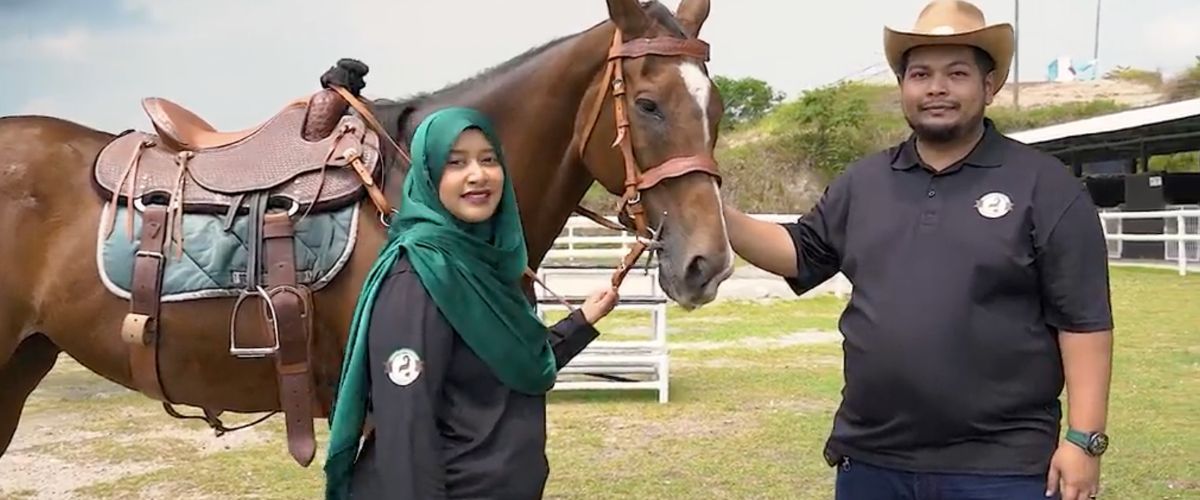

JOHOR BAHRU: For Nabilah Bagarib and her husband Ashraf Bakar, the daily grind used to look like many Singaporeans in the corporate space: desks, deadlines, and perhaps the occasional traffic jam on the way home. Today, their workplace has evolved to a sprawling farm in Johor Bahru, Malaysia, where their view includes cows, sheep, goats, and even camels.
Their story, featured by Channel NewsAsia (CNA), has been making the rounds online, striking a chord with Singaporeans who’ve spent the last few years quietly wondering if there’s a different way to live.
From corporate life to a backyard full of sheep
The couple’s journey started small. Back in 2015, they began with just a modest sheep-rearing operation in Mersing, naming their business after Nabilah’s mother, who, according to CNA, was also their first investor. As the herd grew, they relocated to a bigger plot in Desaru in 2017.
What started as a side project has since grown into a farm covering land equivalent to roughly 150 football fields, now home to hundreds of sheep alongside other livestock, and offering agro-tourism experiences for visitors.
Nabilah, who was a former psychologist, has been candid on why the move made sense both for her family and, in her view, for the region.
Many people might romanticise their story, but here’s the part that often gets lost in the ‘ditched my desk job’ narrative: it took a while for the business to become what it is today. Nabilah was candid about the challenges they faced. Speaking to CNA, she stated, “The challenges in running a business are very real… if you want to have a business in Malaysia, you have to have a trusted partner, and also [a] trusted staff.” This highlights that the journey was far from smooth sailing, as the couple had to contend with unreliable partners during the early stages of the business.
Furthermore, this isn’t a hobby farm anymore. Aliyah Rizq has grown into a regional operation with partnerships extending into other countries. The farm also plays a role in supplying halal meat for religious occasions like aqiqah and qurban, which are services with steady demand from Muslim communities in both Malaysia and Singapore.
In other words, what began as a personal pivot has quietly turned into part of the supply chain that some Singaporean households already rely on, even if they’ve never set foot on the farm itself.
Netizens weigh in
As the story made its way around social media, comments poured in, and they ranged from admiration to a healthy dose of realism.
Many were quick to applaud the couple’s leap of faith. “Wow! Awesome! It takes conviction, commitment, and daring enough to take risks,” one Facebook commenter wrote.
Others used the story as an opportunity to vent about corporate life itself. “Nothing great about corporate life to make it such a great thing when someone chooses to leave it behind. There is no life in [a] corporate setup,” another netizen said.
But not everyone was swept up in the romance of farm life. One commenter pointed out that running a profitable farm is far from straightforward: “Good to see this couple is doing well because it is not easy starting a farm as prices are controlled by middlemen and why farming needs to be done on [sic] scale to see profits if not you are just playing social media farmer.”
Still, the overall sentiment leaned positive, with one user summing it up simply: “There are people who are willing to do the hard work.”
Why this matters for Singaporeans right now
The “Singaporean couple swaps corporate life for farm life in Malaysia” narrative isn’t new, but the timing of this particular story matters.
With the Johor-Singapore Special Economic Zone pushing closer to cross-border integration, and more Singaporeans already making regular trips across the Causeway for cheaper land, food, and a slower pace of life, stories like Nabilah and Ashraf’s offer something beyond inspiration. They’re an early signal of how Singapore-Malaysia economic ties might evolve at a grassroots level, not just through big corporate investments, but through individual Singaporeans building businesses just across the border that loop back into Singapore’s own food supply and halal certification networks.
For some, it may be a story about courage and lifestyle change. For others, it might be a quiet preview of where some Singaporean capital, skills, and even retirement plans are headed next. Instead of going abroad, as some people might traditionally do, perhaps the future is just one drive away.
 Follow Google News
 Join us on WhatsApp
 Follow us on Telegram