


SINGAPORE: New data from Singapore’s Ministry of Manpower (MOM) shows that workers in Administrative & Support Services enjoyed the strongest wage growth in 2025, outpacing employees in finance, insurance and several other traditionally higher-paying industries.
The figures come from MOM’s Report on Wage Practices 2025, released on May 28, and offer a closer look at how salaries moved across different sectors over the past two years.
Earlier this year, MOM reported that Singapore’s median monthly salary rose to S$5,775 in 2025, a 5% increase from 2024. The latest breakdown shows that the gains were far from uniform.
Support services came out on top
According to the MOM data, workers in Administrative & Support Services received average wage increases of 7.5% in 2025, making the sector the strongest performer among all major industries.
At the other end of the table were Accommodation and Food & Beverage (F&B) Services, which recorded the slowest salary growth.
Finance and insurance jobs are associated with higher pay packages, yet their wage growth over the past two years hasn’t kept pace with that in support services.
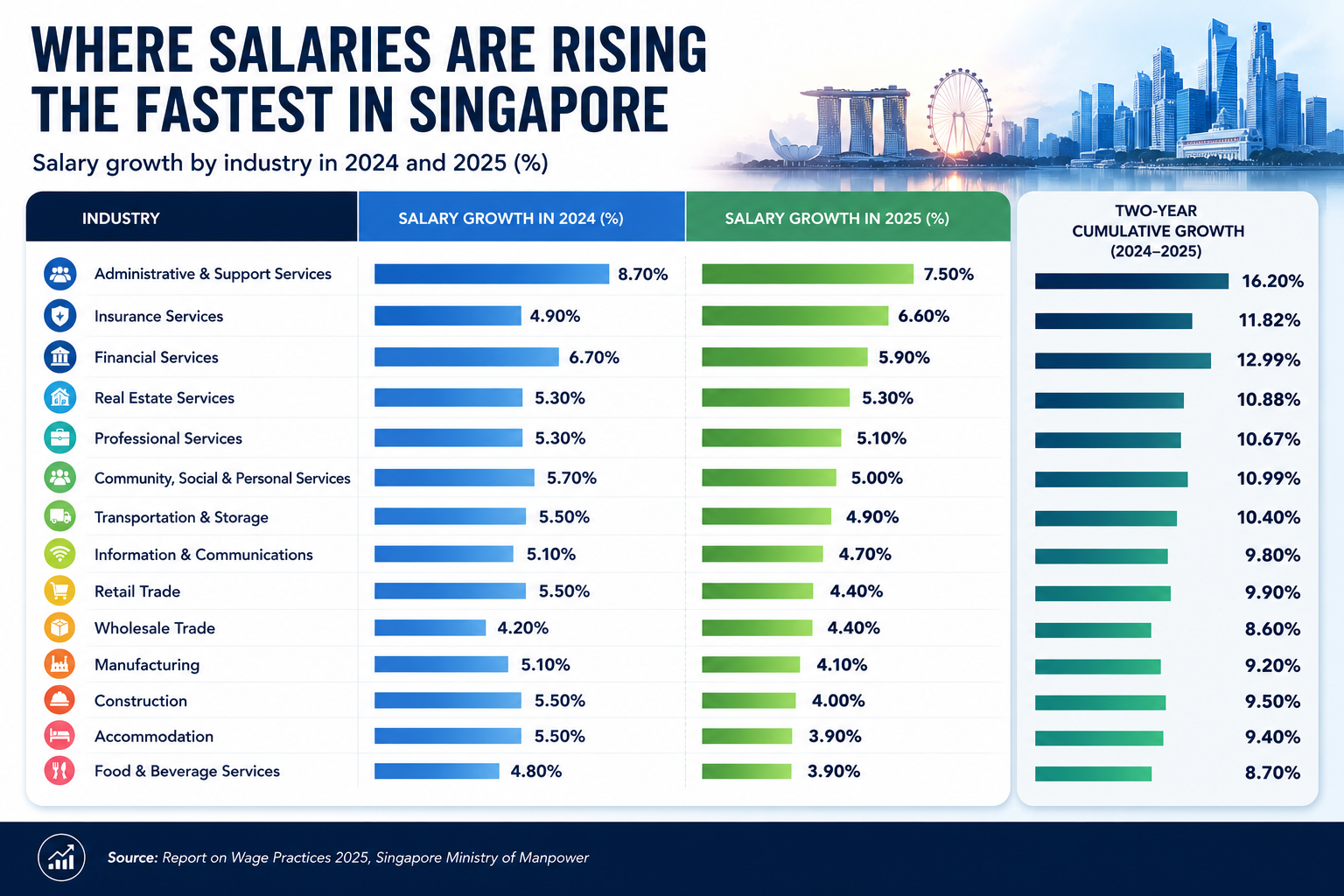
The findings show that salary growth and salary size aren’t always the same. A sector can offer high pay while still recording slower annual increases than industries playing catch-up.
Two years of gains add up
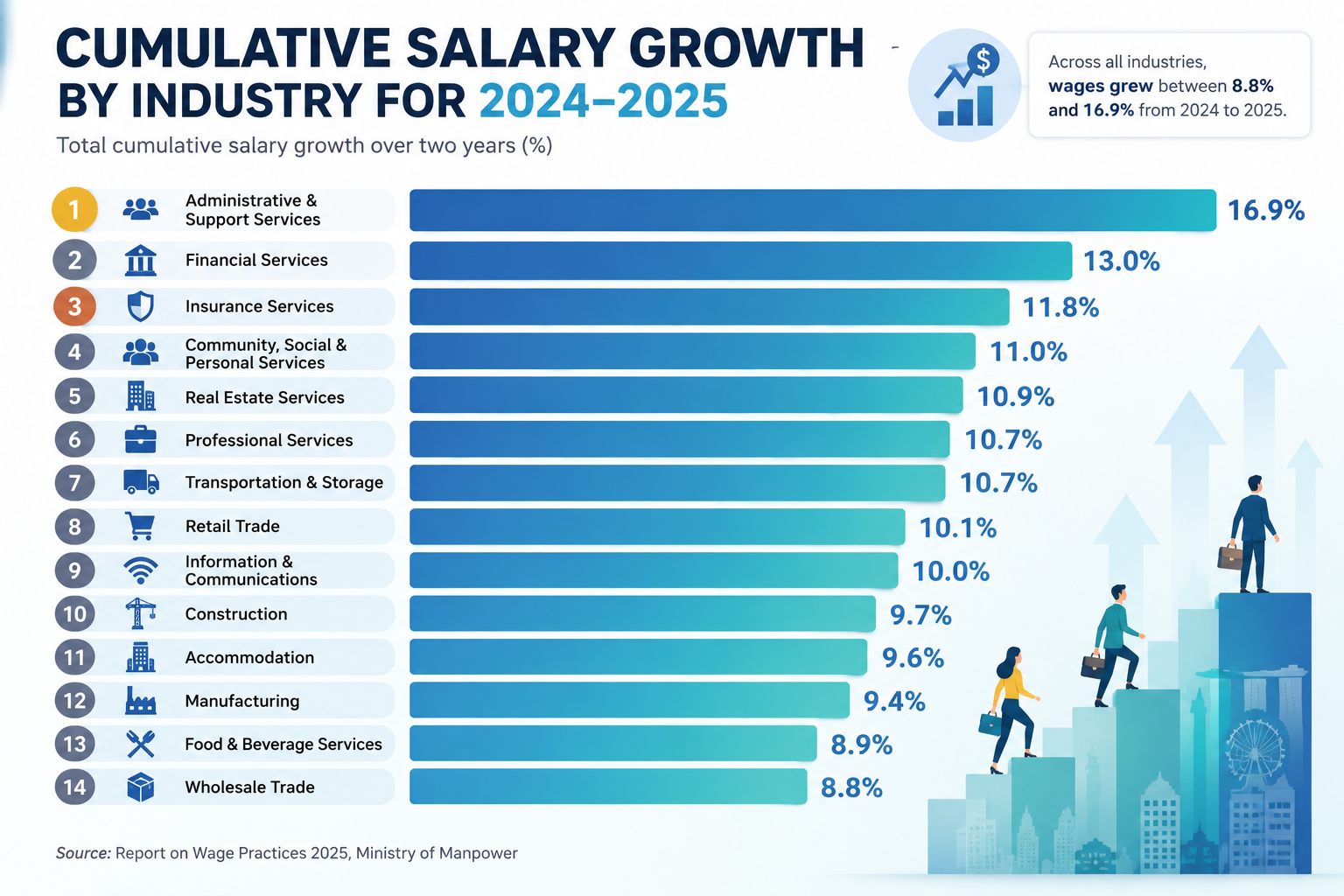
Looking at cumulative wage growth from 2024 and 2025 paints an even clearer picture. Workers in Administrative & Support Services saw wages rise by nearly 17% over the two-year period. In practical terms, that amounts to roughly two extra months of 2023 salary spread across the period.
Workers in sectors near the bottom of the rankings still experienced gains, though at a slower pace. Their cumulative wage growth ranged between about 8% and 9%, equivalent to roughly one additional month of 2023 income.
One notable change involved Wholesale Trade. While it slipped to the bottom of the cumulative rankings, the sector may be positioned for a stronger recovery.
According to the data, rising demand linked to electronics manufacturing and artificial intelligence (AI) has boosted trading activity and improved sentiment within the industry.
The wage outlook for 2026 remains mixed
Singapore’s economy expanded by 6% in the first quarter of the year, showing strength across multiple sectors. Yet businesses are also facing uncertainty stemming from geopolitical tensions and disruptions affecting trade and energy markets, which may make employers more cautious when deciding on salary increases.
Workers in electronics manufacturing and wholesale trade could be among the better-positioned groups if current industry trends continue. Strong demand tied to AI-related supply chains has helped drive activity, and profitable companies may have more room to reward staff.
For many other sectors, however, wage growth could depend on how global economic conditions develop over the coming months.
Number averages only tell part of the story
The latest MOM figures show why headline salary numbers never tell the whole story. A rising national median wage is encouraging, but workers experience the economy differently depending on where they work.
For employees, the report offers a useful benchmark. For employers, it serves as a snapshot of where competition for talent is heating up.
As always, salary growth is strongest when businesses perform well, and workers continue to build valuable skills. Economic conditions matter, but so does staying adaptable in a changing job market.
Read related: MOM: Wage growth slowed down for workers in Singapore last year compared with 2024; expected to stay moderate in 2026
 Follow Google News
 Join us on WhatsApp
 Follow us on Telegram