
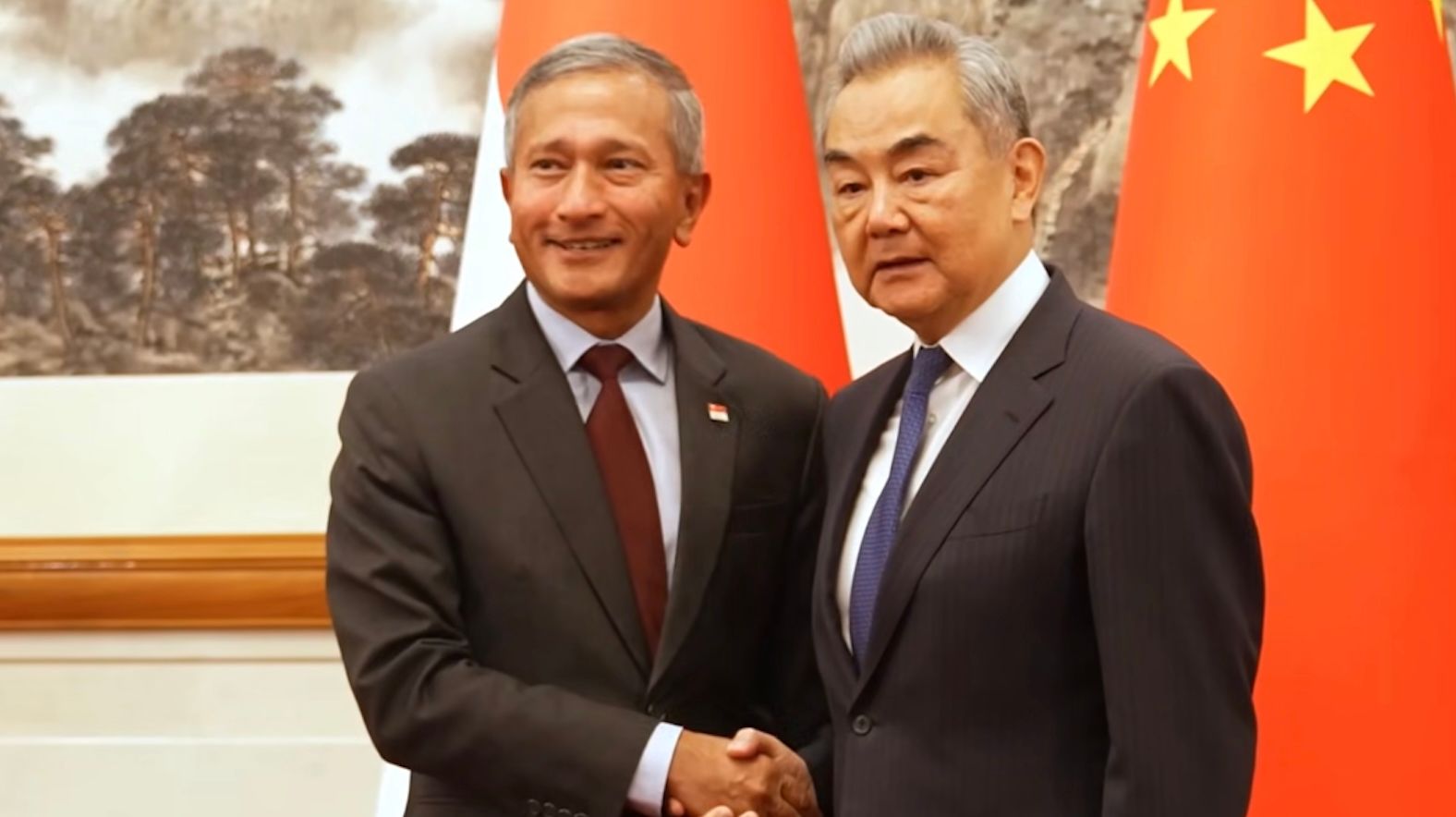

SINGAPORE: During Foreign Affairs Minister Vivian Balakrishnan’s visit to China this week, he met with his counterpart in Beijing, Wang Yi, to discuss a number of topics, including the unhindered passage of maritime vessels through straits used for international navigation.
The two countries affirmed their commitment to keep the Strait of Malacca open.
The issue has become a relevant one due to the conflict in the Middle East, which began on Feb 28 when the United States and Israel started bombing Iran. This has resulted in the closure of the Strait of Hormuz, an important chokepoint through which flows around 20% of the world’s fuel supply. What followed has been a global energy crisis that has particularly affected Asia, toward which much of the oil and gas supply transiting over the Hormuz had been headed.
The war in the Middle East has also led to concerns that the Strait of Malacca, which is controlled and bordered by Indonesia, Malaysia, and Singapore, may be similarly affected should conflicts arise in the region.
After all, the Strait of Malacca may arguably be considered even more important than Hormuz. Considered as a vital highway connecting the Indian Ocean to the Pacific Ocean, more than 35% of the world’s supply of oil transported by sea passes through the Strait of Malacca, making it critical to the supply of energy for Asia. Moreover, as much as 40% of the world’s traded goods pass through the Strait.
Singapore & China
“The Ministers reaffirmed the importance of international law, including the United Nations Convention of the Law of the Sea (UNCLOS) and the UN Charter, and the right to freedom of passage in international waterways. They agreed that all ships and aircraft should enjoy the right of unimpeded transit passage in Straits Used for International Navigation,” reads a May 25 press statement from Singapore’s Ministry of Foreign Affairs.
A report from the South China Morning Post was more specific, saying that Dr Balakrishnan told Mr Wang that Singapore supports “free passage through the strait and other international waterways.” The Chinese Foreign Minister, meanwhile, said that maintaining secure maritime traffic and stable supply chains is “a shared aspiration of all countries.”
Minister Balakrishnan also wrote in a Facebook post that Singapore and China agreed that an immediate ceasefire in the Middle East is necessary, and both countries emphasised the importance of resuming maritime traffic flows through the Strait of Hormuz. /TISG
Read also: Singapore, Malaysia, and Indonesia pledge to protect Strait of Malacca; US warship seen transiting
 Follow Google News
 Join us on WhatsApp
 Follow us on Telegram