
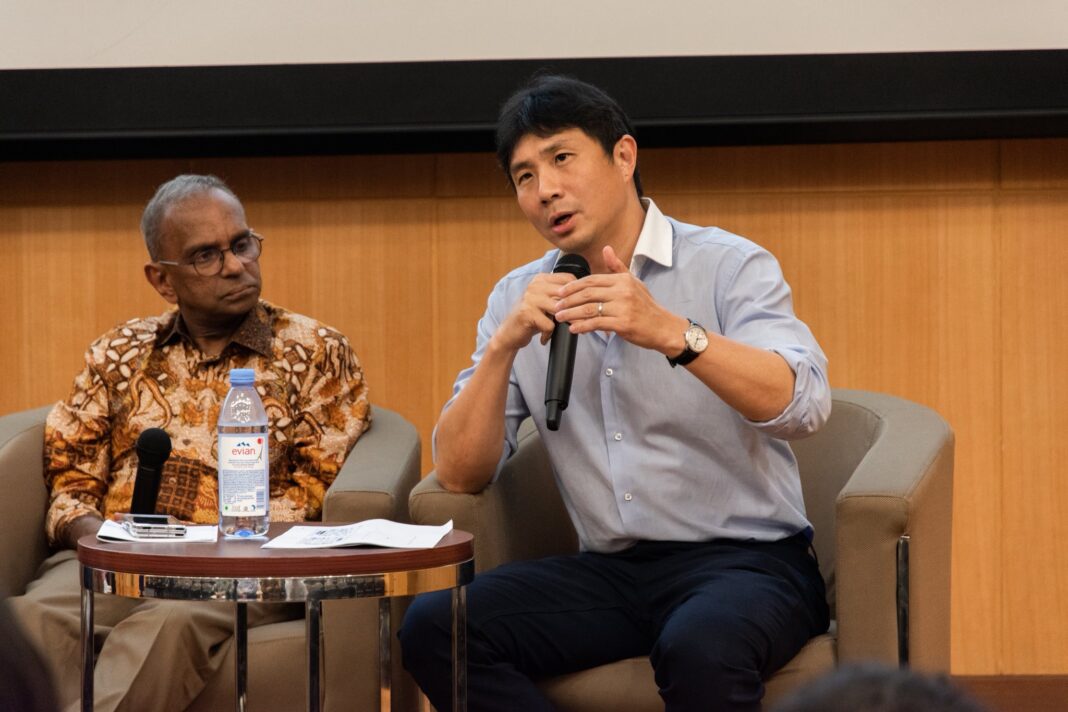

SINGAPORE: Workers’ Party Member of Parliament Jamus Lim donned his academic’s hat for a recent discussion, held by the SMU Economics Intelligence CluB, on the future of Singapore amid the global economy
The Sengkang MP, an Associate Professor of Economics at ESSEC Business School, joined economists Taimur Baig, Manu Baskaran, and Darren Tay as judges and panellists at the closing session of the club’s Future Economy Forum (FEF) in August.
The FEF is an undergraduate macroeconomic research case competition and symposium and is meant to simulate how an economic think tank works, as well as advance research in macroeconomics among undergraduates from different universities in Singapore.

Assoc Prof Lim wrote that the panellists offered different perspectives regarding Singapore’s future amid changes in tariffs and trade flows, with some expressing more concern than others.
He wrote that he is “on the more cautious side, and has held the view for a while now that the future of world trade will lean towards regional blocs, rather than the hyperglobalisation we witnessed in the 1990s through 2010s.”
The panel also tackled the hot topic of artificial intelligence in relation to the future of the workforce, about which Assoc Prof Lim, though still cautious, is a little more optimistic.
“For starters, history tells us that the productivity gains and job displacement risks of any general-purpose technology—AI included—are almost always overstated. This is quite understandable. When novel ideas and tech get introduced, they are often adopted by the most excited boosters, and their benefits viewed from the lens of their most enthusiastic early adopters.”
He predicted that when AI becomes part of the workplace and economy, GDP gains are likely to be around 1 to 2 per cent yearly.
Nevertheless, he acknowledged the effect of AI’s short-term upheaval to the workforce at present, writing, “The world has never really confronted a technological shock that potentially displaces the top end of the skills and education distribution—up till now, you could always upgrade or reskill to something different, but almost always a more ‘qualified’ or ‘credentialed’ position (usually defined as requiring more cognitive abilities).”
AI, however, has disrupted this, which means that a different set of skills is needed, such as “networking, marketing, and sales, human traits like creativity, empathy, and intuition, or perhaps artisan talents like fine motor movements, individual personalisation, and cultural expression”.
Assoc Prof Lim added that these skills are not stressed enough in Singapore’s educational system, which leans heavily towards academics. He ended his post by writing, “But to survive in the unfolding AI future, we’ll need to.” /TISG
 Follow Google News
 Join us on WhatsApp
 Follow us on Telegram