

By David Ngiau
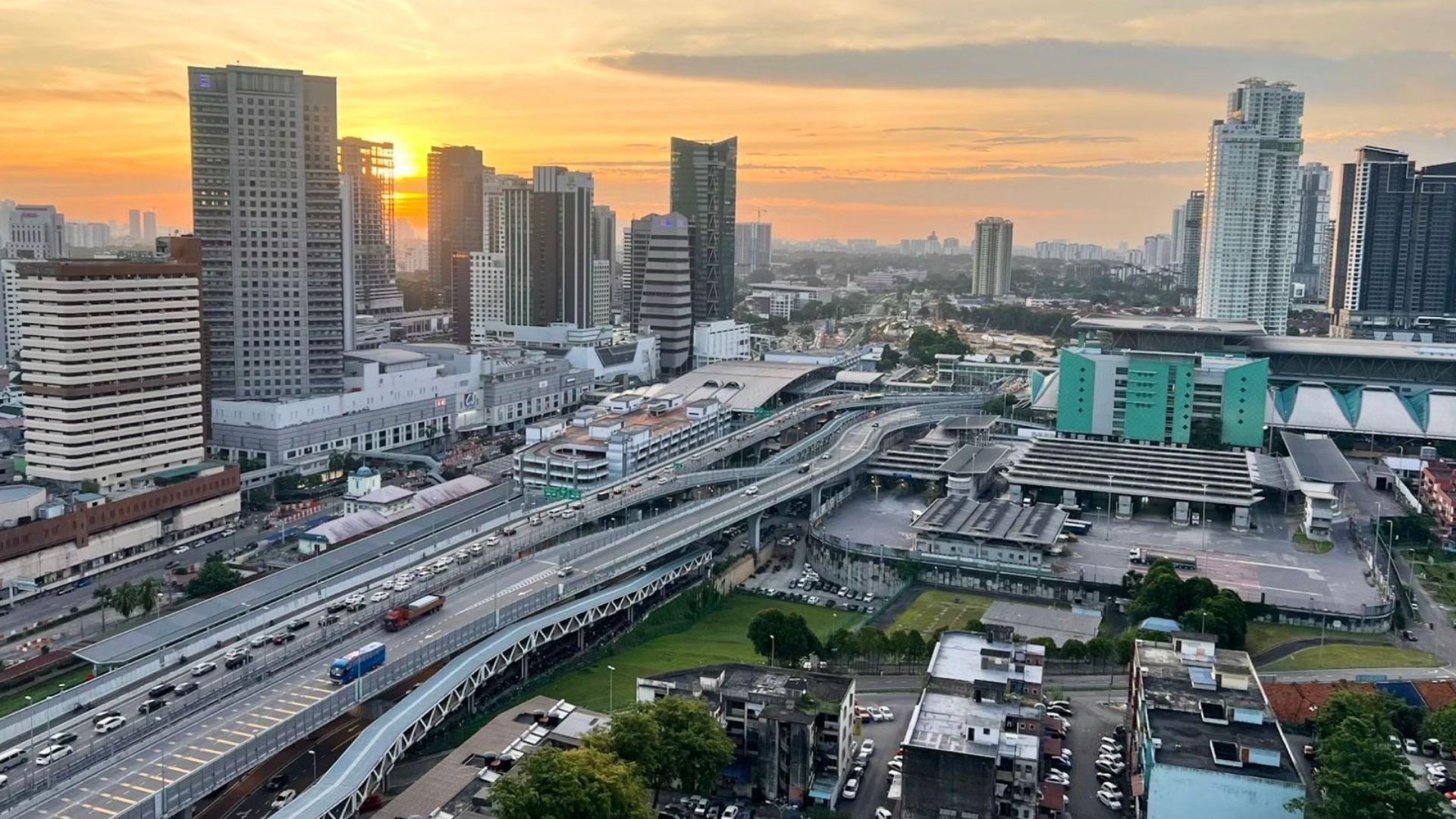
If you happen to cross the Causeway or drive along the elevated tracks near R&F Mall in downtown Johor Bahru (JB) these days, you might catch a heart-warming sight cutting through the city’s skyline: A sleek, silver Rapid Transit System (RTS) train quietly skimming along the elevated track. The much-anticipated rail link, due to go online in early 2027, just began integration and signalling tests in mid-June.
For those accustomed to the decades of grinding, gridlocked misery that defines the Causeway, watching that physical vehicle move across the infrastructure is more than just a milestone. It is a visual promise that the long-prophesied economic symbiosis between Singapore and Johor is finally materialising — and for a Singaporean watching petrol, rent, and grocery prices climb at home, that promise is starting to look less like scenery and more like an exit ramp.
Just as the tracks are being laid to tether these two territories closer than ever before, Johor itself is heading to the ballot box. On July 11, the state goes to early polls. To the casual observer in Singapore, the local horse-trading, candidate shifting, and campaign flags might look like a pedestrian, insular affair — somebody else’s election, somebody else’s problem. In a dramatic twist, Barisan Nasional (BN) has broken ranks with its federal Madani (unity) Government allies to contest all 56 seats on its own, leaving Prime Minister Anwar Ibrahim to manage the fallout in Putrajaya. It is tempting to file that under “Malaysian politics, business as usual” and move on.
That would be a mistake. For a regional audience — and specifically for Singaporeans now treating Johor less as a weekend grocery run and more as a long-term hedge against the cost of living at home — the outcome of this vote has a direct bearing on whether the bet they’re quietly placing on JB pays off. This election is not just about who wins the state assembly; it is about whether Johor can hold the line as a hyper-pragmatic, pluralistic southern fortress, even as the rest of the peninsula drifts toward a more conservative, nationalist political settlement.
The ‘Green Wave’ from the far north
The anxieties shaping Malaysian politics are not unique to Malaysia. Across the world, a defensive swing to the right — from Europe’s conservative resurgence to populist movements further west — reflects a broader unease about globalisation moving faster than people can absorb it. In Malaysia, this shows up as the “Green Wave”: The steady electoral advance of the Islamist party PAS (Parti Islam Se-Malaysia).
The standard Western liberal assumption has long been that prosperity is the cure for cultural conservatism — fill people’s bellies, and their minds open to pluralism. Malaysia is quietly disproving that. Wealth here seems to be funding a more confident, better-resourced traditionalism rather than dissolving it, tracking closer to a Gulf-style pattern where growth and religious conservatism advance together rather than trading off against each other.
The “Green Wave” is no longer just a story of rural Kelantan and Terengganu. It has taken hold among the urban, educated, affluent Malay middle class in states like Selangor — voters who are doing well financially but remain anxious about preserving their cultural and political standing in a country where Malay political power has fractured badly since 2018. To many of them, PAS now reads as the only uncorrupted anchor left standing.
Except, so far, in Johor.
The southern oasis
Johor has always run on a different frequency. Two things have historically kept the Green Wave out: The moderating hand of the Johor Palace — the Sultan, currently serving as Malaysia’s King, and the Regent, both of whom have consistently refused to let race or religion be weaponised in state politics — and the sheer organisational weight of UMNO, the dominant party within BN, which was born in Johor and has never really left.
That second point matters more than is usually acknowledged. It is one thing to credit royal restraint and a strong regional identity for keeping hyper-piety at bay; it is another, more mundane thing to note that BN has pulled a remarkably consistent turnout of around 600,000 votes across the last three elections in the state, an organisational machine that PAS, historically weak in Johor without a strong coalition partner, has never matched. The palace sets the tone. UMNO’s ground game does the work.
By calling this early mandate, caretaker Menteri Besar Onn Hafiz Ghazi and the state’s establishment are betting that both forces hold: that voters can be kept onside through economic delivery rather than religious appeal, and that the machine can get them to the polling stations to prove it.
For Singapore, that bet is not academic. A government in Johor that stays moderate and stays focused on cross-border integration is the difference between JB remaining a viable long-term option and the state becoming just another front in Malaysia’s identity politics — with consequences for everything from the JS-SEZ to the daily commute across the Causeway.
The sweet spot Singapore actually needs
This is where the geography matters as much as the politics. Kuala Lumpur has historically been the default destination for commercial expansion into Malaysia, but it is currently weighed down by fractured federal coalitions and a constant cultural tug-of-war with the conservative north. Singapore, meanwhile, is a financial apex trapped by its own success — prohibitively expensive, land-starved, and increasingly out of reach for middle-class lifestyle security, which is precisely why the hyperscale data centres serving it have been going up by the dozen just across the Straits in Gelang Patah.
Johor has positioned itself as the compromise between the two: Close enough to draw on Singapore’s capital and efficiency, large enough to offer the land and workforce Singapore doesn’t have, and — crucially — politically distinct enough from KL to avoid getting dragged into the federal-level tug-of-war over Islamisation. The numbers back the pitch. Star Property, citing National Property Information Centre (Napic) data, reported in late March that Johor had decoupled from the national property market entirely, posting 5.3 per cent annual price appreciation against a national average of 0.7 per cent — language the outlet itself described as a shift “from speculation to a high-velocity reality”.
That kind of decoupling is exactly what you’d expect if investors are treating Johor’s political stability as a premium worth paying for, not just its proximity to Singapore.
That premium is the thing actually at stake on July 11. JS-SEZ momentum, FDI confidence, and the RTS timeline all assume a Johor government secure enough to keep delivering without distraction. A muddled result — BN underperforming its own 40-seat benchmark, a fractured assembly, anything that hands Putrajaya or the northern coalitions more leverage over the state — would not derail any of this overnight, but it would dent the certainty that has made Johor the obvious bet over the last two years.
What it means for the man on the street
Which brings the macro-politics back down to the ordinary Singaporean who’s weighing whether to make the move, or whether to keep treating JB as somewhere to fill up the tank and the fridge. The RTS test trains gliding past R&F Mall are a literal preview of how close that option is getting — early next year, by most estimates, commuting across the Causeway will look nothing like it does today.
But the political guarantee underneath that physical promise is still being negotiated, on July 11, at 1,076 polling centres across the state.
Even if the wider Malaysian peninsula spends the next decade or two drifting toward a more institutionalised, prosperous form of Islamisation — a trajectory the Gulf states have already shown is entirely compatible with continued economic growth — Johor’s bet is that its royal shield and its UMNO machine, working together, can keep it a secular-friendly, hyper-capitalist exception.
For the regional investor and the weary Singaporean alike, that exception is no longer just a neighbour’s internal affair. It’s the thing their own cost-of-living math increasingly depends on.
 Follow Google News
 Join us on WhatsApp
 Follow us on Telegram