

SINGAPORE: A year after Singapore’s 2025 General Election delivered some of the closest contests in recent memory, political observers and online commentators are already speculating that several battleground constituencies may not survive in their current form by the time voters next head to the polls.
Among the constituencies drawing the most attention are Jalan Kayu SMC and Tampines GRC, both of which saw tightly fought contests in GE2025 and remain politically active long after the campaign season ended. Some Singaporeans online are now predicting that the wards could eventually be merged, dissolved or significantly redrawn under Singapore’s electoral boundary review process ahead of the next election due by 2030.
The speculation comes as politicians from both the ruling People’s Action Party (PAP) and opposition parties continue intensive ground engagements in constituencies that saw narrow margins at the last election.
Jalan Kayu SMC, Tampines GRC, Sembawang West SMC, and Punggol GRC were among the most hotly contested wards during GE2025. Residents have since observed that PAP Members of Parliament (MPs), as well as unsuccessful opposition candidates, have maintained a visible presence through walkabouts, community events and resident engagement sessions.
Political analysts told The Straits Times they expect all four wards to remain competitive if the same candidates contest again at the next election.
In the Workers’ Party (WP)-contested constituencies of Jalan Kayu, Tampines, and Punggol, analysts said the continued activity reflects the party’s long-term electoral strategy of sustained ground engagement. The WP has previously credited years of groundwork for its successes in constituencies it currently holds in Singapore’s north-east.
Singapore Management University law don Eugene Tan told the newspaper that the relatively narrow PAP victories in some constituencies would likely encourage opposition parties to believe they have a realistic chance of winning those seats in future elections.
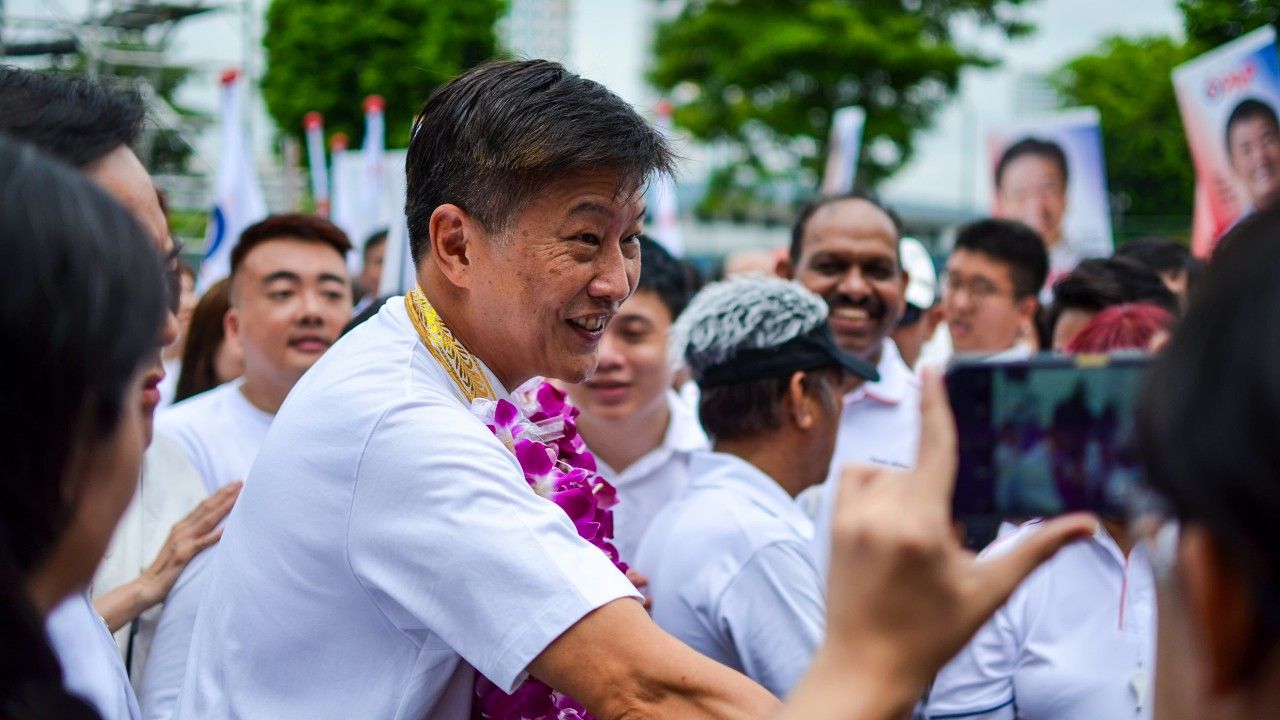
Jalan Kayu emerged as the closest contest of GE2025. Labour chief Ng Chee Meng narrowly defeated WP candidate Andre Low with 51.47% of the vote against 48.53%.
The constituency itself was newly created for GE2025 after being carved out of Ang Mo Kio GRC. Its previous MP, Gan Thiam Poh, retired before the election.
Residents told The Straits Times that both Mr Ng and Mr Low have remained active on the ground over the past year. Retiree Poh Lye Choo, 63, said she saw Mr Low during a Chinese New Year visit in 2026, while optometrist Eric Goh, 44, said Mr Ng had continued building on the work previously done by Mr Gan.
Mr Low, together with WP Tampines candidate Eileen Chong, also entered Parliament through the Non-Constituency MP scheme, giving both figures greater public visibility following the election.
In Tampines GRC, where the WP secured 47.37% of the vote, the party has continued distributing and selling its Hammer newsletter while conducting regular outreach activities in the constituency.
The WP has also organised “combined visits” in Tampines involving candidates from other constituencies, including Punggol and East Coast, joining walkabouts together.
Nearby Punggol GRC was another closely watched battleground. The WP obtained 44.83% of the vote against a PAP team led by Deputy Prime Minister (DPM) Gan Kim Yong.
DPM Gan’s move from Chua Chu Kang, where he had served since 2006, to helm the newly formed Punggol GRC was one of the major surprises of GE2025.
Since the election, he has launched a series of resident engagement initiatives, including a programme called “Date with Gan Kim Yong,” where he shares meals with families in the constituency. The initiative concluded in April, with DPM Gan saying a new series would be announced soon.
The WP’s Punggol team, which included senior counsel Harpreet Singh Nehal, has also remained active through monthly community walk-and-run events as well as nature outings for residents.
Sembawang West SMC also remains under scrutiny after Singapore Democratic Party chief Chee Soon Juan secured 46.82% of the vote against PAP candidate Poh Li San.
Ms Poh has since introduced monthly brunch sessions with residents at the Koufu foodcourt near Woodlands Mart, while Dr Chee has continued posting walkabout activities on social media, including visits to the area during the Christmas season in December 2025.
Even as analysts debate whether parties can realistically sustain such intensive groundwork over the next three to four years, online discussions have increasingly shifted towards another question: whether these constituencies will still exist in their current form at the next election.
On Reddit and other social media platforms, some Singaporeans openly predicted significant electoral boundary changes ahead of GE2030.
One commenter wrote that Jalan Kayu would “probably likely” be reabsorbed into Ang Mo Kio GRC because of population growth in the area. Another speculated that an “AMK North” constituency could potentially combine Jalan Kayu with parts of Punggol, while “AMK South” could absorb neighbouring areas.
Others were more blunt in their predictions. “I fully expect big boundary swings around these wards,” one netizen wrote, while another said: “100% Jalan Kayu will be absorbed into a GRC”. They added that this would be “nothing new.”
A number of netizens made reference to the Electoral Boundaries Review Committee (EBRC), a body convened before every general election in Singapore that has long been one of the country’s most closely watched political institutions.
Convened before every general election, the EBRC is appointed by the Prime Minister’s Office and tasked with reviewing and redrawing electoral boundaries across the country. The committee determines the size, number and composition of constituencies based on factors including demographic changes, population shifts and new housing developments.
The formation of the EBRC is widely viewed as a strong signal that an election is approaching. Once the committee releases its report, polling is often called within months or even weeks.
However, the EBRC has long faced criticism from opposition parties, political observers and some members of the public, who argue that the process lacks transparency and tends to favour the ruling PAP.
One recurring criticism is that the committee operates largely behind closed doors. The EBRC, chaired by the Secretary to the Prime Minister and comprising mainly senior civil servants, does not publicly provide detailed explanations for many of its decisions.
Critics have also questioned the committee’s independence because it is convened by the Prime Minister and reports directly to the Prime Minister’s Office, while the PAP remains the incumbent governing party.
In Singapore politics, EBRC announcements are treated almost like political earthquakes because constituency changes can dramatically alter electoral calculations. Critics have questioned why certain constituencies disappear entirely after closely fought elections, while others are absorbed into larger GRCs or significantly redrawn.
Over the years, several opposition strongholds or battlegrounds have undergone major changes following tight contests. Cheng San GRC, where the WP mounted a strong challenge in 1997, was later dissolved. Eunos GRC also disappeared after competitive elections, while Joo Chiat SMC, where the PAP narrowly retained the seat in 2011, was eventually absorbed into Marine Parade GRC.
More recently, Bukit Batok SMC was dissected and dissolved ahead of the 2025 general election. SDP’s Dr Chee, who had been walking the ground there for about a decade, decried the move and implied that the decision was due to his strong showing at the 2020 polls, where he won 45% of the vote.
While opposition politicians have repeatedly argued that boundary changes make it harder for them to build long-term support bases and maintain continuity with residents, the PAP government has consistently rejected allegations of political bias, maintaining that the EBRC’s decisions are made professionally and based on administrative and demographic considerations rather than partisan calculations.
Government leaders have defended the committee as impartial, pointing to Singapore’s rapid population changes and evolving urban landscape as reasons why regular reviews are necessary.
Despite those assurances, every EBRC report continues to generate intense public scrutiny, with Singaporeans closely analysing how constituencies have been carved and debating what those changes could mean for both the PAP and opposition parties at the polls.
 Follow Google News
 Join us on WhatsApp
 Follow us on Telegram