
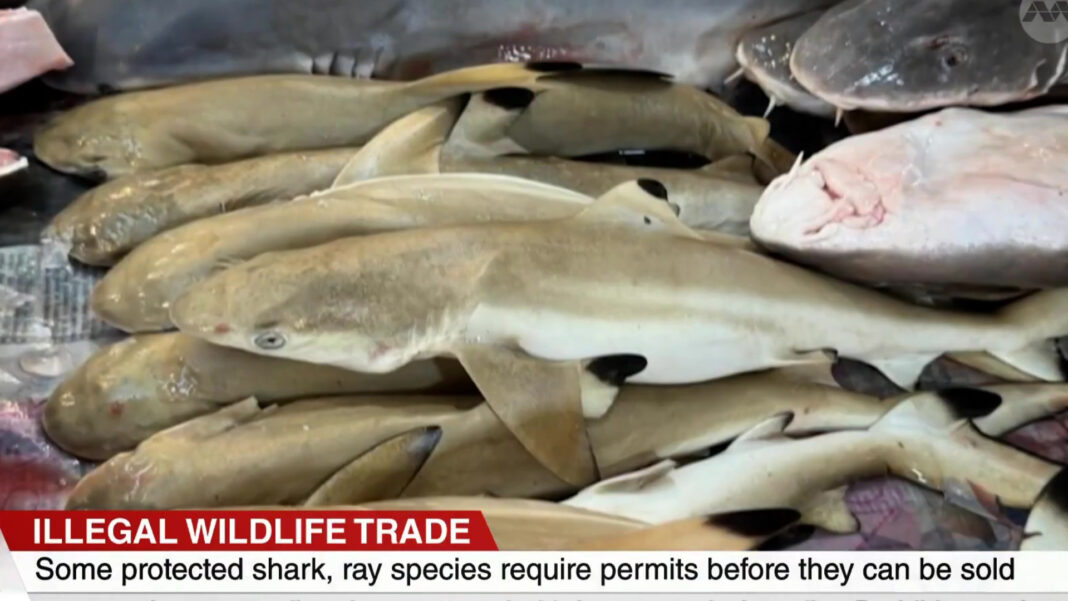

SINGAPORE: Sharks that require permits to trade are allegedly being sold in some of Singapore’s wet markets.
Photos obtained by Channel NewsAsia (CNA) published on Feb 23 showed protected species, such as the Blacktip reef shark, on sale at Tekka Market. International trade records indicate that no commercial permits have ever been issued for the meat of this species or of several other requiem sharks reportedly observed here.
The concern is that the trade in these sharks is not fully banned, but it is tightly regulated under the Convention on International Trade in Endangered Species of Wild Fauna and Flora (CITES). Without permits, sales may breach the law and weaken global efforts to curb overfishing.
CNA reported that Tekka Market appears to be a hotspot. Over two years, most sightings of allegedly illegal shark sales were traced there. Prices ranged from S$10 to S$20 per shark, slightly higher than those for species that do not require permits.
When CNA visited several times a week over a month, most fishmongers said they knew the penalties. Yet one seller was reportedly seen selling sharks in mid-December despite claiming otherwise. Another admitted the sharks were brought in sealed boxes and not displayed openly.
Marine life enthusiast Aidan Raphael Keh, who will study life sciences at the National University of Singapore, said he frequently saw requiem sharks sold on weekends. In his experience, the fish were often cleared within an hour. Buyers, he observed, were mostly elderly shoppers.
`The National Parks Board (NParks) said it handled seven cases of illegal shark and ray imports without permits between 2020 and 2025. Depending on the case, it issued warning letters or composition fines.
Researchers conducting weekly surveys at Jurong Fishery Port said illegal seafood is mixed with legal imports. Naomi Clark-Shen, a shark and ray researcher, said that oversight in seafood supply chains remains limited. Not every box is inspected. Singapore’s only fishery port handles at least 15 per cent of seafood imports as of 2023. The rest enter via land or air shipments, where checks may occur based on intelligence.
Rays such as wedgefish often arrive pre-cut. Once chopped, it becomes difficult to determine whether the meat comes from a protected species.
A 2022 study by researchers from the National University of Singapore’s Wainwright Molecular Ecology Lab found that 27 per cent of shark meat sold locally came from species listed under CITES Appendix II, which require permits. Following expanded protections in 2023 that covered 54 additional shark and ray species, researchers estimate that up to 89 per cent of shark meat traded may now fall under regulated categories.
Golam Rabbani from the lab said most dried shark products are labelled simply as “shark meat”. Without species names, consumers and regulators struggle to verify the legality of products.
Shark meat remains common in Singapore. It is sold in hawker dishes such as shark meat lor mee for around S$5 a bowl. Singapore became a signatory to CITES in 1986. Under the Endangered Species (Import and Export) Act, illegal trade of Appendix II and III species without permits carries penalties of up to S$500,000 in fines, or S$1 million for companies, and jail terms of up to four years, or six years for companies.
NParks said it works with the Singapore Food Agency and international partners such as INTERPOL. Officers also use a locally developed artificial intelligence tool, Fin Finder, to identify shark and ray fins. Suspect shipments may undergo DNA testing. Still, enforcement alone may not solve the issue.
Wildlife trade monitoring network TRAFFIC International Southeast Asia said traceability must cover the entire supply chain and remain practical for both regulators and businesses.
Animal rights charity ACRES said it handled 14 cases involving the sale of prohibited wildlife via Telegram groups in Singapore. Regionally, the World Wildlife Fund for Nature tracked 4,925 protected species listings in 2025 under its Cyber Spotter programme, with live-animal listings doubling from 2024.
Conservation group PasarFish argues that consumer demand plays a role. Co-founder Elliott James Ong said stingrays remain popular in local dishes. While legal, heavy demand adds pressure to already-strained populations.
When species look the same after cutting and labels lack detail, responsibility shifts along the chain from importers to sellers to diners. The CNA’s report shows that laws are only as effective as the systems that support them. Clear labelling, tighter checks, and informed choices may matter as much as enforcement.
 Follow Google News
 Join us on WhatsApp
 Follow us on Telegram