
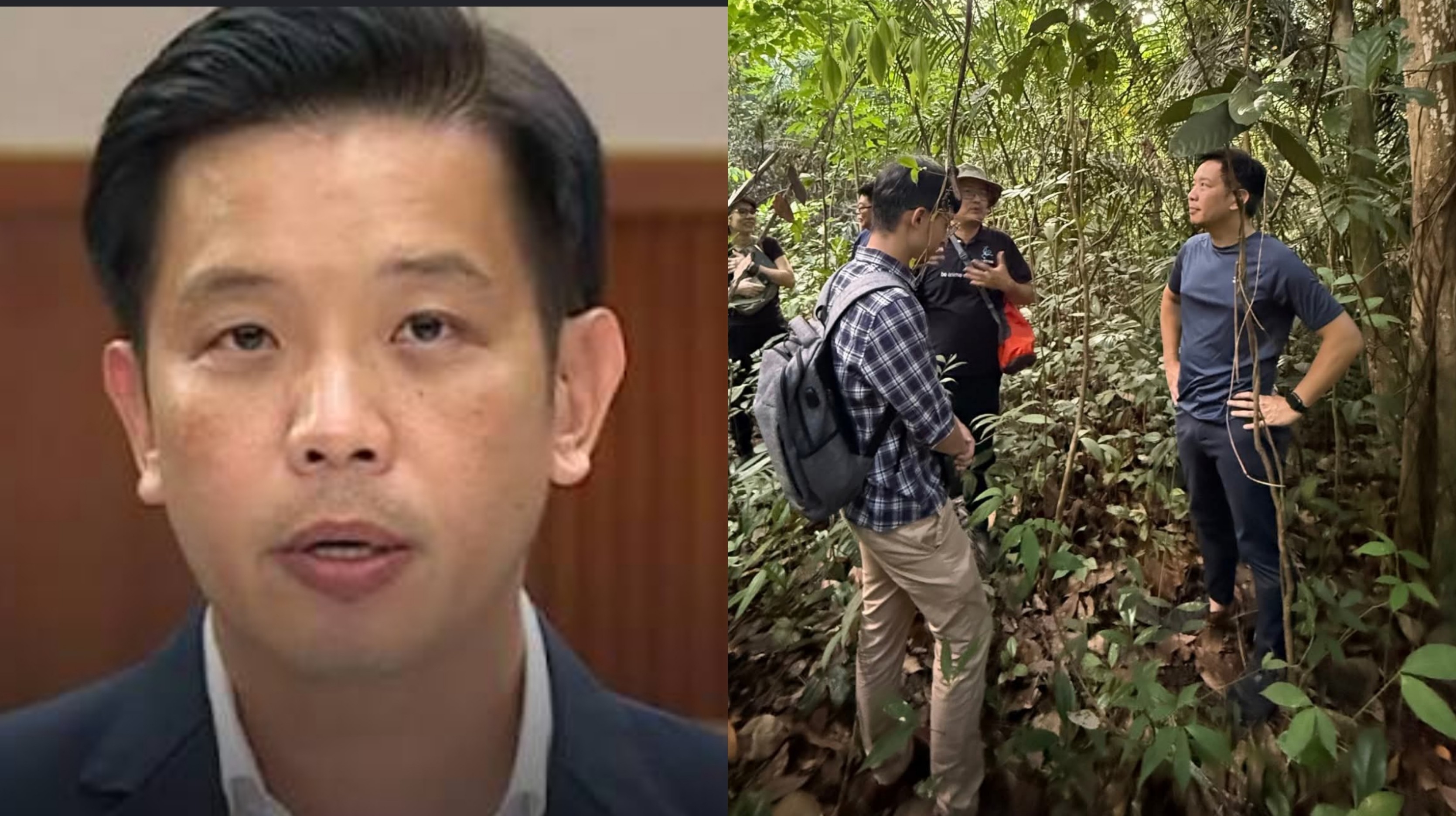

SINGAPORE: Minister of State for National Development Alvin Tan has come under criticism online after his parliamentary response on the proposed housing developments at Gillman Barracks and Maju Forest left some Singaporeans unconvinced that public feedback would have any meaningful impact on the Government’s eventual decision.
The debate centres on HDB’s plans to clear about 10 hectares of forested land near Gillman Barracks and develop about 15 hectares of Maju Forest in the Sunset Way area for future housing. The proposals have sparked widespread concern among residents, nature groups and conservationists, with close to 40,000 people signing a petition calling for the forests to be preserved.
Responding to parliamentary questions on Tuesday (Aug 4), Mr Tan stressed that the housing plans have not been finalised.
He said that while the formal consultation period for the Environmental Impact Assessments (EIA) and Heritage Impact Assessments (HIA) concludes on Aug 6, engagement with stakeholders will continue as the Government adjusts and refines its plans based on public feedback.
According to Mr Tan, the assessments are not intended to justify a fixed development plan that has already been decided.
However, he acknowledged that the issue involves “difficult trade-offs” between meeting housing needs and conserving environmentally and historically significant areas.
He told Parliament that the current conceptual plans have already reduced the number of homes to preserve important green spaces and heritage features identified during the studies, adding that conserving even more land would mean building even fewer homes.
For Gillman Barracks, HDB has said it intends to retain key ecological and heritage features, including historic buildings and areas of native-dominated secondary forest.
At Maju Forest, approximately eight hectares of forested land, including a natural freshwater stream, surrounding vegetation and the area around the Old Jurong Railway Line, are planned to be retained.
Addressing suggestions that housing could instead be built on nearby vacant or underutilised land, Mr Tan said some adjacent sites are already earmarked for housing, required for other national purposes or cannot yet be redeveloped.
He also defended the need to continue building homes despite Singapore’s declining birth rate, noting that many current and upcoming HDB buyers were born during periods when birth rates were significantly higher.
Mr Tan added that changing household trends are also driving housing demand, pointing to more young married couples choosing to live independently and a growing number of singles seeking homes of their own.
“If we want more Singaporeans to qualify for HDB housing, and to get their homes sooner, then we must build more homes and build them faster,” he said.
He added that the Government must be transparent about the difficult choices involved, carefully consider public feedback, improve its plans where possible and ultimately make decisions in the interests of Singapore and Singaporeans.
Despite those assurances, Mr Tan’s response prompted another wave of criticism online, with many questioning whether the redevelopment plans would proceed regardless of public opposition.
Some commenters said the minister’s remarks gave them the impression that the outcome had already been decided and that the consultation process was largely symbolic.
“If the decision is already made, then just say so,” one commenter wrote.
Others questioned the purpose of Mr Tan’s recent visit to Maju Forest if public engagement would not ultimately influence the final decision.
Nature enthusiast and activist Brice Li had taken Mr Tan on a walk through the forest, describing the experience on social media.
“Maju Forest welcomed us with the songs of birds, the cooler air beneath its canopy, and the unique atmosphere of a forest that has regenerated naturally over decades,” Mr Li wrote. “Some things simply cannot be captured in an EIA report or on a map. They can only be understood by being there.”
He thanked Mr Tan for taking the time to experience the forest firsthand and said he sincerely hoped the visit would contribute to ongoing discussions about Maju Forest’s future.
Following Mr Tan’s parliamentary speech, however, several online users questioned whether that engagement would translate into meaningful changes.
Many argued that the Government should explore other options before clearing mature forests.
Some suggested redeveloping older HDB estates instead.
“We can build taller flats and en bloc older flats that are more than 50 years old, right?” one commenter asked.
Another similarly wrote, “Govt should recycle those older flats and build taller and more units per plot.”
Others argued that Singapore still has numerous vacant plots suitable for housing development, with one person claiming, “All over SG there are many vacant land to build.”
Several comments also focused on landed housing and conservation priorities. One netizen questioned whether preserving colonial-era buildings should take precedence over protecting forests, asking, “How about those colonial buildings? Are they really necessary to be conserved?”
Another wrote, “Come to Black and white houses then different logic apply liao.”
Others suggested redeveloping Good Class Bungalow (GCB) areas instead, with one commenter saying, “Develop the GCB into high-rise public housing, can get many more.”
Some pointed out that zoning decisions can be changed by the Government, while others felt Singapore’s environmental ambitions appeared inconsistent with plans to remove mature forests.
One lengthy comment said the Government has consistently encouraged Singaporeans to embrace sustainability and a greener future, arguing that remaining forests and natural habitats should be regarded as valuable national assets rather than undeveloped land awaiting future projects.
The commenter acknowledged that housing remains an important national priority but said biodiversity and natural heritage, once lost, cannot be replaced. They urged the Government to exhaust all alternatives that would minimise environmental damage before proceeding with redevelopment, adding that a truly green Singapore involves not only planting new trees but also protecting mature ecosystems that already exist.
Some commenters also encouraged conservation groups to continue campaigning against the developments.
One supporter called on local wildlife conservationists to “press on and save as much as what is left,” praising the momentum behind the movement while alleging that the Government often waits for public attention to fade before pushing through contentious decisions. The commenter also argued that citizens’ voices should play a greater role in national decision-making.
HDB’s public consultation on the issue ends on Thursday (Aug 6), but for now, the future of a large part of Maju Forest remains as unclear as ever.
 Follow Google News
 Join us on WhatsApp
 Follow us on Telegram