
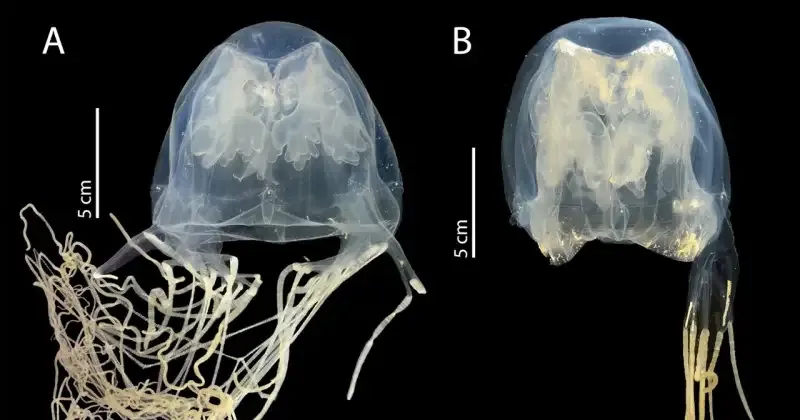

SINGAPORE: Scientists from Japan and Singapore have identified a previously unknown species of box jellyfish in Singapore waters, a discovery they say sheds new light on marine biodiversity in the region.
The newly identified species, named Chironex blakangmati (C. blakangmati), was discovered by researchers from Tohoku University and the National University of Singapore (NUS). Their findings were published in the Raffles Bulletin of Zoology.
At first, the jellyfish appeared almost identical to other members of the Chironex genus. However, genetic testing revealed that it was in fact an entirely distinct species.
Researchers later confirmed the finding through a detailed morphological analysis, which found several physical characteristics unique to C. blakangmati that are not present in other known Chironex jellyfish.
The species was discovered in waters around Sentosa Island, which was historically known as Pulau Blakang Mati, Malay for “Island of Death Behind,” inspiring the jellyfish’s ominous scientific name.
Cheryl Ames of Tohoku University and the university’s Advanced Institute for Marine Ecosystem Change (WPI-AIMEC) said the species initially resembled Chironex yamaguchii, a jellyfish she had previously discovered in Okinawa during her master’s studies.
“But we realised they were completely distinct,” she said, adding that she revisited preserved samples of C. yamaguchii kept in storage in Okinawa to assist with comparisons.
Until now, the two jellyfish had been assumed to belong to the same species. The new genetic analysis, however, showed that this was a case of mistaken identity.
The research team also worked to identify visible anatomical differences that would allow scientists to distinguish the species without relying solely on molecular testing.
One of the clearest distinctions was found in the perradial lappets, structures located at the bottom of the jellyfish’s bell-shaped body that help reinforce the muscular flap used for propulsion.
Researchers found that the three previously known Chironex species possess pointed canals extending from the tips of these lappets. In C. blakangmati, however, those canals are absent.
Danwei Huang from the Lee Kong Chian Natural History Museum at NUS said the team’s review of all known Chironex species had provided important new insights into the group of highly venomous box jellyfish.
“Our thorough review and analysis of all the Chironex species known to date reveal a lot about these box jellyfishes and highlight a new, helpful strategy that other researchers can use for species delineation,” he said.
Alongside the discovery of the new species, researchers also documented the first recorded sighting in Singapore of the Thai sea wasp, C. indrasaksajiae.
The species is typically found in Thai waters, making its appearance in Singapore an unexpected find.
“We were surprised to find C. indrasaksajiae so far away from Thailand,” Ames said.
She added that documenting such range expansions is important because scientists still know relatively little about the biodiversity and geographic distribution of box jellyfish.
Unlike most jellyfish, which drift passively with ocean currents, Chironex species are active swimmers. Researchers noted that they possess a muscular flap used for propulsion, along with complex eyes that help them navigate towards prey.
 Follow Google News
 Join us on WhatsApp
 Follow us on Telegram