
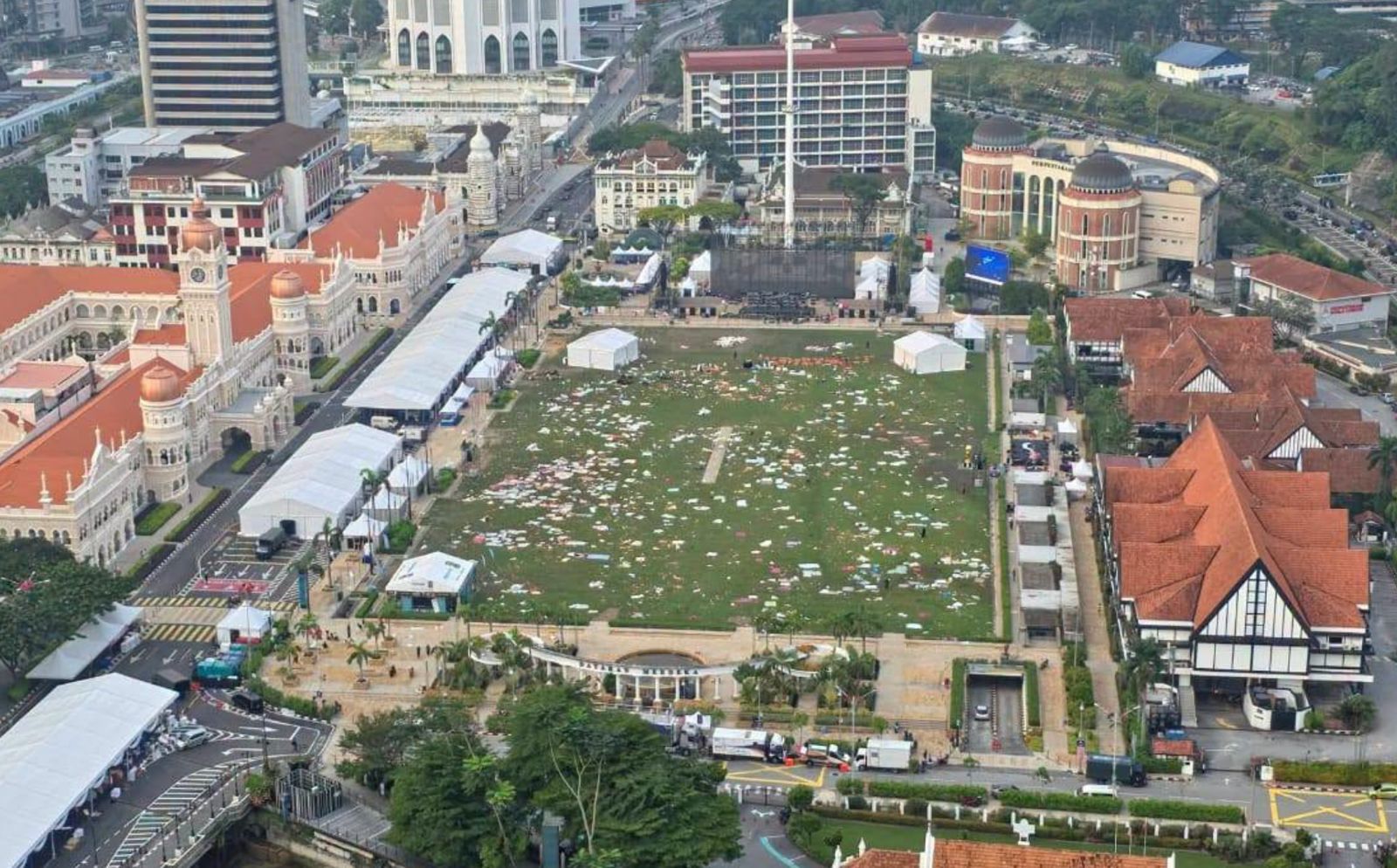

MALAYSIA: Minister in the Prime Minister’s Department (Federal Territories) Hannah Yeoh praised DBKL workers for cleaning up Dataran Merdeka after rubbish was left behind following the live broadcast of the 2026 FIFA World Cup final.
She reminded Malaysians that civic responsibility includes disposing of waste properly, not leaving it for public workers. Yeoh stressed that while taxpayers deserve services, littering undermines national dignity and burdens cleaners.
Some X users argued that the litter problem stemmed from insufficient facilities. One questioned the number of trash cans provided by DBKL during the event. He suggested that bins should be placed every 10 meters to accommodate guests and proposed that auxiliary police issue fines to those caught littering.
Others, however, argued that the issue lies not in the number of bins but in public attitudes. Some stressed that civic mentality matters more than bin frequency. He noted that if trash cans are unavailable, responsible individuals should hold onto their rubbish until they find a proper place to dispose of it.
Many are unaware that the scarcity of trash cans in some cities has its reasons. In 1995, Tokyo was attacked by the domestic terrorist group Aum Shinrikyo, which placed liquid sarin in trash bags and punctured them, killing 12 people. Following the tragedy, authorities reduced the number of public bins as a security measure to prevent similar incidents.
Additionally, another netizen suggested that if no trash cans are nearby, the best option is to hold onto the rubbish and dispose of it at home—even if that feels like the worst‑case scenario. The user emphasised that this is still far better than littering across Dataran Merdeka, which undermines civic responsibility and burdens public workers.
Others argued that the trash people generate is neither poisonous nor grotesque, so there’s no reason to immediately discard it on the ground where they sit or stand. Instead, individuals should hold onto their rubbish until they find a proper bin.
Another user states that when visiting Taiwan, he was shocked at the fact that there were practically no places to dispose of his trash. They have seemed to adopt the culture where you’d dispose of your own discarded items at home.
Be that as it may, there are valid reasons why public trash cans may be limited during large gatherings. Safety remains the primary concern, as authorities must balance convenience with security risks. At the same time, encouraging good civic habits is equally important.
 Follow Google News
 Join us on WhatsApp
 Follow us on Telegram