

Summary
-
Singapore will make heat stress training, cool water, emergency cooling supplies, and suitable clothing mandatory from December 1, 2026.
-
The Ministry of Manpower (MOM) found 56 companies with heat stress management lapses during the first half of 2026, and enforcement action was taken.
-
New shaded rest areas will be recommended, while platform workers face added challenges because their workplaces can change throughout the day.
SINGAPORE: Singapore is tightening heat protection for outdoor workers, with four measures set to become mandatory from Dec 1, 2026.
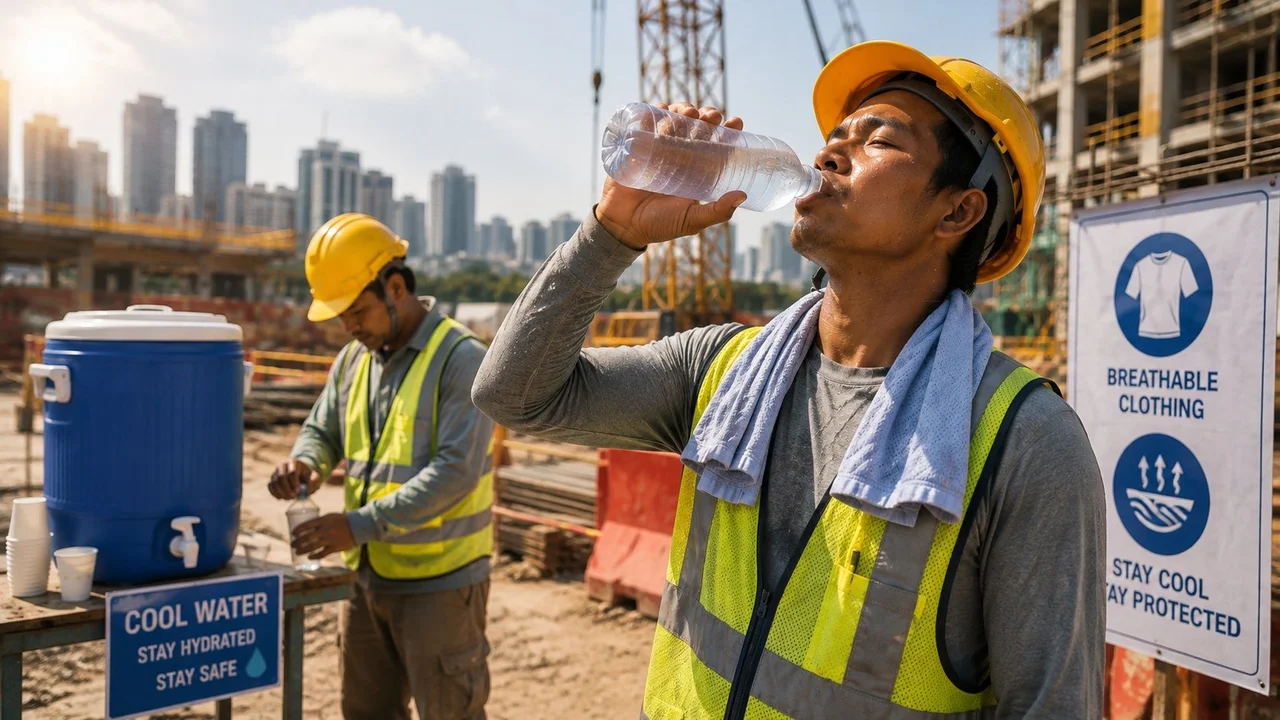
Employers must provide heat stress training, cool drinking water near work areas, emergency cooling supplies and suitable clothing. The Ministry of Manpower (MOM) announced the changes on August 28, 2026.
Employers have three months to implement the new measures. The changes apply to outdoor work regardless of the Wet Bulb Globe Temperature.
MOM said the measures were previously recommended under its heat stress framework and have already been adopted by many employers. Making them mandatory aims to ensure workers receive a consistent level of protection.
Heat protection moves from advice to requirement
The new rules add to existing measures such as hourly Wet Bulb Globe Temperature checks, regular hydration, shaded rest breaks, heat acclimatisation and emergency response plans.
Employers must also keep cold water, ice packs or water spray ready for emergencies. Clothing should help reduce exposure to excessive heat.
A new recommendation will also encourage employers to provide shaded rest areas that are well ventilated and properly insulated or cooled.
Minister of State for Manpower Dinesh Vasu Dash said the changes give employers clearer duties while improving protection for people working outdoors. He also said better heat management can reduce work disruption and support business operations.
MOM said the enhanced framework was developed with tripartite partners, industry groups and government agencies.
56 companies found with heat-related lapses
The need for stronger enforcement is apparent from MOM’s findings. 56 companies were found with heat stress management lapses during the first half of 2026, Channel NewsAsia (CNA) reported (Aug 28).
Problems included missing temperature checks, poor heat acclimatisation and inadequate emergency procedures.
Enforcement action was taken, with financial penalties imposed in some cases. Employers that fail to meet the new requirements can also face measures such as stop-work orders and composition fines.
From 2023 to 2025, Singapore recorded an average of six cases of illness linked to high temperatures and excessive heat each year. No deaths were reported during that period.
Outdoor riders and drivers lack fixed places to escape the heat
Heat protection becomes harder when there isn’t a fixed workplace. NTUC Assistant Secretary-General Yeo Wan Ling said platform workers such as delivery riders, taxi drivers and private-hire car drivers can spend long hours outdoors. Finding cool and shaded places to rest between jobs can be difficult.
NTUC Assistant Secretary-General Melvin Yong also welcomed the new rules, while stressing that workers need practical access to the measures.
Some employers are already testing extra protection. SoilBuild Construction Group is trialling cooling garments, including fan-based vests and shirts designed to cool the wearer.
The company also provides shaded rest areas and cool water dispensers. Its earlier trial found that the cooling garments reduced skin temperature by about 3.9°C.
Singapore’s heat won’t be solved by a rulebook alone. Employers need to make these measures easy for workers to use when the sun is beating down. A bottle of cool water, a proper rest spot, and suitable clothing on a hot worksite can make a difference.
 Follow Google News
 Join us on WhatsApp
 Follow us on Telegram