


SINGAPORE: Singapore’s job market is showing signs of caution, with fewer employers planning to hire in the coming months, yet workers with artificial intelligence (AI) and technology skills continue to stand out as companies become more selective about who they bring on board.
According to the latest Employment Outlook Survey released by ManpowerGroup Singapore on June 12, 2026, only 35% of employers in Singapore expect to increase headcount between July and September. Another 41% plan to maintain current staffing levels, while 22% anticipate reducing their workforce.
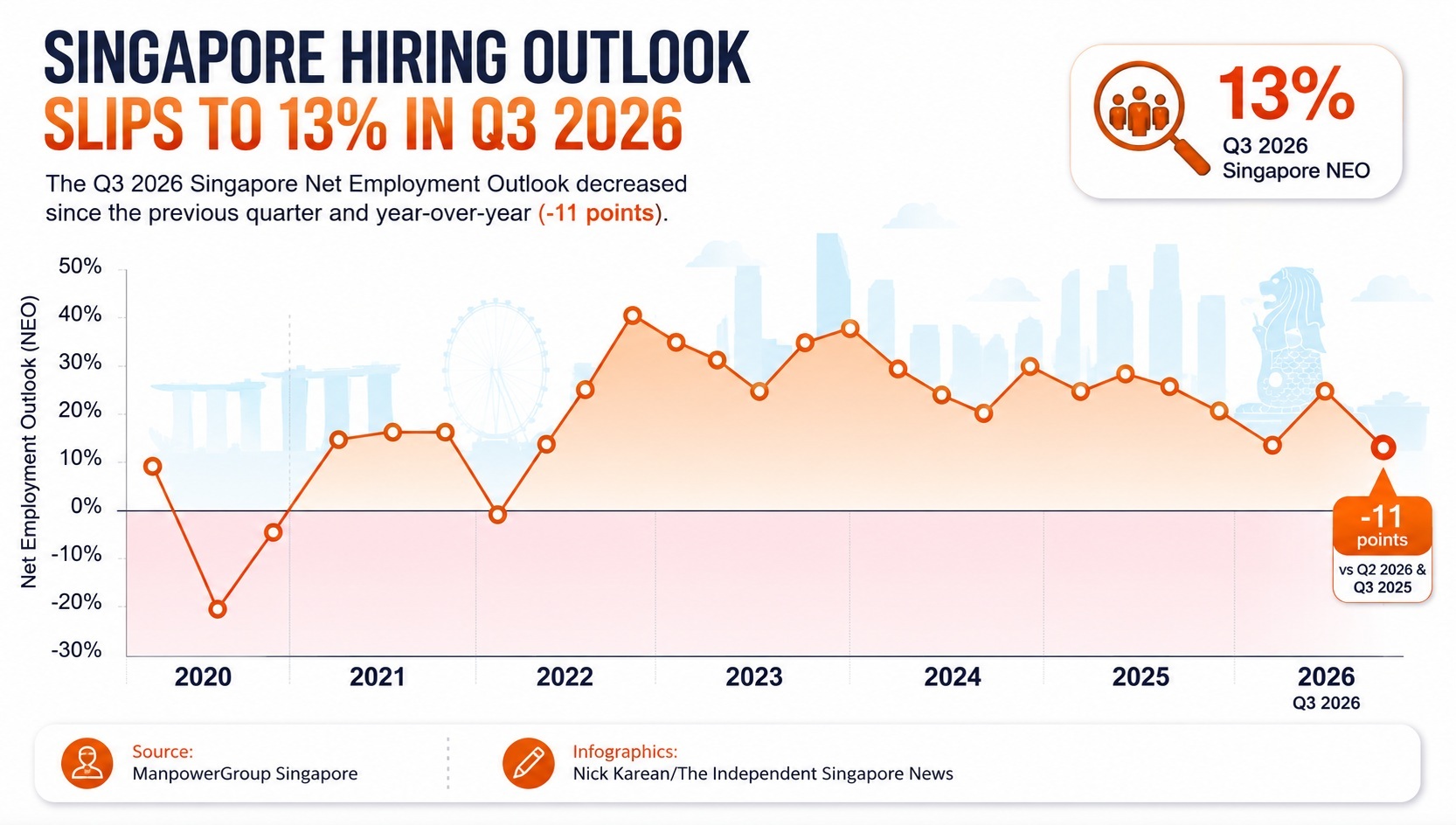
The survey, which gathered responses from 599 employers, found Singapore’s Net Employment Outlook (NEO) had fallen to 13%. That represents an 11-point drop from both the previous quarter and the same period last year. It is also the weakest hiring outlook since late 2021, when hiring sentiment briefly turned negative.
While the figures suggest employers are tapping the brakes, they don’t point to a hiring freeze. Many firms are choosing to wait rather than expand aggressively.
Employers choosing caution over expansion
Among companies planning no staffing changes, 38% said their current workforce already meets business needs. Another 27% said they were delaying hiring decisions until economic conditions become easier to assess.
Linda Teo, Country Manager of ManpowerGroup Singapore, said employers are taking a more measured approach as they navigate ongoing economic and geopolitical uncertainty.
The Republic’s hiring outlook of 13% sits below both the global average of 26% and the Asia-Pacific average of 28%. Competition for openings may become tougher, even if opportunities are available.
The manufacturing sector leads, while the finance sector struggles
The survey found that most industries still expect to hire more workers than they cut, although confidence has weakened across much of the economy. Manufacturing recorded the strongest hiring outlook among all sectors surveyed.
Finance and real estate stood out for a different reason. It was the only major sector to post a negative outlook, with more employers expecting to reduce headcount than increase it. Hospitality and retail stayed flat.
Technology and information technology (IT), however, proved to be one of the most stable sectors. Its hiring outlook was unchanged from the previous quarter, bucking the trend of falling confidence.
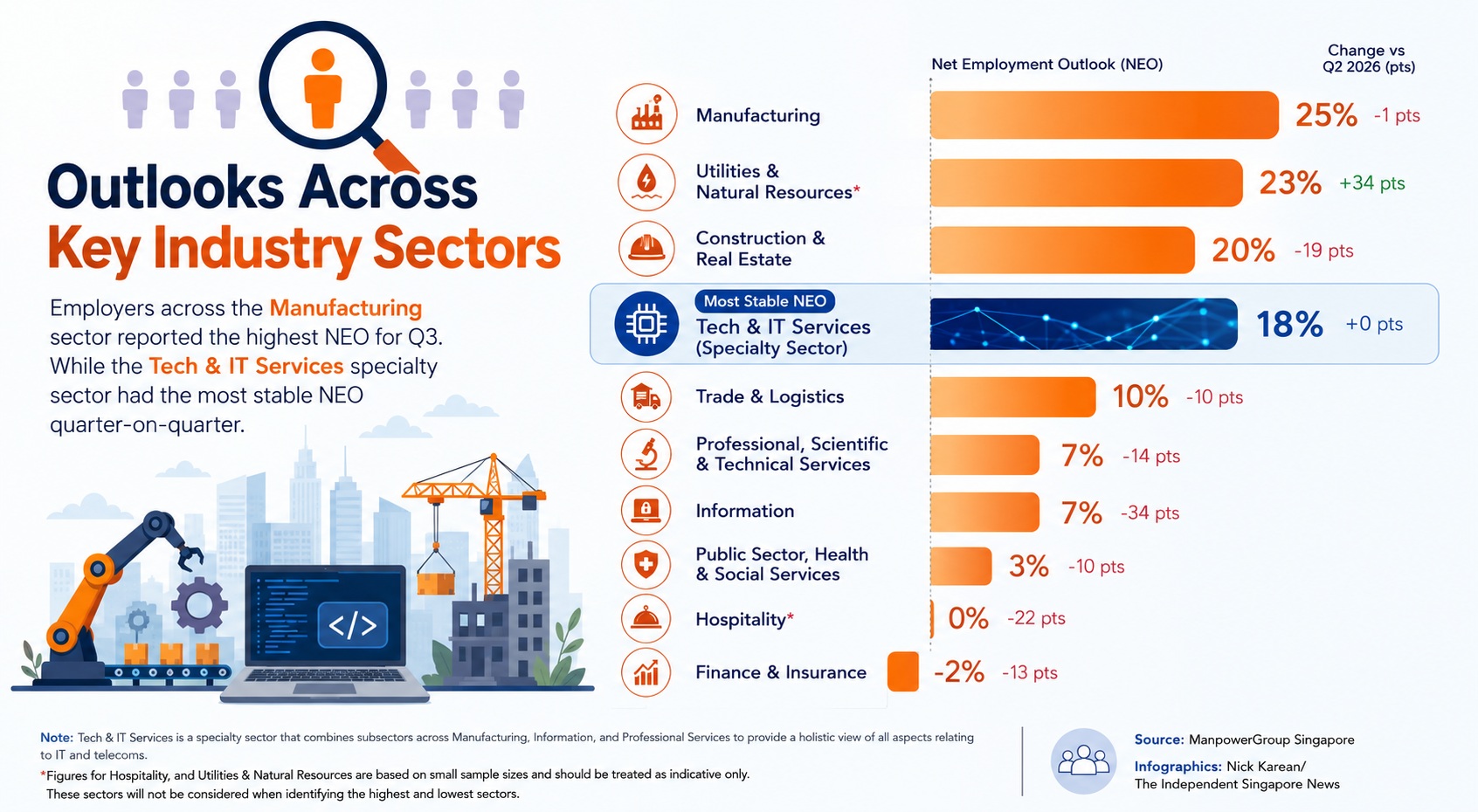
Another area drawing attention was utilities and natural resources, where hiring expectations rose sharply. Although the sample size was relatively small, the increase comes as Singapore continues investing in clean energy and sustainability projects.
That trend aligns with comments made by the Minister of State for Trade and Industry Gan Siow Huang last year, when she said Singapore’s clean energy workforce could grow by about 60%, or roughly 1,000 workers, over the next decade.
AI skills are becoming a salary booster
Even as companies slow hiring, many are willing to pay more for workers with sought-after skills. The survey found that AI-related capabilities topped employers’ wish lists.
Around 66% of employers said they would offer higher salaries to workers with AI literacy skills, such as the ability to use AI tools effectively. Nearly as many were prepared to pay more for AI development skills, including building AI models and applications. Traditional IT and data skills are also highly valued.
The strongest appetite for AI literacy came from public-sector, health, and social-service employers, followed by professional services and technology firms. Demand for AI development expertise was especially strong among information sector employers, professional services firms and financial institutions. The findings suggest that employers are becoming more selective rather than simply hiring fewer.
Soft skills still matter: Employers still want people who can work with others
While technical skills may attract attention, two-thirds of employers surveyed said they would pay more for workers with strong critical-thinking and problem-solving abilities.
The same proportion valued communication, teamwork, and collaboration skills, while leadership capabilities ranked highly as well.
That sends a practical signal that AI skills can open doors, but employers still want people who can work with others, make sound decisions and adapt to changing situations.
There’s still some hope: It’s a slower job market, not a completely closed one
The survey provides insight into a labour market that is becoming more cautious rather than collapsing. Hiring plans have cooled, and some sectors are under pressure.
Yet technology, manufacturing and emerging clean energy fields continue to create opportunities. At the same time, employers seem to be willing to reward workers who invest in both technical and human skills.
For Singaporeans navigating a softer job market, the lesson is to keep learning, stay adaptable and build skills that solve real business problems. Companies may be hiring fewer people, but they are still searching for the right ones.
Read related: SG Ministry of Manpower wage report 2025: Which industries are workers’ salaries rising the fastest in Singapore
 Follow Google News
 Join us on WhatsApp
 Follow us on Telegram