
In Parliament: SM Shanmugam & WP MP Fadli Fawzi spar for 18 minutes on foreign & national interests
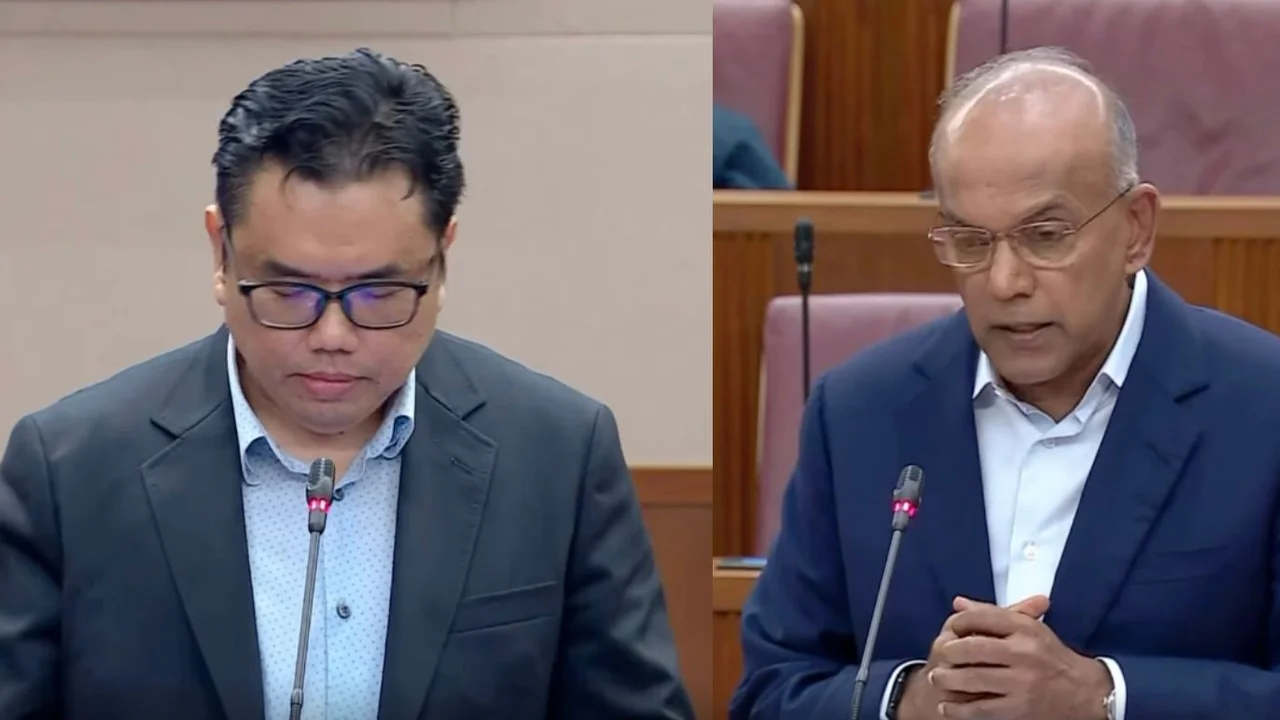
SINGAPORE: In Parliament on Wednesday (Nov 4), there was a lengthy exchange between Workers’ Party MP Fadli Fawzi (Aljunied) and Senior Minister K. Shanmugam, Coordinating Minister for National Security and Minister for Home Affairs (MHA).
The back-and-forth between the two men lasted over 18 minutes and stemmed from questions Mr Fadli had raised about a meeting between officials from Singapore and Israel earlier this year. The Israeli newspaper Haaretz reported on a visit from an Israeli delegation in May, and alleged that the city-state had asked for the meeting to remain confidential.
The MP had asked on Oct 7 whether the issue of Israeli settlements in the West Bank had been raised during the meeting, whether a request had been made for it to be kept secret, and if the Haaretz report was inaccurate, why the Government had not issued a correction direction under the Protection from Online Falsehoods and Manipulation Act (POFMA).
In his written response, the Senior Minister said that the meeting had been about operational and security-related issues, adding that discussions between MHA and foreign counterparts were confidential.
Mr Shanmugam also asked the MP to clarify if he believed Singapore should use bilateral meetings with foreign governments to raise broader concerns about their policies and conduct.
Mr Fadli, who posted his clarification here, said he is of the view that the issue of Israel’s settlements is a grave violation of international law and a threat to international security.
He added that he believes it would have been relevant to state Singapore’s principled position on the matter, though he acknowledged that the city-state has security and law-enforcement interests in maintaining relationships with other countries.
"It is also my belief that when engaging with foreign counterparts, Singapore should maintain a whole-of-government approach in upholding our commitment to international law and a rules-based international order,” he said.
SM Shanmugam presented his counterargument, taking issue with what he believed Mr Fadli was implying. He asked whether the MP was suggesting that every Singapore ministry should raise international law concerns whenever it meets a foreign counterpart, even if those concerns are not directly connected to the purpose of the meeting.
Mr Shamugam added that foreign policy is determined by the Ministry of Foreign Affairs and the Cabinet, and not by individual ministries, which deal with matters that are directly relevant to their purview.
He spoke of Singaporean diplomat Rena Lee, who earlier that day received the highest number of votes in the UN General Assembly as a judge of the International Court of Justice. In seeking support for Ms Lee from other countries, it would not have made sense to start the meetings with other countries by raising every international law controversy involving those countries, he argued, as this could undermine Singapore's immediate diplomatic objective.
"I think Members and Singaporeans can see how absurd and novel such a position is…. We are elected as MPs and ministers to safeguard Singaporeans' interests primarily, not just principles of international law,” he said.
However, the exchange between SM Shanmugam and Mr Fadli turned contentious when he said that the MP was sending two different messages to two different audiences, one to the general Singaporean public and another to the Malay-Muslim community.
"That's what this question and the subsequent explanation is all about – getting people to view our international relationships through the prism of race and religion,” he said, later adding, "That is just wrong.”
On his part, Mr Fadli rejected the characterisation that the questions he raised are motivated by race and religion, saying, “This is primarily an issue about how Singapore can uphold its commitments to international law, consistently, impartially, and objectively."
Newsletter
Get updates straight to your inbox
He also clarified that he had not asked for Singapore to raise every possible international dispute at every bilateral meeting, and added, "The general principle of whether to raise an issue during a bilateral engagement is if it is relevant, and in our interest to do so."
Interestingly, the exchange was commented on afterwards by the Singaporean diplomat and lawyer, Professor Tommy Koh.
“First, the principles of international law are objective, and they do not change because of your national interests. For example, the Israeli settlements in the West Bank are illegal under international law. Second, the position which a country takes on this question depends on your national interests. A country may decide to keep silent or support Israel or criticise Israel.
In the case of Singapore, we have a strong national interest in supporting the UN Charter and international law and the rule of law. For this reason and in spite of our good relationship with Israel, we have consistently condemned the settlements as illegal. Third, we should only raise this issue in our exchanges with other countries when it is relevant.” /TISG
Read also: WP MPs to raise questions about Singapore's Muslim institutions