
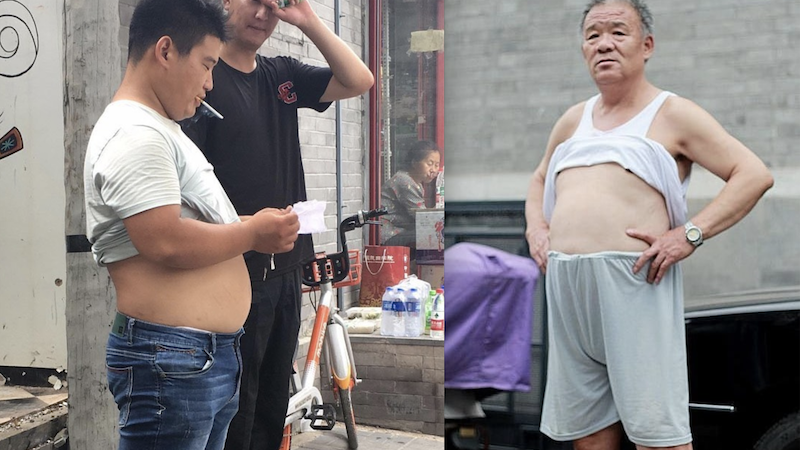

Beijing – Due to the heat of summer, middle-aged men in China are often seen rolling up their shirts to cool off. However, Chinese cities are deeming the practice as “uncivilised behaviour” that damages the reputation and image of the city.
Commonly known as the “Beijing Bikini” or “Beijing Belly,” men who partially expose their midriff or completely remove their top to deal with summer heat are now targets for the authorities for “uncivilised behaviour.”
Jinan, a Chinese city in Shandong province, issued a notice on July 2 (Tuesday), concerning “unseemly” behaviour which include exposing one’s bare feet, spitting on the ground, cutting in line, bathing in water bodies, tossing trash from car windows, and raising a ruckus in addition to the Beijing Belly.
Those caught engaging in such behaviour will be given a verbal warning.
According to ABC News, a spokesperson for Beijing Youth Daily expounded on the directive against the practice.
Older men referred to as bang ye (“topless guy”) donning the Beijing Bikini affects “the image of the city and the perception and feeling of the public.”
“Urban civilisation is related to everyone. We also hope that we can start from scratch and jointly maintain the image of the city,” said the spokesperson.
While it is unknown when and where the Beijing Bikini originated from, the sight of older men showing off their bellies is a common sight in Chinese cities.
In traditional Chinese medicine, the belly is an essential container for energy; therefore, exposing the belly gets rid of excess heat.
In 2015, foreigners in Beijing even started a photo contest of men showing off their bellies.
Cities cracking down on such behaviour is not new, with campaigns against exposed midriffs usually being initiated before a major event such as the 2008 Olympics. Their effectivity rate is not so high, however.
The Beijing Bikini is practiced based on practicality, poverty, or environmentalism, reported Inkstone. With temperatures going over 100 degrees and having no access to air conditioning, removing extra body covering is the easiest way to cool off.
In May, the northern city of Tianjin started fining those who refuse to wear shirts after a police warning.
Another approach in limiting this practice is to publicly shame the men not wearing their shirts properly.
In 2002, the Beijing Youth Daily published images of the Beijing Bikini in hopes of embarrassing the men. The same will be applied to Jinan’s latest ruling.
Offenders will first be given a warning followed by being named and exposed by authorities upon non-compliance.
The city mentioned that it has the support of the local media, grassroots organisations, and other parties in “vigorously supervising, exposing and attacking” the Beijing Bikini.
Would the same be applied to those exercising and flaunting their abs?
 Follow Google News
 Join us on WhatsApp
 Follow us on Telegram