

SINGAPORE: Businesses in countries leading the charge in artificial intelligence (AI) adoption are experiencing notable impacts on their sustainability efforts, according to a recent report by NetApp. The study highlights stark differences in how AI is influencing environmental strategies across regions.
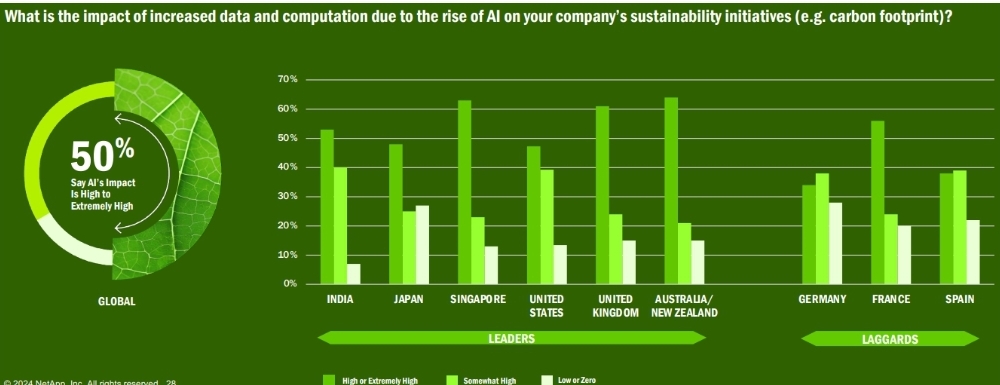
In the Asia-Pacific (APAC) region, firms are seeing significant benefits from AI in reducing their carbon footprints. Australia and New Zealand lead the region, with approximately 64% of businesses reporting a high or extremely high impact.
Close behind is Singapore, where 63% of companies state that AI has significantly influenced their environmental goals.
Other countries in the region, such as India and Japan, reported lower yet notable percentages, at approximately 53% and 49% respectively, which still surpass the global average of 50%.
European countries lagging in AI adoption show less pronounced impacts on sustainability. Germany and Spain, for example, reported lower percentages, with 38% and 39% of businesses, respectively, seeing a high impact from AI on their carbon reduction efforts.
However, France stands out as an exception. Despite being among the slower adopters of AI, approximately 56% of French businesses reported a significant effect, exceeding the global average.
NetApp’s findings are based on a survey of 1,300 technology and data executives from nine key markets. These include the US, EMEA (UK, France, Germany, Spain), and APAC (Australia/New Zealand, India, Singapore, Japan).
As AI continues to evolve, its role in advancing corporate sustainability strategies will likely become even more significant, particularly for nations leading its integration into business practices.
 Follow Google News
 Join us on WhatsApp
 Follow us on Telegram