

Summary
-
A Malaysian Redditor described giving up his citizenship after years of local political disappointment and a deepening admiration for Singapore’s governance.
-
His journey included youthful political activism, a move to Singapore, early financial struggles, and, eventually, a settled life there.
-
He credited the Singapore government’s planning, public transport, workplace culture, and COVID-19 response with strengthening his decision to stay.
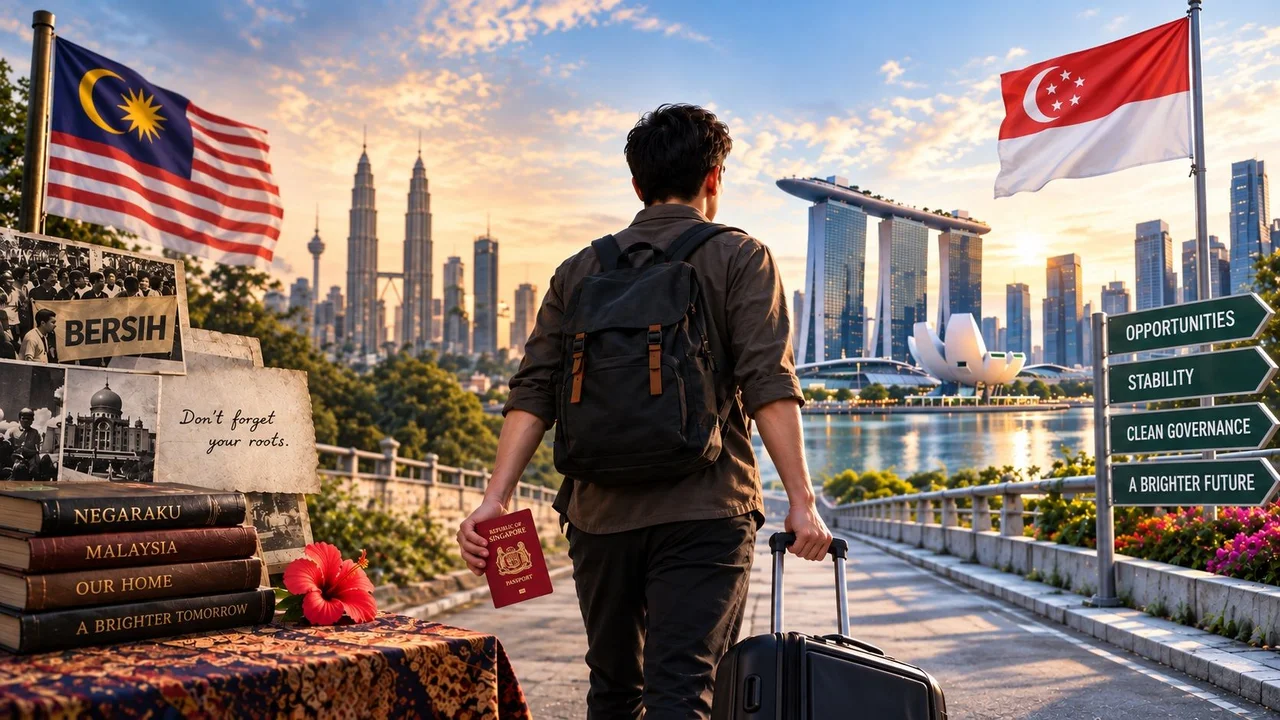
MALAYSIA/SINGAPORE: From once singing Negaraku with pride to now surrendering his Malaysian passport, one man says his years of living with political disappointment in Malaysia and his life in Singapore have changed his sense of home.
The Malaysian man has given up his citizenship, expressing unexpected admiration for Singapore’s government for its ability to plan and deliver on its promises to its people.
In two posts on Reddit’s r/malaysianow, published Aug 27 and later on Sep 4, he described the decision as deeply personal. He wasn’t celebrating Malaysia’s shortcomings or pretending Singapore was perfect.
Instead, he looked back at the country that shaped him, a story that began with patriotism, not rejection, and then explained why he eventually chose to build his future elsewhere.
A young Malaysian who believed politics could change the country
The former Malaysian recalled growing up in a home where three newspapers arrived every day.
He developed an early interest in current affairs and remembered waiting for the national broadcaster to begin its daily transmission.
He would stand at attention and sing “Negaraku” with genuine pride. That interest later became political activism.
While still in Form 5 in school, he even attended the BERSIH (The Coalition for Clean and Fair Elections) rally alone and experienced tear gas for the first time, and during Form 6, he followed the 2008 general election closely, despite being too young to vote. When Barisan Nasional lost five state governments, he remembered feeling thrilled by the result.
At university, political involvement became part of his routine. He returned home to campaign, handed out flyers, organised protests and even spoke at DAP ceramahs.
He believed change was possible because he cared about Malaysia. That optimism eventually took a beating.
Political disappointment changed how he saw Malaysia
After Malaysia experienced a change in government, the former Malaysian watched former political allies move into state and federal leadership roles.
He said he watched people he had known from PKR (Parti Keadilan Rakyat or People’s Justice Party) and DAP (Democratic Action Party) rise into state and federal government. Their later defence of policies they had once opposed left him questioning how much had really changed.
He wasn’t particularly upset that every campaign promise went unfulfilled. He understood that governing was more complicated than making promises during an election.
What hurt more was what he saw as a lack of determination to pursue reforms.
Then came several controversies that further tested his patience, including the KK socks controversy and the order to close a shop after it displayed an upside-down Jalur Gemilang Malaysian flag.
To him, these episodes felt painfully small compared with bigger matters such as attracting investment and preparing for artificial intelligence. Yet his disappointment never erased his affection for Malaysia.
His father had always told him, “Don’t forget your roots. Be grateful and remember where you came from.” These words were never forgotten and have always stayed with him.
Singapore started as a curiosity, not an escape plan
His relationship with Singapore developed slowly. As a schoolboy in Selangor, he saw Singapore simply as a more advanced neighbouring country.
He became more curious after a classmate received the Singapore Government’s ASEAN Scholarship, which covered school fees and expenses.
Later, he read Lee Kuan Yew’s memoirs and became interested in Singapore’s approach to government salaries and corruption. He then began dreaming about studying there.
The former Malaysian said he even created a rather embarrassing Gmail address combining the name of his course with “Singapore University”. Years later, he was still using it. His grades and finances eventually took him elsewhere.
At 20, however, he made his first solo trip to Singapore. Instead of heading straight for the popular tourist attractions, he visited places such as Singapore City Gallery, Singapore Mobility Gallery and the NEWater Visitor Centre.
He joked that it wasn’t really a holiday. It was a “site visit”. Those visits gave him a closer look at how Singapore planned its infrastructure and managed scarce resources.
More importantly, he became impressed by the country’s ability to turn plans into working systems.
Life in Singapore slowly changed his priorities
After university, he worked in Petaling Jaya and became increasingly frustrated by the daily traffic. He eventually moved to Singapore, partly because he didn’t want to maintain a long-distance relationship.
His first job search in Singapore wasn’t smooth. During one interview with a construction company, he was told that his Malaysian work experience wasn’t considered relevant because he hadn’t worked in Singapore before.
Money was tight. He had borrowed RM3,000 from his brother, much of which went towards rental costs. He eventually rented a room in a three-room HDB flat in Lorong 8 Toa Payoh for about S$550 a month.
His landlords were a retired couple, and he was their only outsider tenant. The main problem was the cigarette smoke he encountered when returning home.
His first employer in Singapore was a family-run food-ingredients wholesaler. The salary wasn’t particularly high, but lunch was provided, and he received a S$4 dinner allowance.
The office was in the city centre. Working hours ended at 5 pm, and staying late merely to appear busy wasn’t expected.
Public transport also changed his daily routine. He no longer needed to leave home before sunrise or spend hours trapped in Klang Valley traffic.
The ordinary people around him surprised him too. He recalled colleagues bringing him food and looking after him as a newcomer.
With his life partner, workplace and church community around him, Singapore gradually became comfortable. He summed up that feeling with another joke: “Perhaps my naturally boring personality was simply made for Singapore.”
COVID-19 strengthened his faith in Singapore
The biggest shift in his thinking came during the COVID-19 pandemic. His company was classified as an essential service, so he continued working throughout the crisis.
He paid close attention to the daily briefings led by both Singapore’s Prime Minister Lawrence Wong and Deputy Prime Minister Gan Kim Yong, who were then co-chairs of the multi-ministry task force.
The Job Support Scheme made a strong impression on him. He saw the government’s willingness to spend billions to support businesses and protect jobs as evidence that the state was serious about helping people through the crisis.
Singapore’s access to vaccines and its stable food supply also reinforced his confidence in the country. He was particularly impressed that Singapore, despite relying heavily on food imports, managed to maintain supplies during a global crisis.
The government’s later decision to live with COVID-19 also stood out to him, even though it attracted criticism at the time. Looking back, he felt the decision had proved sound.
Leaving Malaysia didn’t mean leaving his roots
By the time he surrendered his Malaysian passport and identity card, the decision had become more than a career choice. He knew he was changing his legal identity and allegiance.
He also knew that citizenship couldn’t erase childhood memories, culture or language.
His ancestors had once crossed the sea in search of a better life. Some later fought for citizenship and defended mother-tongue education, helping create the opportunities he enjoyed growing up.
He acknowledged that Malaysia had given him a good childhood, friendly people and an important cultural foundation.
He also understood why some people told him to wait. Countries go through cycles, they said. Malaysia might become better one day. He wasn’t sure he would live to see it. Still, he hoped that day would come.
His farewell was therefore less an angry rejection than a silent acceptance that his future had taken another direction. “Goodbye, Malaysia. I wish you well,” was his final line, and something was striking in that final line: A person can change his passport without changing everything that made him who he is. He left Malaysia, but he didn’t leave behind his language, memories, family history, or gratitude for where he began.
Because sometimes moving forward means accepting that home can have two different meanings: the place that raised you, and the place where you finally decide to stay.
 Follow Google News
 Join us on WhatsApp
 Follow us on Telegram