
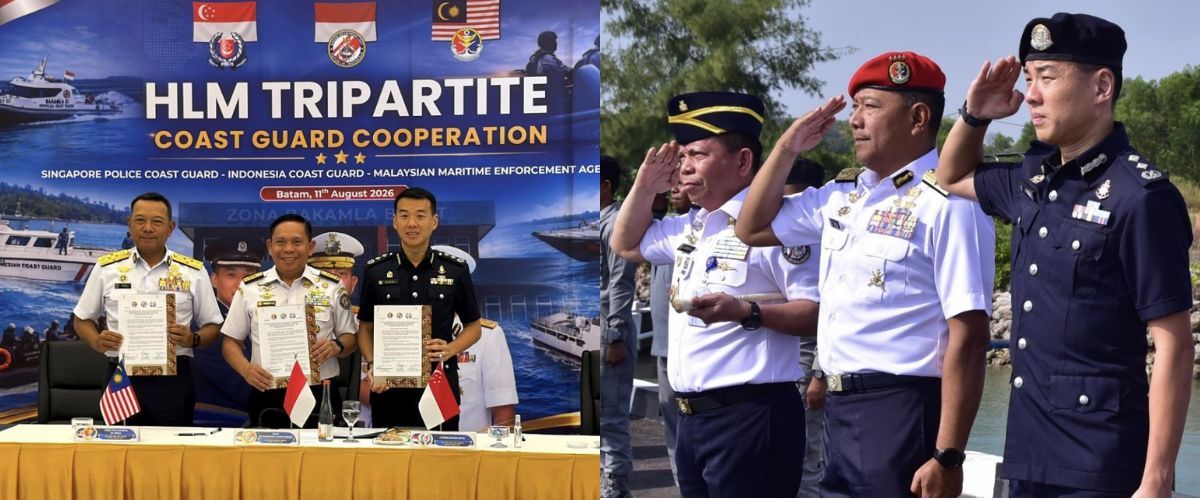

ASIA: The Singapore Police Coast Guard (PCG) has participated in the Second Tripartite Cooperation Port Visit in Batam, Indonesia, bringing together senior leaders and officers from Singapore’s PCG, Indonesia’s Badan Keamanan Laut Republik Indonesia, and the Malaysian Maritime Enforcement Agency for a three-day programme from August 10 to 12, 2026.
Hosted by BAKAMLA at its newly established Batam Base, the visit drew approximately 80 officers from the three agencies and built on the inaugural Tripartite Cooperation initiative introduced by PCG in 2025.
The 22-member PCG delegation was led by Commander PCG Senior Assistant Commissioner Ang Eng Seng. Senior leaders from all three agencies held discussions on strengthening cooperation under the Tripartite Cooperation framework, with a focus on addressing maritime threats and coordinating enforcement responses across the waters of Singapore, Malaysia, and Indonesia.
As part of the programme, patrol vessels and enforcement officers from all three agencies sailed into BAKAMLA’s Batam Base. This was a symbolic and practical demonstration of the partnership in action. Officers also participated in professional exchanges to deepen their understanding of one another’s operational capabilities and operating environments.
Why this framework matters
The waters of Singapore, Malaysia, and Indonesia are among the most trafficked in the world and are deeply interconnected; this means that maritime threats such as transnational crime, smuggling, and illegal activities at sea routinely cross national boundaries. The Tripartite Cooperation framework is designed to address exactly this by enabling timely information sharing, training exchanges, and capacity development across the three agencies.
The visit also supports outcomes from the recent Singapore-Indonesia Leaders’ Retreat, at which both countries reaffirmed their commitment to strengthening maritime cooperation, giving the tripartite framework an added layer of political backing at the highest bilateral level.
PCG, BAKAMLA, and MMEA said they share a common interest in “combating transnational crime, deterring illegal activities at sea, and maintaining maritime safety and security” across this shared waterway.
 Follow Google News
 Join us on WhatsApp
 Follow us on Telegram