

Not too long ago, Asians cooled themselves the old-school way, with fans made of bamboo, paper, or plant fibres. With technological advances, however, as well as higher temperatures, handheld electric fans have become nearly ubiquitous. Commuters, students, shoppers, and practically everyone and their mother are now considering them essential to cope with the heat, and in Singapore, the humidity as well.
However, these are not the only devices Asians are using in order to beat the heat, and reports say that a new market for personal cooling devices has emerged as summer has gotten hotter and longer across the continent.
Japan, for example, has had fan-cooled jackets for the past two decades. But with batteries and motors having grown less expensive and more effective over the years, more people are availing of them.
Moreover, according to a New York Times report this week, personal cooling devices are being added to the strategies both governments and companies use to help people adapt to increasingly hotter temperatures.
After all, 2025 was one of the warmest years on record, with the annual mean temperature for Asia rising nearly one degree higher than the average for 1991 to 2020. Pakistan and other parts of South Asia saw highs of almost 50°C, and Japan, China, and South Korea saw their hottest summers ever.
This year, with the Super El Niño, it is likely to be even warmer, and the heat is expected to last until 2027.
But this summer alone has had South Korea hitting a record high of 42.5°C on Aug 2, and different areas in Japan and China are recording temperatures higher than 40°C not just for short periods but for prolonged stretches. Meanwhile, pre-monsoon and summer heatwaves caused temperatures in countries such as India, Pakistan, and Myanmar to hover between 45°C and 50°C.
Air-conditioned apparel
In China, “air-con jackets” are being tested for delivery workers on the platform Meituan, while workers at the government-owned power company in Hubei Province in central China were given mini fans attached to their waists, according to the NYT.
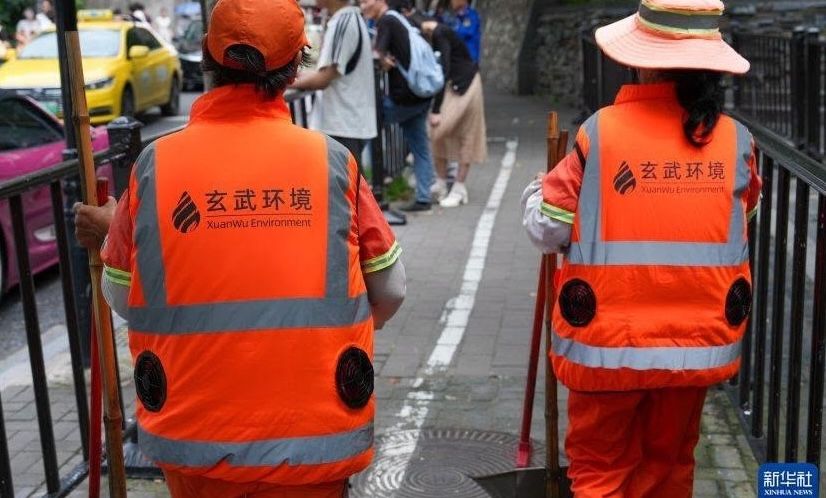
On Aug 1, a video of a sanitation worker in China’s Jiangsu Province who was wearing an “air-conditioned vest” was featured in the Daily Mail earlier this month.
The video explained that each vest has two cooling fans powered by a battery pack and helps hasten sweat evaporation and reduce heat stress while workers laboured under a hot sun.
On a full charge, the vests can operate between three and four hours, and workers recharge them during their lunch breaks.
In South Korea, farm workers have also been trying out cooling vests, especially greenhouse workers who have to deal with the heat and humidity and whose work is time-sensitive when it comes to produce that needs to be harvested.
The country has also seen collars filled with coolant become more popular, in keeping with the trend of people purchasing personal cooling devices. /TISG
Read also: Traveler says SG is ‘super cool’ but he can’t live here because it’s too hot
 Follow Google News
 Join us on WhatsApp
 Follow us on Telegram