

SINGAPORE: As more Singapore residents reach the end of their lives without close family, charities, funeral directors and volunteers are taking on a role once filled by relatives: giving the dead a proper goodbye.
One recent funeral at Mandai Crematorium brought together about 10 people carrying flowers and offering prayers around the coffin of a man who had died from cancer. None were relatives or lifelong friends. They only met him during the final chapter of his life, after learning he had no one left to arrange his funeral. The following day, his ashes were scattered at the Garden of Peace in Choa Chu Kang, honouring one of his last wishes.
The silent farewell reflects a change that social workers say is becoming more common across Singapore. More seniors are growing old without partners, children or relatives who can care for them in their final days or plan what happens after they die. Charities and funeral providers are now handling far more pro bono funeral cases than just a few years ago, Channel NewsAsia (CNA) reported (July 20).
Giving people a dignified farewell
One organisation seeing that change firsthand is Cheng Hong Welfare Service Society. The charity supports people with little or no family by helping them prepare for death and carrying out their final wishes after they pass away.
Its eldercare social worker and senior executive, Adelina Koh, believes no one should leave the world without someone by their side. This belief has become part of her daily work.
The charity has about 800 volunteers, with around 40 trained to handle afterlife services. Besides arranging funerals, volunteers visit isolated seniors, deliver groceries, share meals with them and keep an eye on their well-being long before the final farewell becomes necessary.
Cases have more than tripled in four years
Singapore recorded about 87,000 residents aged 65 and above living alone in 2024. While there are no national figures showing how many people die alone, frontline workers say they are seeing more people reach the end of life without family support.
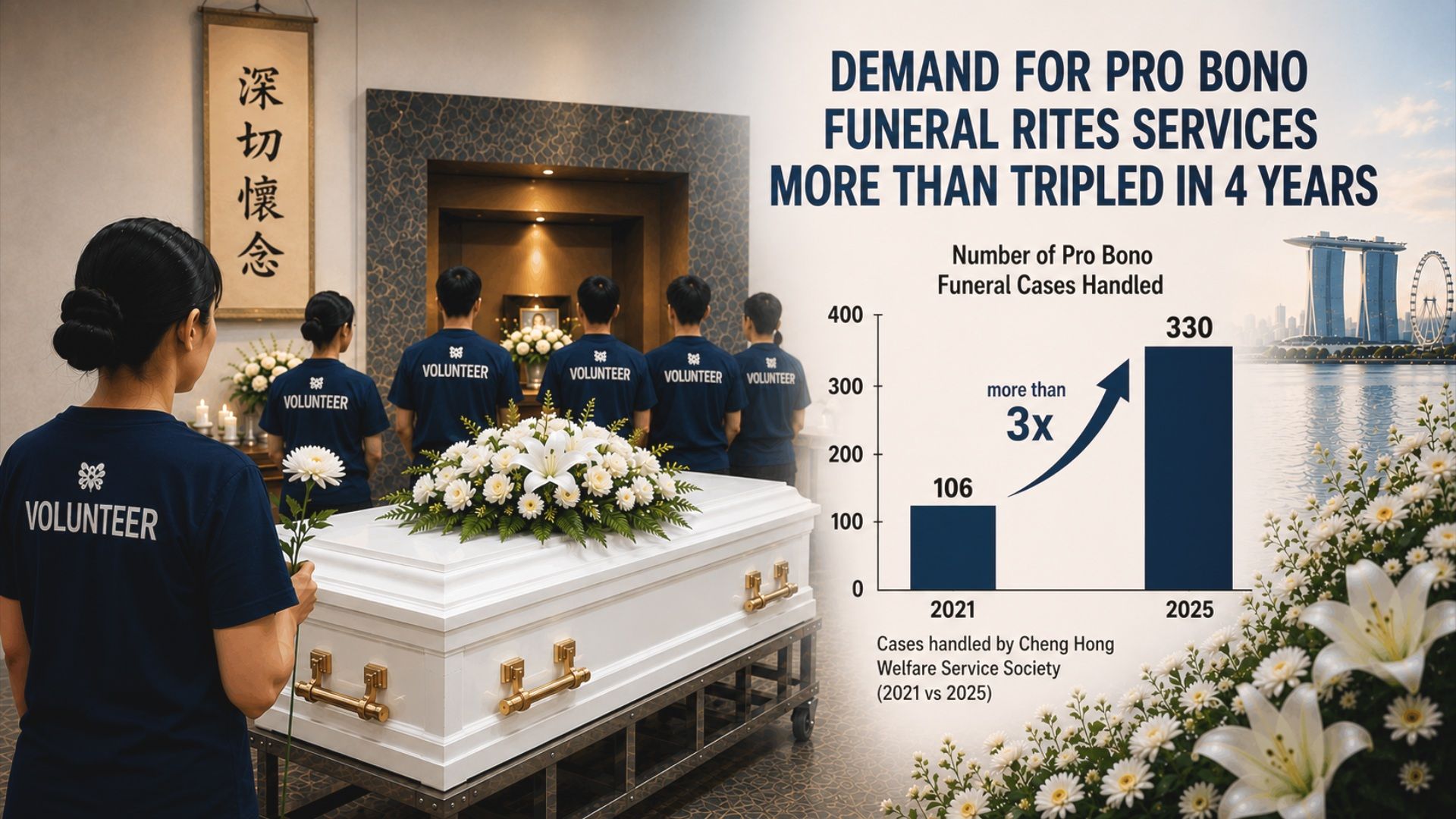
Cheng Hong Welfare Service Society handled 330 pro bono funeral cases last year, more than three times the 106 cases it managed in 2021. The charity expects this year’s total to climb even higher.
Cases come from several sources. Some are identified through outreach work in lower-income neighbourhoods. Others are referred by hospitals, nursing homes or the police.
Each funeral costs the organisation about S$3,000 on average, with donations and volunteers covering almost all of the expense.
One beneficiary, Teo Ting Pow Chu, 70, lives alone in a rental flat after losing her husband six years ago. She has already decided on a simple cremation and hopes her ashes will one day be scattered at sea.
Her story shows that planning for death is no longer a distant thought for many older people living alone. Instead, it has become another part of preparing for old age.
Funeral directors are filling the family’s empty space
Funeral homes are also seeing more cases where people die alone and are discovered only days later after neighbours notice unusual smells or signs coming from their homes.
Harmony Tee, funeral director at Harmony Funeral Care, said funeral providers are increasingly stepping in when no family member is willing or available to make arrangements. Singapore law doesn’t require relatives to pay funeral expenses, leaving charities and undertakers to carry the responsibility in some cases.
Many funeral directors choose to provide cremation services without charge because they believe it is the right thing to do rather than because they are legally obliged to do so.
A funeral plan became peace of mind
Another funeral provider, Direct Funeral Services, has also seen demand rise. The company now handles more than 120 pro bono funeral cases each year. Every few months, it charters a boat to scatter into the sea the unclaimed ashes of around 30 to 40 people whose remains were never collected.
Its managing director, Jenny Tay, recalled meeting an elderly trishaw rider who feared dying alone more than death itself. Frail and living by himself, he asked whether the funeral company could install a CCTV camera in his flat so someone could check on him if he fell.
The request was unusual, but the company agreed.
The decision proved life-saving. Staff monitored the camera each day and, during one check, spotted the man lying on the floor after a fall. They rushed him to hospital before it was too late.
That experience encouraged Direct Funeral Services to start a foundation that organises outings and social activities for isolated seniors. The aim is to help older people build friendships so someone will notice when something is wrong.
Chief executive officer Darren Cheng said stronger social ties mean neighbours and friends are more likely to check on one another and respond sooner during emergencies.
Care homes are taking on family responsibilities
The challenge isn’t limited to seniors living alone in the community. Nursing homes are also caring for more residents who have no known relatives or anyone willing to make decisions on their behalf.
At Sree Narayana Mission Singapore, about three in every 10 residents now have no family support, up from around two in 10 a year earlier. The increase has left staff performing duties that would traditionally fall to next of kin.
Yogeswari Chandrasekaran, Head of Social Work for Resident Programmes, recalled collecting the body of a resident who died during Hari Raya because there was no family member to claim it. She said that moment drove home the reality that, without staff stepping in, some residents would have no one to carry out even the most basic responsibilities after death.
At Thye Hua Kwan Nursing Home, residents live in smaller “households” instead of traditional wards to encourage friendships and mutual support. Around seven per cent of its more than 280 residents have no known family members.
The home also begins conversations about end-of-life wishes while residents still have the mental capacity to make their own decisions. These discussions help ensure their preferences are respected later.
Planning ahead can ease the burden on everyone
Those working closest to the problem believe Singapore will face more cases like these as the population ages and family sizes continue to shrink.
Government programmes and community partners have strengthened support for seniors living alone, but charities, care providers and academics say no single organisation can solve the problem on its own. It will take families, neighbours, volunteers and community groups working together.
Professor Paulin Straughan, a sociologist at the Singapore Management University, said many people still avoid talking about death because it’s still a taboo subject. She said discussing funeral wishes early can spare loved ones difficult decisions later while ensuring a person’s preferences are respected.
For many of the organisations involved, the work begins long before someone dies. A shared meal, a home visit or a regular phone call can build trust and reduce loneliness. Those small acts may not change how life ends, but they can change how it is lived.
Death is one of life’s few certainties, yet many people still avoid talking about it. Beyond being just about funerals, addressing loneliness, dignity and the people who quietly step forward when no one else does matter much.
Planning ahead, staying connected with neighbours and checking in on older relatives or friends may seem like small gestures, but they can make a profound difference. No one should leave this world believing they have nobody in their lives and feeling they have been forgotten.
 Follow Google News
 Join us on WhatsApp
 Follow us on Telegram