
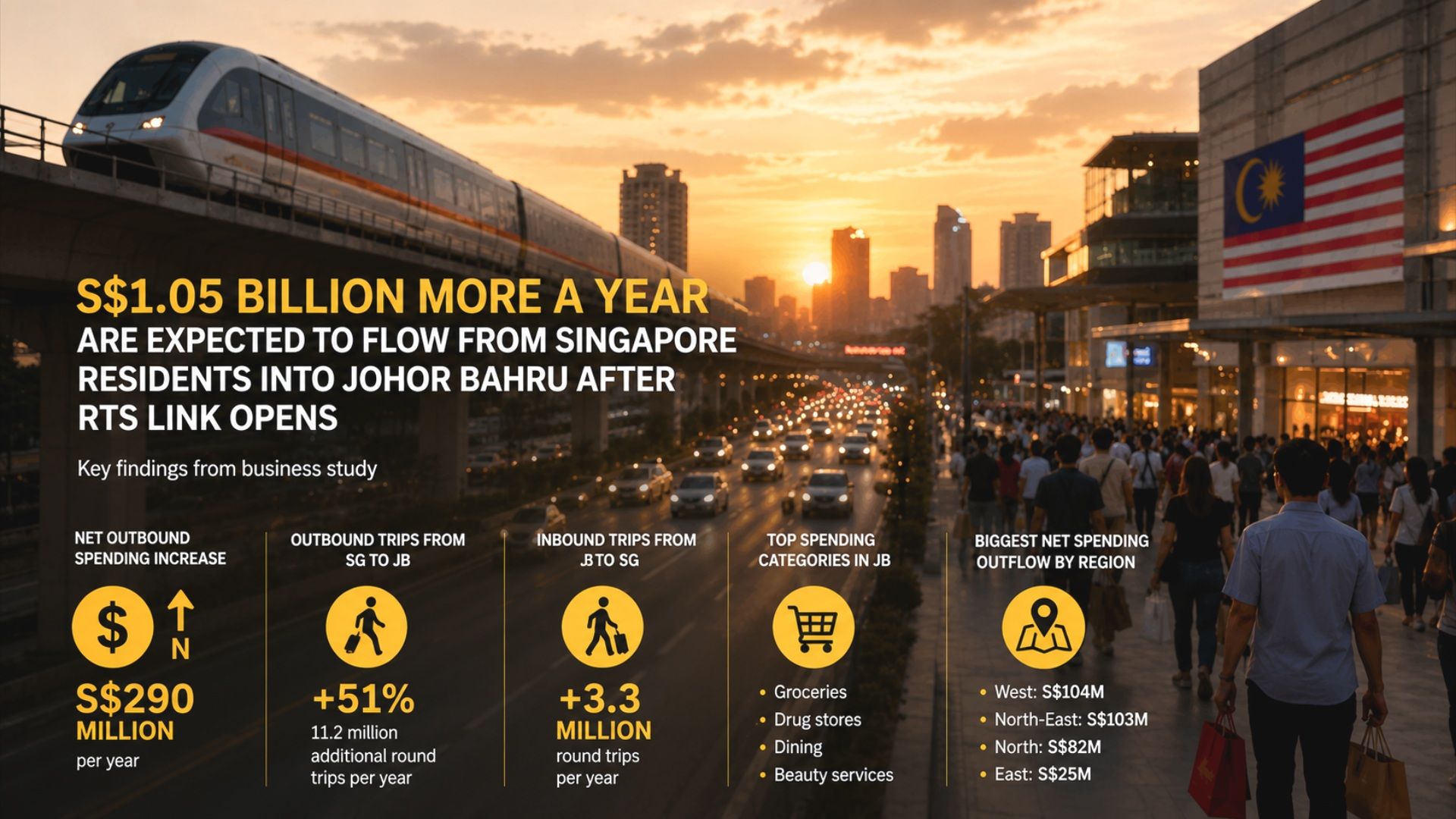

SINGAPORE: Singapore residents are expected to spend an extra S$1.05 billion a year in Johor Bahru (JB) after the Johor Bahru-Singapore Rapid Transit System (RTS) Link opens in January 2027, according to a new business study.
Johor Bahru visitors are also expected to spend more in Singapore, but the increase is smaller at S$756 million a year. This leaves Singapore with a net increase in outbound spending of about S$290 million annually.
The study, commissioned by the Singapore Business Federation (SBF), the Restaurant Association of Singapore, and the Singapore Retailers Association, examined how the RTS Link could change shopping habits, tourism, and business competition across the Causeway, Channel NewsAsia (CNA) reported (July 16).
More Singaporeans are expected to cross the Causeway
Researchers estimate outbound trips from Singapore to Johor Bahru will rise by 51 per cent, adding 11.2 million round-trip trips each year.
Travel in the opposite direction is also expected to grow, with another 3.3 million trips from Johor Bahru into Singapore annually.
The findings were based on surveys of about 1,700 Singapore consumers and 400 Johor Bahru consumers conducted in March, together with historical credit card spending data and government statistics.
Everyday essentials are expected to drive spending
Groceries are expected to account for the biggest share of additional spending in Johor Bahru. Drug stores, dining, and beauty services follow close behind.
Businesses involved in the study said lower prices across the border are already shaping consumer choices, especially for everyday essentials. They believe the RTS Link will make those trips even easier.
The study also predicts Singapore’s non-central regions will feel the biggest impact. The west is expected to record the largest net spending outflow at S$104 million, followed by the north-east (S$103 million), the north (S$82 million) and the east (S$25 million).
Central Singapore, however, could benefit more from visitors coming from Johor Bahru. Higher-end shopping, entertainment, hotels and dining are expected to attract much of the extra spending.
Businesses say competing on price isn’t enough
Singapore Business Federation chief executive officer Kok Ping Soon said the RTS Link brings opportunities to attract more visitors, but it also increases competition for Singapore retailers and food businesses.
Instead of trying to match lower prices, businesses believe they will need to stand out through better service, unique experiences and products that customers can’t easily find elsewhere.
The study also found that many firms, particularly small and medium-sized enterprises, are already facing labour shortages, higher rents, and rising operating costs. Many said they would need more support to adapt to stronger cross-border competition.
Industry groups propose support measures
Based on the findings, the three industry groups suggested several ways to help businesses stay competitive.
They proposed expanding support for retail and food businesses that are most exposed to cross-border spending, including groceries, pharmacies, restaurants and cafés.
The groups also recommended strengthening Singapore’s tourism appeal by encouraging visitors to stay longer through more events, entertainment, cultural performances and a stronger night-time economy.
To help businesses adjust, they suggested temporary property tax relief during major upgrading works and more flexible deployment of foreign workers across related business operations.
The recommendations have been shared with government agencies and the RTS Link task force for further discussion, according to Mr Kok.
The RTS Link will make crossing the Causeway faster and easier. This convenience is good news for travellers, but it also means Singapore businesses will have to work harder to give people reasons to spend locally.
Price matters, yet good service, fresh ideas and memorable experiences are what keep customers coming back.
 Follow Google News
 Join us on WhatsApp
 Follow us on Telegram