


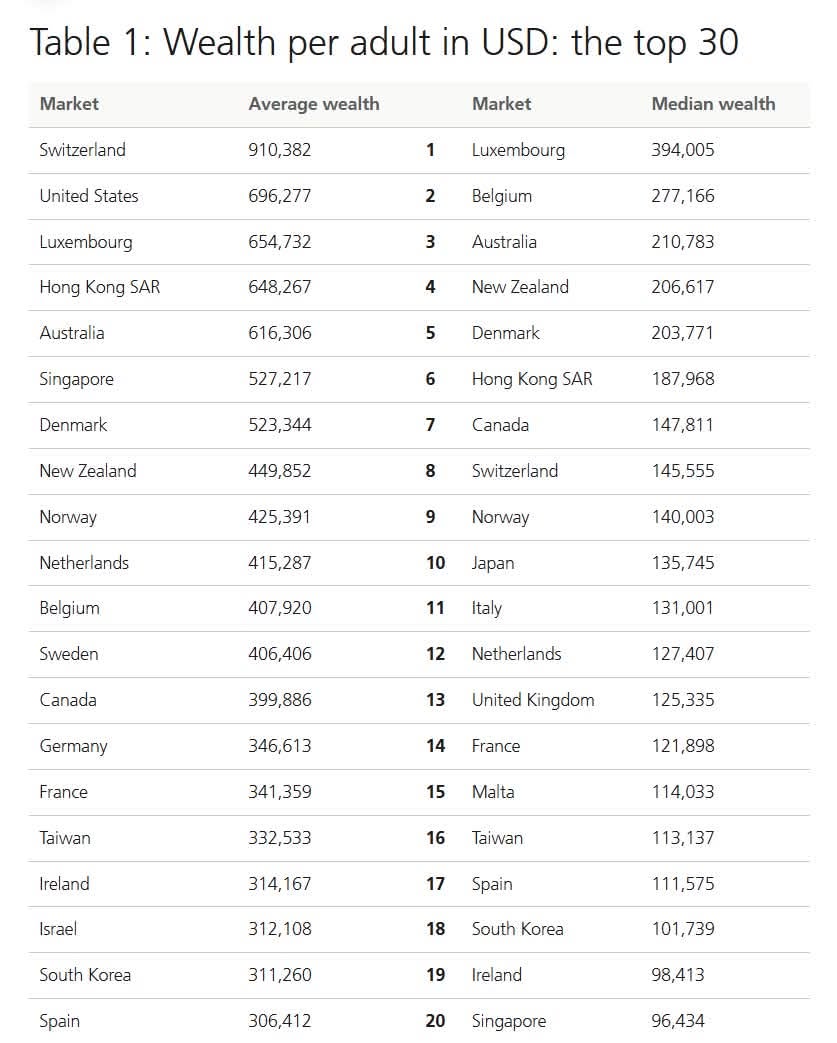
SINGAPORE: In a social media post on Tuesday (July 7), Jamus Lim noted how UBS just released its annual global wealth report, and posted a screenshot showing the countries with the highest amount of average and median wealth per adult.
It showed that in terms of average wealth, Singapore ranks sixth (US$527,217), but for median wealth, the city-state is in 20th place (US$96,434). Average wealth is the total wealth of a population divided by the number of people. Median wealth is the middle point of the amount of wealth people have, where half of the people have more, and half have less.
The Workers’ Party Member of Parliament, who is an economist by profession, noted that “Wealth isn’t the same as income… For most Singaporeans, assets will include CPF balances and the value of their home, plus extra savings, perhaps via insurance. The big-ticket liability is the mortgage, along with car loans and credit card debt (most student debt is small, given subsidised education, and parents often cover their kids using CPF),” he wrote.
He noted how it was recently reported that in Singapore, one in seven household incomes now exceed S$30,000. Those who save much of their income, noted Assoc Prof Lim, will accumulate wealth. However, if expenses are high, an individual can still have a low net worth.
The Sengkang MP underlined that “you can have a small number of very rich folk pull up the mean, even if the bulk of people, as measured by the median, aren’t necessarily doing that well.”
For him, what stood out the most about the UBS report is that having too many wealthy in a given society can distort results, which is likely why he also included a screenshot of the top 20 economies by mean-to-median wealth ratio, wherein Singapore ranked fourth.
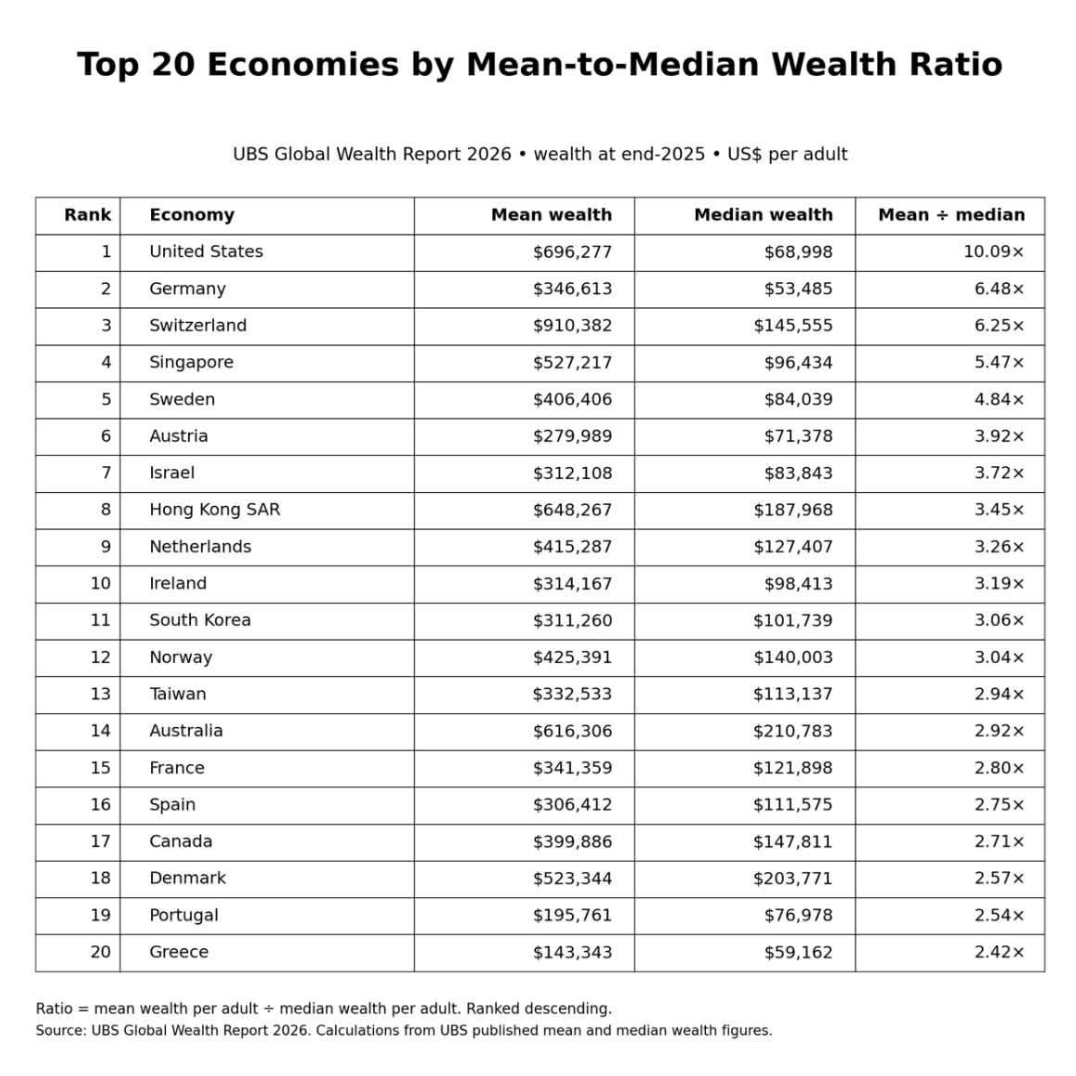
He pointed out that Singapore has among the greatest imbalances in mean-to-median wealth across the globe, and in Asia, it’s the highest. In Hong Kong, which ranks second in Asia, the situation is only “around two-thirds as bad.”
“While Singaporean households are indeed wealthy on balance, when compared to other countries, the typical household has done less well. It is therefore misleading to look at average wealth and conclude that there is little basis for better redistributive policy,” he wrote, adding that he still believes a “modest net wealth tax” would help with reducing wealth inequality in Singapore. He argued that instead of merely being populist, it would add to Singapore’s social stability.
He also said that this may help explain why Singapore can appear both very wealthy to others across the globe, and yet leave many residents feeling they are not especially rich. The statistics are not wrong, Assoc Prof Lim argued, but they focus on averages instead of typical outcomes, and give an incomplete picture of people’s lived reality. /TISG
 Follow Google News
 Join us on WhatsApp
 Follow us on Telegram