


SINGAPORE: Parents who rely on strict discipline or physical punishment may be doing the opposite of what they hope, according to new research from the National University of Singapore (NUS).
Two long-term studies of Singapore families found that children exposed to authoritarian parenting or harsh punishments such as slapping and spanking were more likely to lie and cheat over time. The research suggests these behaviours aren’t simply acts of defiance. Instead, it may be about the ways children cope with fear of failure, harsh self-judgment, and pressure to meet expectations.
The findings were published in the journals Child Development and Developmental Psychology. The studies were led by Associate Professor Ding Xiao Pan, doctoral student Liwen Yu, and Associate Professor Ryan Y. Hong from NUS Psychology.
Strict parenting can shape how children see themselves
The first study followed 479 Singapore families from the Growing Up in Singapore Towards Healthy Outcomes (GUSTO) birth cohort.
Researchers examined parenting styles when children were four-and-a-half years old, then tested them about 18 months later using a game designed to measure cheating. About 61 per cent of the children cheated during the experiment.
Children whose fathers used a more authoritarian style of parenting were more likely to cheat. Researchers also found these children tended to criticise themselves more during another activity, suggesting strict discipline affected how they viewed themselves.
“Authoritarian parenting is characterised by high control, low warmth and harsh discipline without explanation. While parents may believe this approach instils discipline, our research shows it may actually undermine children’s internalisation of moral values,” Assoc Prof Ding said.
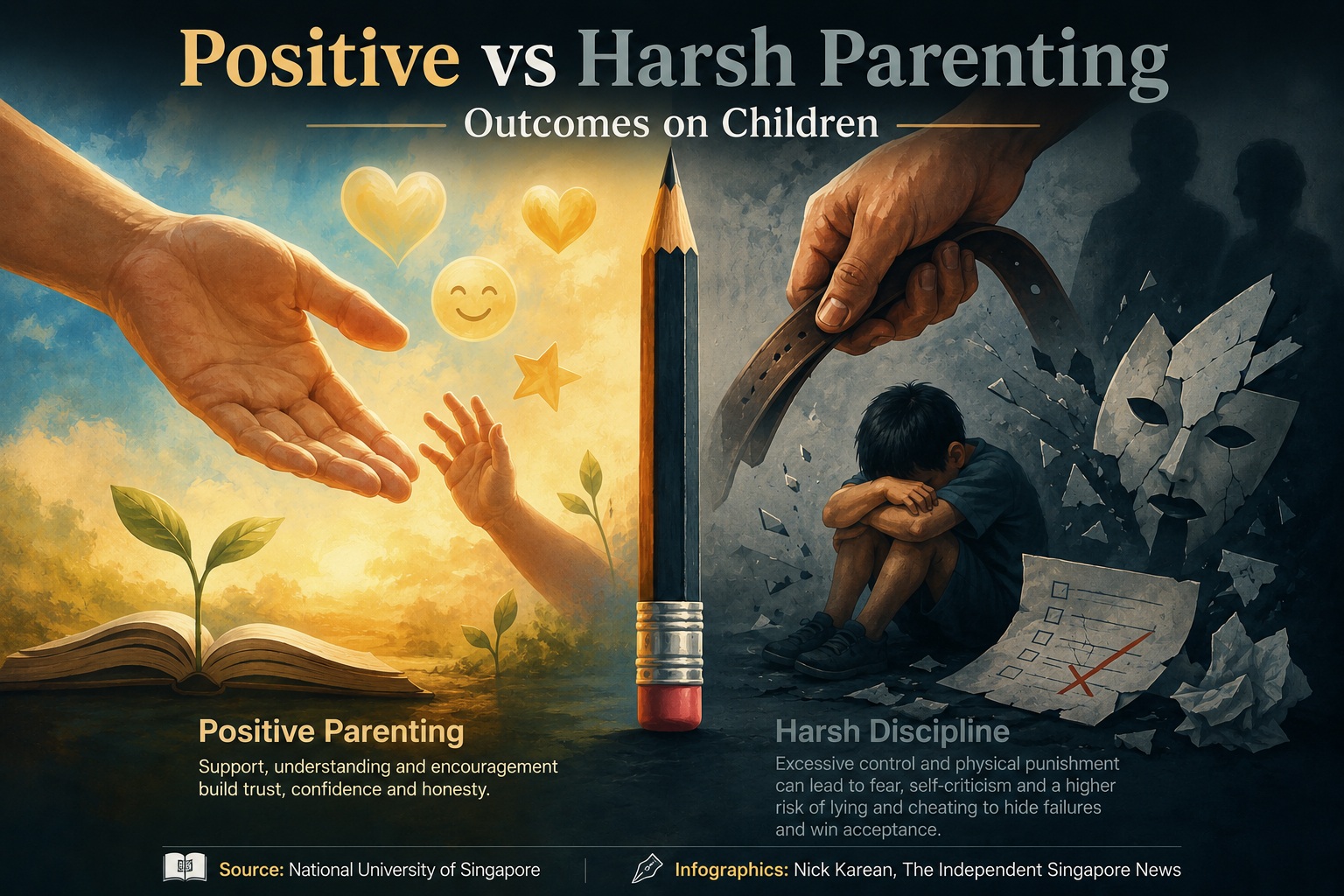
The research team said this self-critical mindset may push children to hide mistakes or seek approval through dishonest behaviour instead of learning from failure.
“Self-critical children may feel intense pressure to maintain a flawless image, and cheating becomes a maladaptive coping strategy. It is a way to avoid feelings of inadequacy and secure external validation,” Ms Yu explained.
“To our knowledge, this is the first study to investigate the developmental mechanisms linking a discipline-oriented family environment to cheating behaviour,” she added.
Physical punishment may create a cycle of dishonesty
The second study tracked 302 Singapore families with children aged seven to nine over three years.
Researchers examined different forms of negative parental control, including harsh punishment, discipline such as taking away privileges, and ignoring children.
Only harsh punishment, including physical discipline such as slapping and spanking, consistently predicted higher levels of lying and cheating over time.
The relationship also worked both ways. Children who became more dishonest were more likely to receive harsher punishment later, creating a cycle that reinforced both behaviours.
“Children exposed to higher levels of negative parental control were more likely to internalise dysfunctional beliefs such as ‘I have to do well to be liked’ or ‘I shouldn’t make mistakes’. They may then resort to lying to meet these unrealistic expectations or avoid further punishment,” Ms Yu explained.
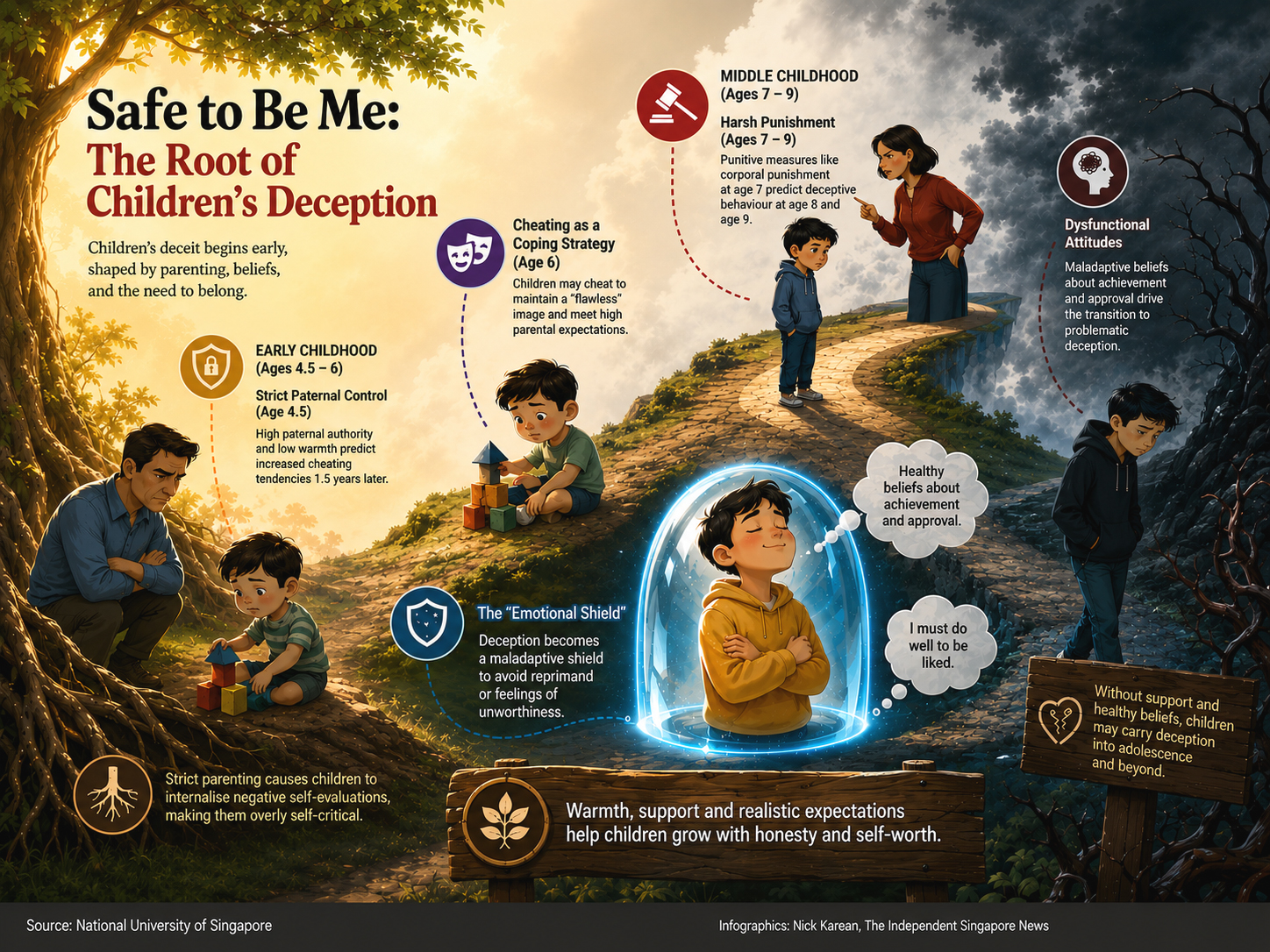
Researchers also found these children were more likely to develop unhealthy beliefs, such as feeling they had to succeed to earn love or believing mistakes made them bad people. Those beliefs were linked to more dishonest behaviour.
Researchers found risks to children’s moral development, even where strict parenting is culturally accepted
The researchers said Singapore provides an important setting because strict, obedience-focused parenting and physical punishment are still accepted in many families.
Even so, the studies found that harsh discipline didn’t directly cause dishonesty. Instead, it changed how children thought about themselves, making lying or cheating a way to protect themselves from shame or disappointment.
The research team stressed that children’s behaviour is shaped by many influences, including personality, social surroundings and development. Parenting is only one part of the picture.
“What both studies reveal is that strict parenting doesn’t directly cause dishonesty. Rather, it changes how children see themselves, and it’s this altered self-view that leads to cheating and lying,” said Assoc Prof Hong.
The researchers further said the findings point towards a better approach. Rather than responding to dishonesty with even harsher punishment, parents and educators should understand what is driving the behaviour and help children build confidence, trust and healthier ways of coping with mistakes.
“Understanding these developmental pathways is essential for designing effective interventions. Rather than responding to children’s dishonesty with harsher punishment, which our research shows may actually worsen the problem, parents and educators need to address the underlying psychological mechanisms,” said Ms Yu.
Children will make mistakes as they grow up. The challenge isn’t stopping every mistake. It’s helping them feel safe enough to admit one, learn from it and try again.
 Follow Google News
 Join us on WhatsApp
 Follow us on Telegram