


SINGAPORE: While Singapore employers can legally retrench workers when jobs become genuinely redundant, they still have legal duties to meet. That includes paying notice pay or salary in lieu, final salary, and any unused annual leave where applicable.
Retrenchment benefits, however, aren’t automatic and depend on your employment terms. The Union of Security Employees (USE) reported on July 1 that knowing these rules can help workers avoid being shortchanged. Being retrenched is stressful enough without worrying whether you’ve received everything you’re entitled to.
The guidance comes as companies continue adapting to changing business needs, including the use of artificial intelligence (AI), making it more important for workers to understand the difference between retrenchment and other forms of dismissal before signing any documents.
Companies can retrench workers, but only under genuine redundancy
Retrenchment occurs when a role is no longer needed due to redundancy or surplus manpower, rather than due to an employee’s conduct or performance.
According to the Tripartite Advisory on Managing Excess Manpower and Responsible Retrenchment (TAMEM), employers are expected to treat retrenchment as a last resort after exploring options such as redeploying staff or changing work arrangements.
USE cited Patrick Tay, Director of the NTUC Legal Department and Assistant Secretary-General of the National Trades Union Congress (NTUC), who explained that Singapore law doesn’t treat AI-related retrenchments differently from any other retrenchment.
Instead, what matters is whether AI has genuinely made certain jobs redundant. If it has, companies may proceed with retrenchment after exhausting other reasonable alternatives and complying with the relevant legal requirements.
The guidance also notes that employers with at least 10 employees must notify the Ministry of Manpower within five working days of informing affected staff of the retrenchment exercise. This allows workers to be connected with employment support services such as NTUC.
What employers must pay when retrenching staff
Employees who are retrenched should receive a written notice explaining the termination and their entitlements. Employees should also be given a notice period; otherwise, the statutory default notice periods under the Employment Act apply.
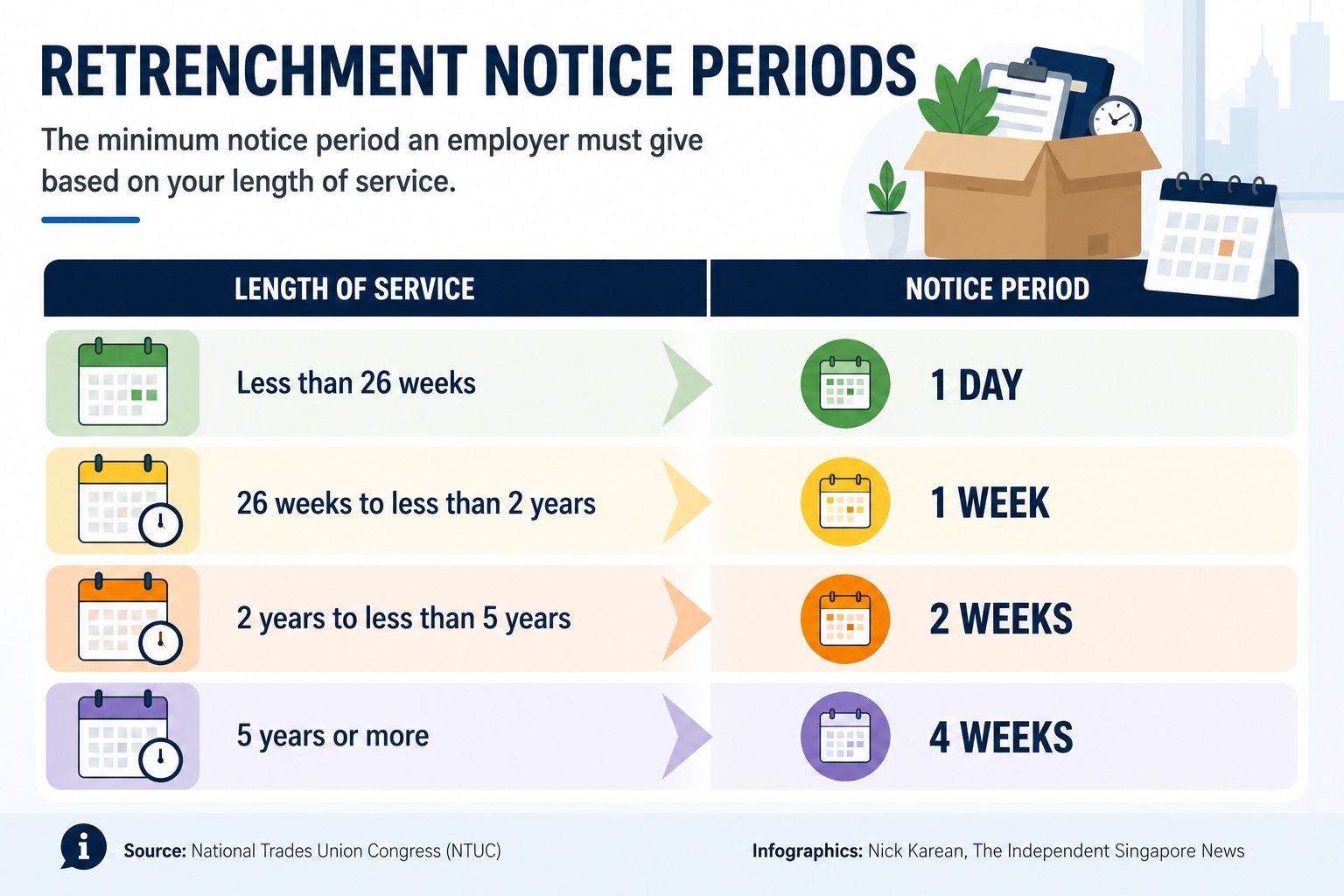
Employers can either require employees to serve their notice period or end employment immediately by paying salary in lieu of notice.
Mr Tay also advised workers to seek independent legal advice before signing any separation agreement, especially if it includes a full and final settlement of claims, as the agreement becomes legally binding upon signing.
Workers should also receive:
-
Final salary by the last day of employment
-
Payment for unused annual leave or other outstanding benefits, where applicable
-
Notice pay or salary in lieu of notice
-
CPF contributions on wages earned during the notice period, although CPF isn’t payable on salary paid in lieu of notice
Retrenchment benefits aren’t automatic in Singapore
One of the biggest misconceptions is that every retrenched employee automatically receives retrenchment benefits. Singapore law, however, doesn’t require employers to pay retrenchment benefits.
Whether you’re entitled to retrenchment benefits depends on your employment contract, company policy, collective agreement, union negotiations, length of service and union membership.
Employees with at least two years of service may qualify for retrenchment benefits, while those with less than two years of service may receive an ex gratia payment instead.
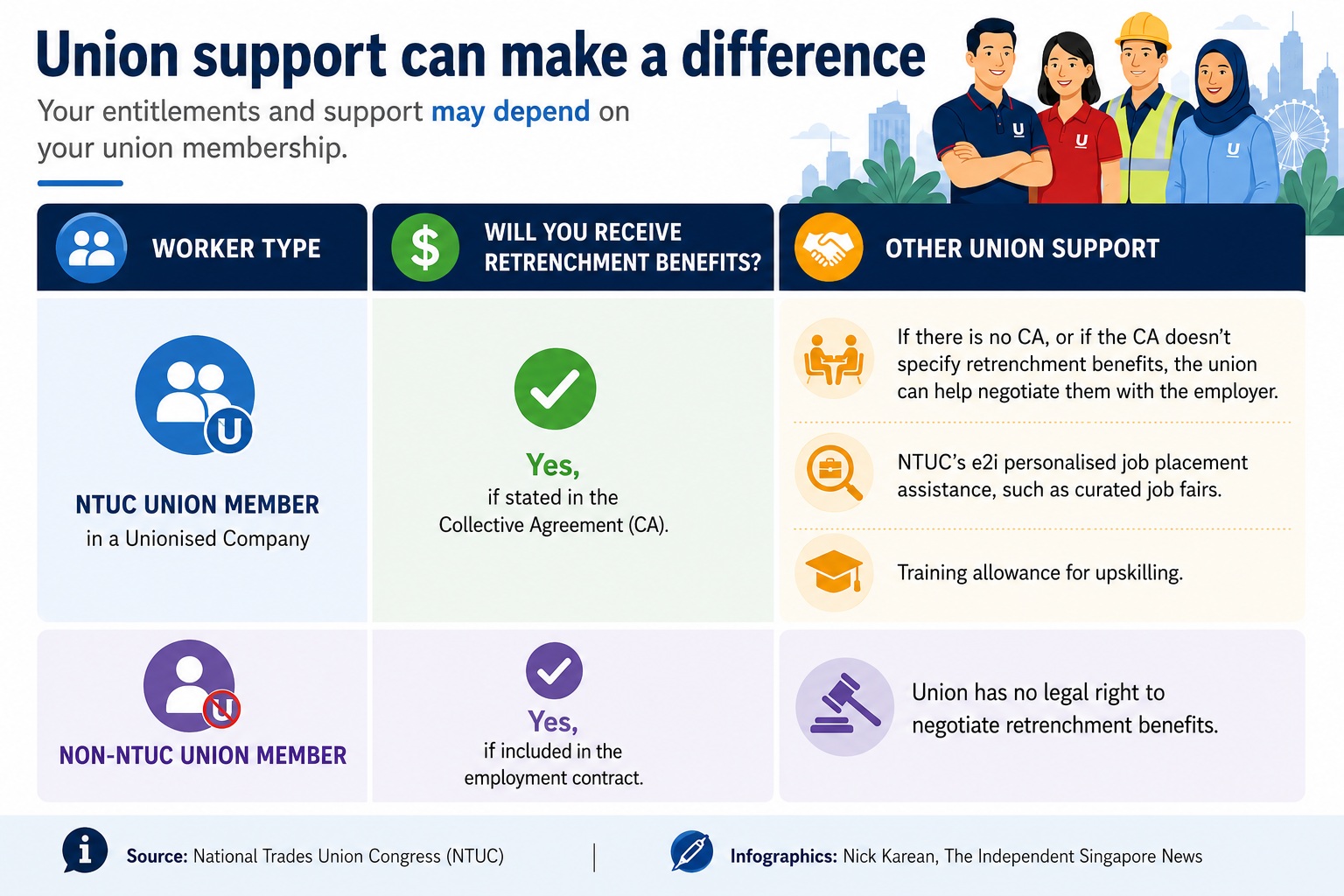
Where a unionised company has a collective agreement setting out retrenchment benefits, employers must honour those terms because the agreement is legally binding.
If there’s no fixed amount in the collective agreement, unions may negotiate based on the common benchmark of between two weeks’ and one month’s salary for each year of service.
Workers in non-unionised companies generally don’t have union representation during retrenchment benefit negotiations.
NTUC union members may also receive additional support through career coaching, job placement assistance, curated job fairs and training support via NTUC’s e2i (Employment and Employability Institute).
Retrenchment is not the same as being fired
Losing a job doesn’t always mean you’ve been retrenched. Singapore employers may also terminate staff for poor performance or misconduct. These situations follow different legal processes and don’t automatically qualify an employee for retrenchment benefits.
Poor work performance generally requires termination with notice, whereas dismissal for misconduct may occur without notice only after a proper inquiry has established the misconduct.
Knowing which category your termination falls under matters because it affects what payments you may receive before leaving the company.
No one wants to face retrenchment, but understanding your rights before accepting an offer or signing a settlement can make a difficult transition a little fairer. A few minutes spent checking what you’re entitled to today could save you from losing benefits you’re legally or contractually owed tomorrow.
 Follow Google News
 Join us on WhatsApp
 Follow us on Telegram