
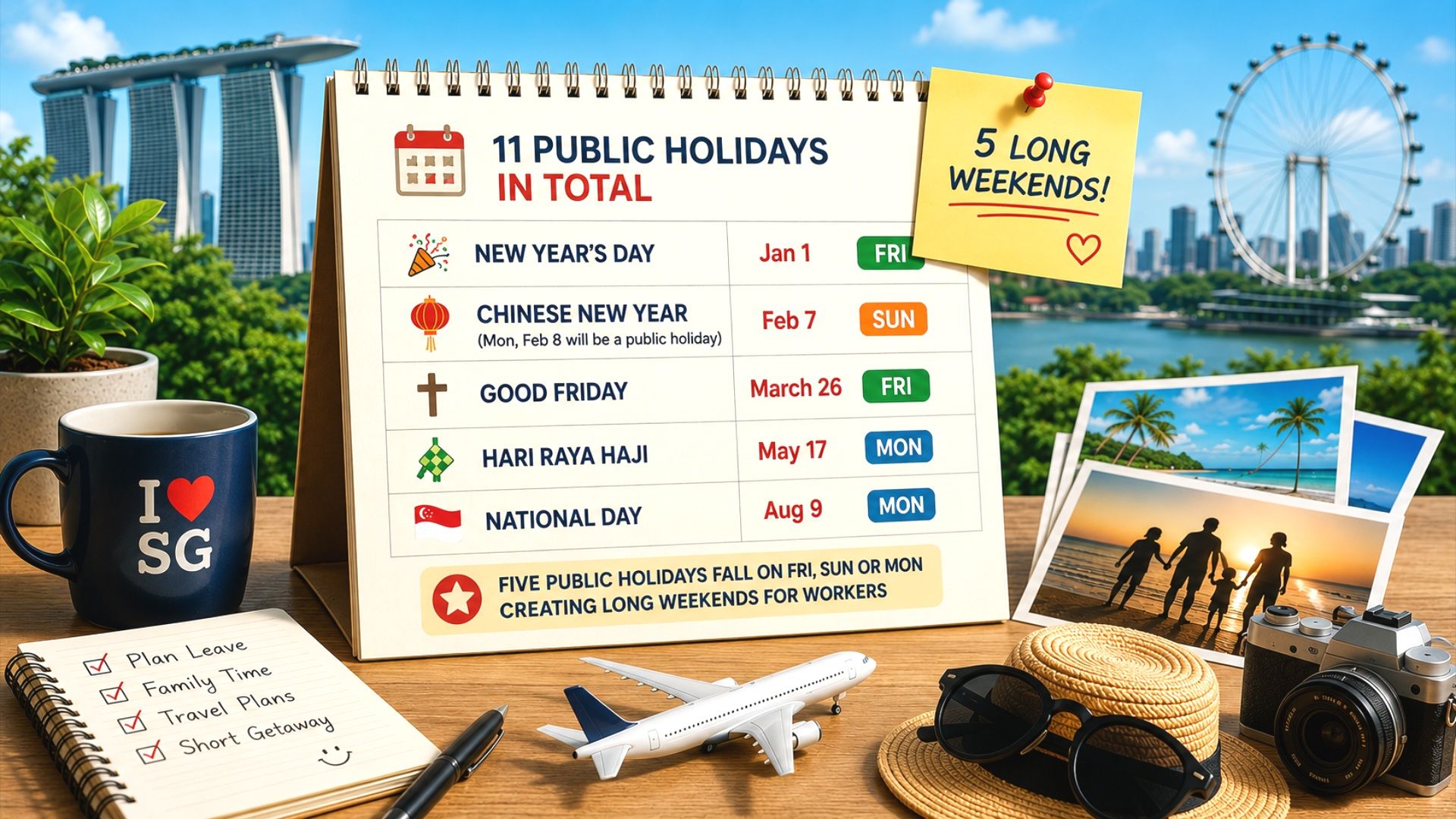

SINGAPORE: Singapore workers can start planning their leave calendars for 2027, with five long weekends set to fall throughout the year.
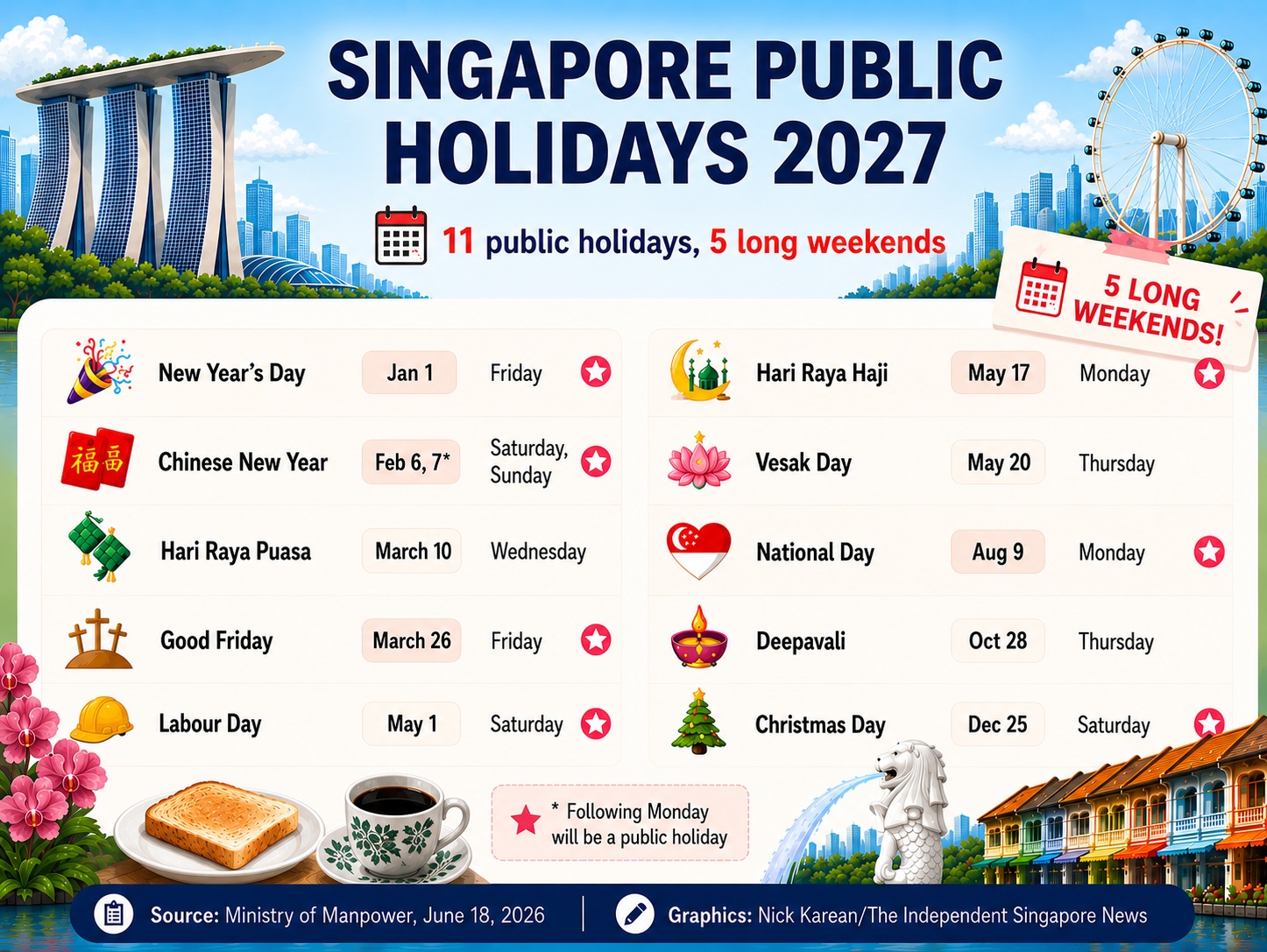
The Ministry of Manpower (MOM) released the 2027 public holiday calendar dates on June 18, confirming there will be 11 public holidays next year. Five of them will create long weekends by falling on a Friday, Sunday or Monday.
Although the number of long weekends in 2027 is lower than the six seen in 2026, it is still higher than the four recorded in 2025.
Five public holidays create long weekends
Two public holidays will fall on a Friday, giving workers an immediate three-day weekend:
-
New Year’s Day (Jan 1)
-
Good Friday (March 26)
Chinese New Year, which falls on Feb 7, lands on a Sunday, but under Singapore’s public holiday rules, the following Monday will be observed as a public holiday.
Two other public holidays also fall on a Monday:
-
Hari Raya Haji (May 17)
-
National Day (Aug 9)
For many employees, these dates offer opportunities for short getaways, family time or simply a break from work without using annual leave.
Worker compensation for working on public holidays
MOM said employers and employees may mutually agree to substitute a public holiday with another working day. The ministry also reminded employers of compensation rules for staff who work on public holidays.
Employees required to work on a public holiday are entitled to an additional day’s salary at their basic rate of pay, in addition to their pay for that day’s work.
For higher-income employees, alternative arrangements may apply. Employers can offer time off in lieu instead, provided both parties agree. This applies to workmen earning more than S$4,500 a month, non-workmen earning more than S$2,600 a month, and managers and executives.
Long weekends give workers more time to rest, travel and be with family
Public holiday calendars attract attention because they shape travel plans, family gatherings, and leave schedules months in advance.
In Singapore, where annual leave is limited for many workers, long weekends are seen as valuable opportunities to recharge without taking extra days off. They also tend to boost domestic spending and short regional travel during peak holiday periods.
While five long weekends may not match 2026’s six, they still offer workers several well-spaced breaks across the year.
A practical approach is to plan leave early and coordinate with colleagues where necessary. With popular travel periods likely to see higher demand, early planning can help workers make the most of the long weekends without the last-minute rush.
 Follow Google News
 Join us on WhatsApp
 Follow us on Telegram