
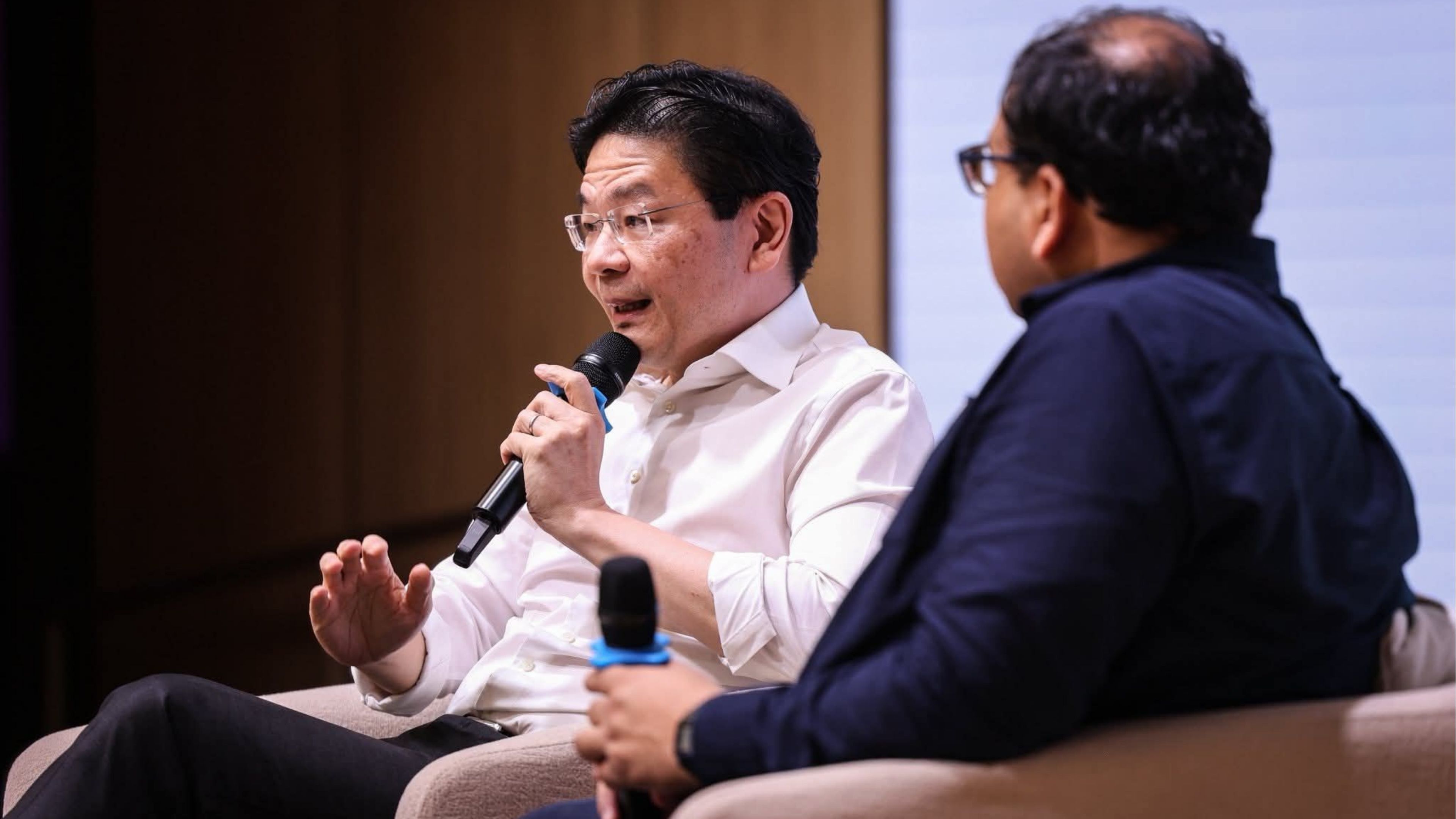

SINGAPORE: Questions about the need for highly paid mayors in a country like Singapore have emerged once again after Prime Minister Lawrence Wong launched a new global mayor initiative this week.
Speaking at the World Cities Summit (WCS) on Monday (June 15), Mr Wong unveiled the Mayoral Fellowship, a new initiative aimed at creating opportunities for city leaders from around the world to connect, exchange ideas, and learn from one another.
Addressing delegates at the Suntec Singapore Convention and Exhibition Centre, Mr Wong said cooperation between cities is becoming increasingly important in a world that feels “more divided and fragmented”.
“Between countries, governments may not always see eye to eye on every geopolitical issue, but cities can still find common ground, exchange practical ideas, and learn from one another’s experiences,” he said.
Mr Wong noted that city leaders around the world are grappling with many of the same issues, including how to harness technology while ensuring no one is left behind, how to strengthen social cohesion in increasingly diverse societies, and how to meet infrastructure needs while keeping cities sustainable and liveable.
“There are no perfect answers or silver bullets to these questions,” he said, adding that every city faces its own constraints and must find solutions suited to its circumstances.
At the same time, he stressed that cities do not need to tackle these challenges in isolation because they can learn from one another’s experiences.
The new Mayoral Fellowship will broaden learning and exchange opportunities beyond cities that have won the Lee Kuan Yew World City Prize. It joins two existing programmes under the Lee Kuan Yew World City Prize Network: the Research Fellowship and the Urban Leaders’ Fellowship.
The network currently comprises 26 cities.
The inaugural group of fellows includes mayors from Agra, Bucharest, Kigali, and Tshwane, while former mayors of Helsinki and Paris will participate as visiting fellows.
Mr Wong said the programme is intended to provide a platform for mayors to engage candidly with one another, share both successes and failures, and build long-term relationships that could lead to future partnerships and cooperation.
He also highlighted Singapore’s longstanding approach to policymaking, saying the country has always been guided by pragmatism rather than ideology.
“We try different approaches, we keep what works, and we change what does not, and above all, we focus on what delivers the best outcomes for Singapore and Singaporeans,” he said.
However, news of the fellowship quickly drew sceptical reactions online, with many Singaporeans using the announcement to revisit longstanding questions about the role and value of mayors in Singapore.
One commenter referred to New York mayoral candidate Zohran Mamdani, writing: “Mamdani laughing his ass off at what our mayors do.”
Others questioned how Singapore’s participation in the fellowship would work, given that the country has five mayors despite being a single city-state.
“So which of the 5 mayors represents SG in the city-to-city cooperation?” one netizen asked. “Do we need new mayor to do global work like representing the country at international events?”
Another commenter suggested that Singapore’s system could attract scrutiny from foreign counterparts.
“Wish we could see the reaction when foreigners and foreign mayors learn one city has 5 mayors… and their salaries… and their workloads… lack of elections. Embarrassment,” the person wrote.
Some commenters went further, questioning whether mayors are needed at all.
“I still do not understand the need for mayors. What next? Sheriffs?” one netizen remarked.
Others argued that city-to-city exchanges would be more useful if they involved officials directly responsible for implementing policies rather than elected or appointed political figures.
“I wonder what’s the point of all this,” one commenter wrote. “Mayors are essentially only figureheads; they are never the ones on the ground planning projects, doing the calculations and feasibility studies and finding solutions for problems that crop up.”
The commenter added that when a city successfully addresses a particular challenge, it would make more sense to send specialists and officials directly involved in the work to study the solution.
The controversy around Singapore’s mayors has been one of the country’s longest-running political debates, resurfacing almost every election cycle and budget debate.
Singapore has five mayors, each heading a Community Development Council (CDC) that covers one of the country’s five districts. The CDCs were created in 1997 to coordinate community programmes, social initiatives and partnerships across multiple constituencies. Today, they are perhaps best known for administering CDC vouchers, but they also run programmes involving job matching, community outreach, volunteerism and support for vulnerable groups.
The five mayors are typically elected MPs who are appointed to lead their respective CDCs.
This is where much of the controversy begins.
According to government salary reviews, mayors receive an annual salary of about S$660,000, which includes bonuses and variable pay. They also continue to receive their MP allowance, which is currently about S$192,500 a year.
Critics have long argued that Singapore is too small to need five mayors. As a nation of about six million people, critics point out that many much larger global cities such as London or New York have only one mayor. They therefore see the positions as an unnecessary layer of administration.
Opposition politicians, including Workers’ Party chief Pritam Singh, have argued that many CDC functions could potentially be handled by ministries, statutory boards, Social Service Offices, grassroots organisations or other government agencies. They question whether a separate mayoral structure is still needed.
Critics also contend that the salary appears disproportionate to the perceived workload. The issue that generates the most public attention is pay. Opposition leaders have repeatedly noted that many Singaporeans view the salaries as “outrageous” because they do not believe the compensation matches the responsibilities of the role.
The issue became particularly prominent during the 2025 General Election.
The Workers’ Party called for the abolition of the Office of the Mayor, arguing that the role has become redundant and that many functions previously handled by CDCs have been transferred elsewhere. The party argued that the high salaries are difficult to justify given the current scope of responsibilities.
The Singapore Democratic Party also campaigned on abolishing mayoral positions, arguing that the money could instead be spent on healthcare, education and social support programmes.
The PAP and current mayors argue that critics misunderstand the role.
Mayor Denise Phua has repeatedly said that mayors are not estate managers or duplicate MPs. Instead, they operate at a regional level, coordinating programmes across multiple constituencies, identifying common needs across districts and bringing together resources from government agencies, businesses and community groups.
Online, many Singaporeans have questioned why a small city-state requires five mayors and whether their salaries represent good value for taxpayers. Some commenters say they cannot name all five mayors or clearly explain what they do. Others argue that the positions should be elected directly if they are to remain.
The debate on the value of mayors and whether they justify their hefty pay packages sits at the intersection of two sensitive issues in the country: political salaries and government efficiency. Even those who support the PAP have questioned whether the current structure is still necessary, while defenders argue that the public often sees only the visible parts of the job.
 Follow Google News
 Join us on WhatsApp
 Follow us on Telegram