
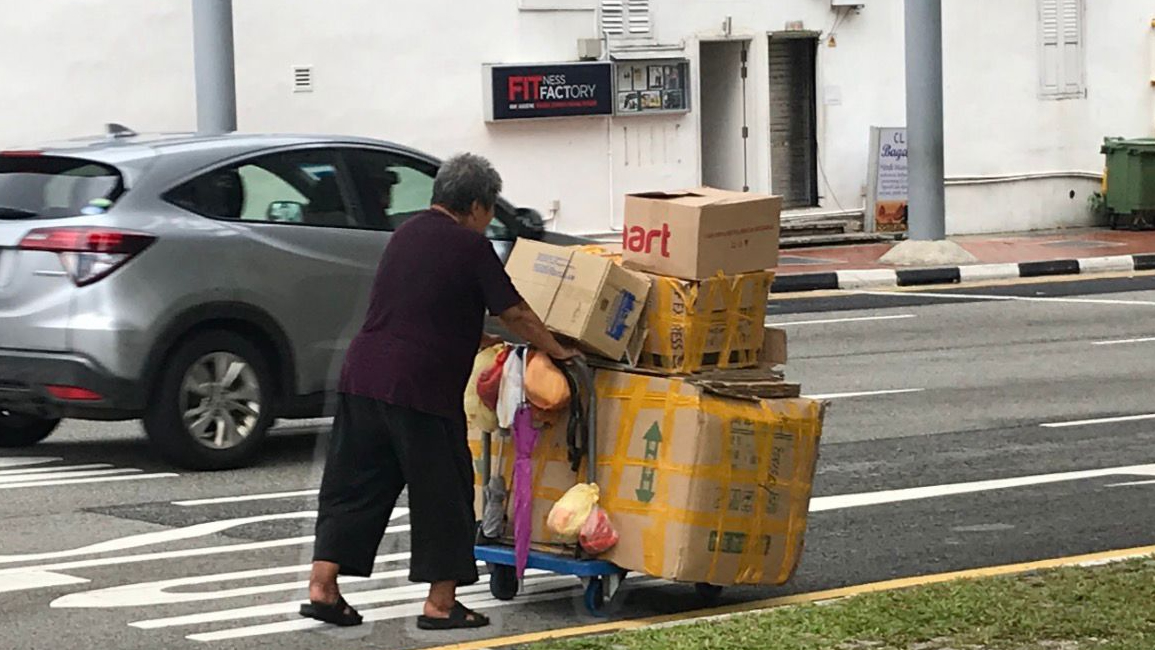

ASIA: Less than a decade ago, Hong Kong’s “cardboard grannies” were featured in the news, and people across the globe were shocked to learn about many elderly poor, especially women, collecting cardboard long hours each day to support themselves, in one of the richest cities in the world.
In 2017, after one of these “cardboard grannies” sold a cardboard box to a domestic helper for HK$1 (S$0.17), she was charged by the Food and Environmental Hygiene Department for selling without a license. After much public outcry, the case was dropped.
Hong Kong has had the longest life expectancy of any city in the world, with an average lifespan of about 85.9 years. However, among its senior citizens, around 580,000 live in poverty, according to a 2024 report from Oxfam Hong Kong.
A May 24 CNN piece said that one of Hong Kong’s cardboard grannies earns HK$100 about each day (S$16.30), scarcely sufficient to pay for two meals. Lately, she’s been earning less, with recycling companies slashing their rates in half, and when the cardboard she collects is thrown away by mistake, she gets nothing at all.
Hong Kong, however, is hardly the only Asian city faced with this issue.
In Singapore, there are karung guni aunties and uncles, older people who collect cardboard, cans, and scrap. Like Hong Kong, many find it shocking that the elderly have to work this way in such a rich society. While Singapore has a substantially stronger social safety net than Hong Kong, especially when it comes to housing, subsidies, and cash supplementation, there are still concerns over the financial vulnerability of the elderly and their need to keep on working long past retirement age.
South Korea’s problem of poverty among the elderly is among the highest in the OECD. In China, elderly “ayi” recyclers are common, and in Taiwan, where the problem is not nearly as bad as in other places in Asia, many elderly people informally collect cardboard, cans, and recyclables.
What’s behind the problem?
In a sense, Asia’s elderly poor may be seen as victims of success. The incidence of poverty among senior citizens coincides with several factors, including rapid economic growth, ageing populations, weakening family support systems, and insufficient retirement adequacy for older generations who grew up before modern pension systems matured.
The problem is not uniquely Asian, but wherever there is a gap between the cost of living and old-age income support, some elderly people end up doing informal survival work, including collecting recyclables, street vending, begging, and scavenging.
Surprisingly, Japan, though its society has aged as rapidly as many of its Asian neighbours, is the outlier. While Japan has its share of elderly poverty problems, it has fewer visible cardboard collectors. There are a number of reasons for this, including a stronger social order and broader pensions. However, it may also be argued that Japan has more hidden poverty than other Asian societies.
Instead of being out on the streets, Japan’s elderly poor are more likely to work low-wage service jobs or continue with their employment into old age. /TISG
 Follow Google News
 Join us on WhatsApp
 Follow us on Telegram